• Skip to primary navigation
  • Skip to main content
  • Skip to footer

Fish Eagle Safaris

Fish Eagle safaris

Contact

Logo
  • About
  • Destinations
  • Blogs
  • Newsletter
  • FAQS
  • Team
  • search
  • Contact
  • About
  • Destinations
  • Blogs
  • FAQS
  • Team
  • Contact

Kenya

A Fresh Perspective on Lewa and Samburu

19th April 2026

A Fresh Perspective on Lewa and Samburu

We’ve been sending our guests to the northern and north-central region of Kenya for many years, and fortunately most of them have enjoyed the area and what it offers as much as we do. Depending on exactly where you find yourself in the area, the views hardly ever disappoint. If it’s not the striking sight of Ololokwe, the sacred mountain of the Samburu, it could be the craggy ridge of Mt. Kenya or just blue hills fading into nothingness. Distinctively ‘out of Africa’, unquestionably romantic, and often quite mesmerizing in the early morning and late afternoon golden light. This huge swath of northern Kenya has a lot else to offer visitors, notably fascinating people and culture, some extraordinary endemic mammals and birds, and an all-round safari experience that often exceeds expectations. 

Lewa Wilderness

Our long-time friend and expert Origins guide Edwin Selempo picked us up after we flew from Nairobi to Lewa. Having spent some time with him already in the Mara (more about that in our June newsletter), we jumped right into a new area with his invaluable assistance. Edwin knew what we had already experienced and helped show us something new whenever possible. We stopped by Lewa Wilderness for an inspection and lunch. The property is right near the top of the options in Lewa. Great location including being the hub for horse and camel activities in the area.

The property itself is well hidden in a small protected forested area (protected from elephants). Part of the main area still serves as a private home to the owners, and each cottage has its own beautiful view of the surrounding area. During our inspection we saw elephants and rhino on the nearby hillside, so game viewing can be done without setting foot in a safari vehicle.

Lunches are mostly served family style at Lewa Wilderness, so group dining is somewhat typical. Private dining is possible if requested but it’s typically quite nice to get to know other guests at the camp. We bumped into some guests that saw some of the same things we saw while we were in the Mara as they stayed at a neighboring safari camp in Naboisho. Small world!

Lewa House

Slightly more centrally located within Lewa, Lewa House is also family owned and operated. Calum and his wife Sophie have owned the property since 2012 and essentially all guests are hosted by one or both of them. Previously there were two-bedroom cottages and one-bedroom ‘Earth Pods’, but the cottages are being removed and turned into two-bedroom Earth Pods which will no doubt be wildly popular. They make sense for couples traveling together or families of 4 or slightly more. Plenty of room and tons of comfort. The pods themselves aren’t the best for Wi-Fi connectivity, so the best (and sometimes only) signal is available in the central living area of the two-bedroom units or the main bedroom for one bedroom units.

The quality of the wildlife viewing in Lewa is its major attraction, particularly because of the presence of several superb endemic mammals which include the stunning reticulated giraffe, the distinctive – and endangered – Grevy’s zebra as well as Beisa oryx and Somali ostrich. Lewa is also one of several private conservancies in Kenya where both black and white rhinos are thriving and where they can be seen with their horns intact.  

If Lewa is the first location for a safari, guests will see more giraffes, zebras, elephants and rhinos than they can imagine. There are a couple prides of lions, quite a few leopards and a healthy population of cheetahs as well. During our 2-night stay in Lewa we managed to see several lions and we had one fleeting viewing of a single leopard.  

Beyond traditional game drives, visitors to Lewa can explore the landscape on guided walking safaris, horseback riding, or unique camel treks. Adventurous guests may enjoy scenic flights or visits to the Ngare Ndare Forest for a canopy walk and waterfall swim. Cultural immersion includes Maasai village tours, while conservation enthusiasts can meet tracker dogs or visit local schools and healthcare clinics.

Sirikoi

During a site inspection of Sirikoi we were wildly impressed by both the camp itself and the back of house tour. We fully recommend a tour to see their workshop and garden to get an idea of just how much goes into running a safari camp like Sirikoi. They are fully self-sufficient. They recycle everything: from food leftovers to wine bottles. Sirikoi also has  one of the largest avocado trees we’ve ever seen – absolutely loaded with fruit.

On a previous visit, we found Sirikoi to be an oasis like few others, from location to accommodation and management. The tented rooms, main lounge and dining room areas are stylish and immaculately maintained, and the food and beverage service is of an exemplary quality. With its mix of four luxury tents and two exclusive use houses (with 2 and 3 bedrooms, respectively), Sirikoi caters for discerning guests who like and enjoy comfort and luxury, but in an elegant, understated fashion. There is nothing over the top or extravagant about Sirikoi. It strikes a perfect balance between being luxurious and stylish, yet retaining the essence of a true Kenyan retreat. Sirikoi’s location right alongside the Sirikoi stream, on the edge of a large swamp, results in wildlife often entering the property and being visible from the open dining deck in front of the camp.

For any slightly larger groups, we’d recommend one of their family cottages or the private house.

Kifaru House

Kifaru House is a lovely, purposefully ‘old school’ safari property in Lewa. Each of the cottages are built with wood and stone with a king sized bed plus a sitting room and extra twin bed. Even with the extra furniture, there is plenty of room to move around. The restroom is also quite large with fantastic water pressure. Entry into the room is through double doors, although we only ever opened one of the doors. With just one door open, the entry way was quite narrow. You’ll also be asked to use a key to lock the door anytime you aren’t in the room as the property has a few naughty monkeys around who have learned how to open doors.

During breakfast and lunch for guests, some extra bread and seeds are put out in front of the dining area where dozens of birds and small animals come to eat. A bit of a meal and a show. The food from Elewana continued to impress, with some of our favorite meals on the trip being served at Elephant Pepper in the Mara and Kifaru House.

Basecamp Samburu

We were pleasantly surprised with every part of our experience at the new Basecamp Samburu. Saruni/Basecamp have a winning combination of a great view, amazing staff, delicious food, slightly spartan accommodations with the most comfortable mattress on our trip, and good game viewing between their private conservancy and Samburu National Park which is about an hour away. Guests can leave early in the morning to arrive in Samburu by sunrise to enjoy the wildlife viewing along the Ewaso Nyiro River. Heading back by late morning, they can then spend the afternoon in the Kalama Conservancy itself. Within Kalama, Basecamp and Saruni have a sunken hide near a waterhole which can be an interesting spot for game viewing during the dry season.

Saruni Samburu

Unlike the many riverside lodges in the region, Saruni Samburu is perched high atop a volcanic rocky outcrop within the Kalama Conservancy, offering breathtaking, panoramic views of the Northern Frontier District. Its dramatic architecture and eco-chic luxury appeal to travelers seeking total privacy and isolation. The lodge’s dramatic cliffside setting requires steep, strenuous uphill walks between villas and the main area and in the sometimes intense Samburu heat it can be a challenge. A  long, bumpy drive of 45 minutes to an hour is required to reach the prime riverside game-viewing areas in the main Samburu Reserve. Even so, many guests find the spectacular views and exclusivity of Saruni Samburu well worth the longer transit into the park.  

We liked the location as much as Basecamp Samburu, but prospective visitors need to be aware of the many steps and long walks between your rooms and the main area and to the upper infinity pool which has unbelievable views of Ololokwe and Samburu. Saruni Samburu is shortly undergoing some minor renovations with new paint and new furniture.

Elephant Bedroom Camp

Like a few other properties, EBC is planning some renovations including a rebuild of their main area. We’ll see how that turns out, but at the moment it works quite well with great views of the Ewaso Nyiro River. The Elephant Bedroom tents are spacious and comfortable, although you will need an escort to and from your room both day and night because of frequent  elephant activity within the camp. There are at least 6 named male elephants that regularly visit, including Obama (a docile elephant) and Mang’ati who is quite the opposite.

The area near Elephant Bedroom Camp is also consistently one of the hot spots for all of the wildlife in Samburu. So even though you might not be driving too far if you stay somewhere else, you’ll probably end up somewhere near this camp during a game drive. On a previous visit a couple of years ago, Bert and Kathy witnessed a female cheetah taking down a young Grant’s gazelle less than half a mile from the entrance to the camp. The female cheetah had some hungry cubs to feed. On that same day leopards, lions and African painted dogs were all seen at one time or another in the same area. 

Samburu Intrepids

Samburu Intrepids, very similar in terms of style and size to its sister property Mara Intrepids, could be an option for guests and groups that are looking for a safari experience at a lower price point. Even though the property is larger than most with 28 rooms strung out along the Ewaso Nyiro, guests generally rate it favorably in terms of  offering an authentic wilderness experience. Guests frequently praise the attentive, “above and beyond” staff and the camp’s pretty riverside location, which allows for wildlife viewing from one’s own private deck. On previous visits, we’ve noticed consistently good management, generally excellent food offerings and highly experienced safari guides.

Soroi Larsens Camp Samburu

The new Soroi Larsens Camp is well located along the Ewaso Nyiro River in Samburu. It is quite central in the park with quick access to the west or the east depending on where wildlife is spotted. The western area has a ridge where leopards are often seen and the eastern area has some slightly more open areas with more lion and cheetah sightings. During our short stay, we managed to see lions, cheetah (mother and cubs with a kill), and a striped hyena along with all of the traditional plains game.

The camp itself is quite uniquely laid out compared with others along the same river. Winding concrete pathways lead you to all of the different areas and tents. The spa and pool are set back a bit, away from the river. The main dining area and most of the rooms are set a bit closer to the river. We were upgraded to the deluxe rooms all the way at the end of the property which has its own car park in case guests don’t want to walk all the way. The walkway to the last two units is also no longer in the shade of the large trees along the river. In Samburu things can get quite hot, so staying in the shade is important when possible.

Food, comfort, and staff at Larsens were all excellent. The standard rooms are significantly larger than most tented rooms we’ve seen during the trip. This would make a perfect option for all guests visiting Samburu – families, couples, and small groups.  

For some fresh, up-to-date information and advice about traveling to Lewa and Samburu, reach out to Jason at jason@fisheaglesafaris.com or leave a message with our answering service any time – day or night – at 1-800-513-5222 or 713-467-5222 and one of us will call you back.  

All photos provided by their respective properties unless otherwise noted.

YOU MIGHT ALSO BE INTERESTED IN

Destinations
Zambia

10th September 2021

Chindeni and the Bushcamp Company, Zambia

By late July we found ourselves at Chindeni, a small Bushcamp Company property
Read more
Botswana
Destinations
Okavango Delta

3rd October 2022

Camp Okavango, Botswana

Camp Okavango is in the heart of the permanent part of the Delta. In this idyllic setting there are no vehicles, and it is just a short walk
Read more
Area
Destinations
Nyerere National Park
Ruaha
Tanzania

14th October 2023

From My Safari Notebook: Wildlife Photography

Birds in flight and wildlife photographers have an uneasy relationship. Things go wrong as often as they go right. Getting focus-lock on a moving subject

Read more

SUBSCRIBE TO OUR NEWSLETTER

READERS FAVOURITES
Destinations
India

27th May 2023

India

India’s tiger, mammals and birds.

Read more
Botswana
Destinations

4th August 2022

On Safari At Belmond Eagle Island Lodge, Okavango Delta

What is the ‘secret sauce’ for an unforgettable few days on safari in Botswana? It starts with the animals, of course. The elephants, lions, giraffes, hippos

Read more
Destinations
Zambia

10th September 2021

Chindeni and the Bushcamp Company, Zambia

By late July we found ourselves at Chindeni, a small Bushcamp Company property

Read more

Nairobi Revisited – March 2026

19th April 2026

Nairobi Revisited – March 2026

Members of the Fish Eagle Safaris team have been traveling to Nairobi regularly over the years: most recently Jason and Katie in March this year, for a 3-week Kenya familiarization visit. Dealing with entry and exit formalities and procedures at Nairobi’s Jomo Kenyatta International Airport can sometimes be vexing, but with the dependable meet and assist services of Tradewinds – we book it for all guests – our arrivals into Nairobi are usually quick and pleasant. It was no different for Jason and Katie this time, making it through immigration, baggage claim and customs in well under an hour. And then it was off to The Emakoko where they spent the night.  

Most of our regular guests are transferred to their Karen area hotel on the relatively new cross-town expressway; it hardly ever takes more than 30 minutes or so. For departing guests, Nairobi Airport can be a bigger pill to swallow and this is where the Menzies airport assistance really comes in handy. For one thing, there’s a security check right at the entrance of the airport, followed by checking in, immigration and then another security check before proceeding to a business lounge or the gate, as the case may be.  

Manzili House

Our first stop was Manzili House for lunch. This boutique-style property has a unique atmosphere, reminiscent of Lamu and Shela on the Swahili coast. The rooms directly off the main lobby area might have slightly less privacy than some guests may be used to. For families with children, the villa in the back is ideal. The property can coordinate additional touring and activities based on guests needs – particularly artistic or cultural activities. They can bring in a musician to perform or have an art exhibition and the like. 

After the long flight we needed a bit of energy. A hot latte from their espresso machine was just the ticket, simply amazing. Lunch was extremely fresh and fantastic. The French-born owner of Manzilil House – Mina Gaillard, is often to be seen around the property as she lives next door with her family. Combining her passion for interior design and African aesthetics, Mina built the house as a private sanctuary before opening it to guests in late 2021. 

House of Waine

The family-owned House of Waine was slightly larger but not too big of a property, with a total of 11 individually styled bedrooms and a 2-bedroom cottage. Originally a private residence before being converted into a boutique hotel in 2004, House of Waine has a very lush garden in the front and the back. Not surprisingly, staying there feels like being a guest at a grand private home, rather than a hotel. Their little villa was a bit further in the back with a slightly odd entry right next to an electric fence but the unit itself was nice enough. We don’t consider it to be a significant upgrade compared to being in the main house. Small groups or families should make use of one of their adjoining rooms instead.

The main house rooms are large and comfortable. Each has a tub except one. Meals can be taken essentially anywhere on the property. House of Waine has a good, quiet location just minutes from Sheldrick Wildlife Trust and the Giraffe Center, and it is reasonably priced. 

Karen Blixen Cottages

Karen Blixen Cottages are also in a good location and for the most part guests enjoy its peaceful garden setting. Once in a while a loud vehicle would drive by on the main road and we were advised that the property can get very busy when they have an event. Nonetheless, it remains a good option for guests to have a relaxing couple of nights in Nairobi to start their trip. Many guests notice the hotel’s exceptionally friendly service and they enjoy the cozy atmosphere provided by the fireplaces in each room. Likely the most compelling reason to opt for Karen Blixen Cottages is its historical authenticity, being situated on the author’s original 1906 coffee estate. The hotel offers a “step back in time” atmosphere and it is within walking distance of the Karen Blixen Museum and the wildlife attractions in the area such as the Sheldrick Elephant Orphanage and the Rothschild’s Giraffe Center. 

The Emakoko

The Emakoko is ideal for guests who want to hit the ground running with their safari or those that have limited time in Kenya and want to maximize their safari experience. The Emakoko is within Nairobi National Park, about 16 miles (25 km) from the airport, a drive of about 45 minutes which isn’t significantly longer than transfers to hotels in the Karen suburbs. In the mornings, guests can have a game drive in NNP and then head straight to the Sheldrick Elephant Orphanage and Giraffe Centre before returning to the property. Food and service were excellent. There are a couple of rooms on the ‘ground level’ and a few up higher on the hill that are accessed by a funicular which is an interesting and fun experience. There are lots of bush hyrax around the property, but fortunately not many tree hyrax which are known to be a bit loud through the night.

A bush baby joined us for dinner but apparently doesn’t come by every night. The staff nursed an injured bush baby a few years ago and she became habituated. Her daughter is now semi-habituated but the property doesn’t make it a focus or selling event for guests. If you’re lucky, she might make a surprise visit during your stay. With the right clients, we think this is a homerun property.

Hemingways Eden

For guests desiring a more sophisticated boutique option in Nairobi, we think Hemingway’s Eden with its artistic, “living museum” atmosphere will absolutely work. Formerly a private home, the property has just nine uniquely styled rooms, providing an intimate, residential feel. Guests enjoy 24-hour private butler service, a gourmet restaurant overlooking a lagoon, and direct access to the Giraffe Centre. We liked the lush gardens and indigenous forest bordering a small lake. Walking from place to place can be a bit daunting in the evenings when there isn’t much light. The pathways are relatively flat but slightly uneven stones make things interesting so guests should exercise caution.

We inspected the lofts and the main house and ended up staying a night in the master bedroom of the main house. The lofts were set off to the side and would work well for those wanting to be a bit more on their own in a slightly newer room but with a bit less space. The main house is certainly older and not built for efficiency but everything essentially works how it should.

If you’re considering a first or return trip to Kenya, we can help with all the arrangements inclusive of a couple of nights in Nairobi on the front end; please email Jason at jason@fisheaglesafaris.com or Bert at bert@fisheaglesafaris.com to get the process started. A good first step is a 30-minute Zoom call, so schedule a meeting for a time which suits you – we’re generally available during regular business hours, Monday to Friday, Central Time.  

Property photos courtesy Manzili House, House of Waine, Karen Blixen Cottages, The Emakoko (including NNP lions and rhino) and Hemingways Eden.

YOU MIGHT ALSO BE INTERESTED IN

Destinations
Zambia

10th September 2021

Chindeni and the Bushcamp Company, Zambia

By late July we found ourselves at Chindeni, a small Bushcamp Company property

Read more
Botswana
Destinations
Okavango Delta

3rd October 2022

Camp Okavango, Botswana

Camp Okavango is in the heart of the permanent part of the Delta. In this idyllic setting there are no vehicles, and it is just a short walk

Read more
Area
Destinations
Nyerere National Park
Ruaha
Tanzania

14th October 2023

From My Safari Notebook: Wildlife Photography

Birds in flight and wildlife photographers have an uneasy relationship. Things go wrong as often as they go right. Getting focus-lock on a moving subject

Read more

SUBSCRIBE TO OUR NEWSLETTER

READERS FAVOURITES
Destinations
India

27th May 2023

India

India’s tiger, mammals and birds.

Read more
Botswana
Destinations

4th August 2022

On Safari At Belmond Eagle Island Lodge, Okavango Delta

What is the ‘secret sauce’ for an unforgettable few days on safari in Botswana? It starts with the animals, of course. The elephants, lions, giraffes, hippos

Read more
Destinations
Zambia

10th September 2021

Chindeni and the Bushcamp Company, Zambia

By late July we found ourselves at Chindeni, a small Bushcamp Company property

Read more

Kenya: What a Difference the Equator Makes

3rd April 2026

Kenya: What a Difference the Equator Makes

If you’ve read some of my older blog posts about Kenya, you’ll know that I am a big fan – for many reasons – but mostly because of the country’s incredible diversity. From the point of view of a photographer of any level of competency and experience – or anyone who wants to light up social media with a great image – Kenya is the shutter that keeps on clicking. 

Thinking back over many Kenya trips starting 30 years ago, these are some of the reasons which keep me going back again and again and recommending Kenya as the #1 option for a first, an only and a repeat safari.

The elephants

We’ve long been firm believers that any really good African safari itinerary should have at least one signature elephant experience. One day, one game drive, one elephant experience, one photograph which you will remember forever. To be sure, Kenya has more than just one area where the elephant experience will blow your socks off. 

Amboseli is one. It’s where I took what might still be my most liked elephant photo. One morning on a game drive from Tortilis Camp we were watching a herd of elephants move through the woodland. A herd of elephants moving down to the swamps, kicking up some dust, is always worth watching so we stopped. I soon had a 400mm lens pointed in their direction. 100 different photos of elephants walking in good light in Amboseli would all be nice shots, but none would have stood out.

Nothing would have distinguished any one of them from a 1,000 similar photos taken at Amboseli every day of the year. Except this time, something clicked. The matriarch paused for barely a second, and turned her massive head to check on the herd. It changed everything. When I later checked the images on the computer, this one and only this one stood out. It was not ‘just’ elephants walking. The one turned head created an arresting moment, an artfully captured scene. A scene which speaks volumes about elephants. About their herd behavior, how they instinctively protect their young and above all: who’s in charge.  

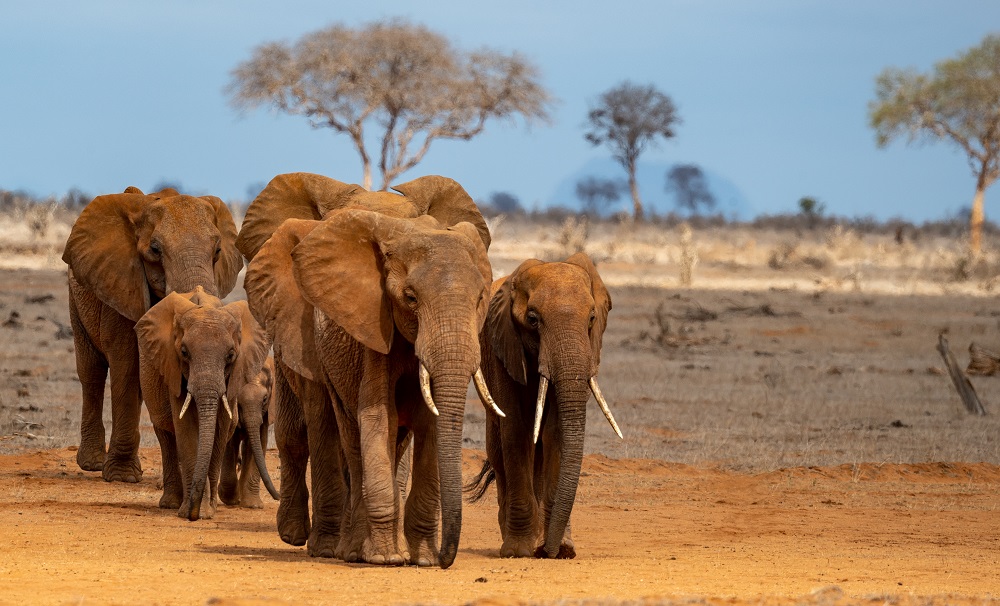
Another great Kenya elephant experience awaits visitors to Tsavo East, particularly in the dry season when small breeding herds kick up the telltale red Tsavo dust, creating drama and pathos. Even the most dispassionate of observers, analyzing the scene purely in terms of its photographic potential, cannot help but to be moved by the experience. It becomes impossible not to sense and empathize with the elephants’ barely suppressed distress. You cannot look away when their struggle for survival in this harsh environment is as  clear as if it were written in the Tsavo dust.  

Ideally I think everyone who comes back from a Kenya trip should have  a dozen or so of those once-in-a-lifetime elephant images locked away in memory. The baby orphan elephants being bottle-fed at Sheldrick in Nairobi. The startlingly white tusks of Amboseli’s swamp-feeding elephants – and their daily, dusty marches back into the woodlands. The unmistakable red clay colored elephants of Samburu, and their equally dusty Tsavo cousins. The joie de vivre of the young elephants being readied for reintroduction into the wilderness at the Sheldrick reintegration units at Ithumba and Galdessa. They’re all special, all precious and infinitely fascinating and you could spend a lifetime observing and admiring them and never tire of it. 

The mammal and bird diversity

In a single Kenya trip, you can observe and photograph as many as 45 different species of mammals and over 100 different kinds of birds. Among these, some standouts are three type of giraffes (Rothchilds, plains and reticulated giraffes), two species of zebras (Burchells and Grevy’s zebra), two different ostriches (common and Somali ostriches) and both white and black rhinos with their horns intact. Even if you spend just a week in Kenya, you’ll also see at least two, likely three different big cats – lions, cheetahs and leopards. Plus several other predators including spotted hyenas, black-backed jackals, and with a bit of good fortune, a sighting of bat-eared foxes, servals or caracals.  

Kenya’s mammals and birds are generally easy to see, often present in large numbers in open terrain such as the grassy plains of the Masai Mara. Where it is not unusual to see as many as six or seven different large mammals all at the same time. 

I personally look forward to every return trip to Kenya knowing that so much of what I will be seeing and experiencing will be new and exciting. Every time. It’s a slightly different recipe, but still your favorite dish. Your most beloved opera with a particularly callous Pinkerton. All the same glorious notes and melodies but fresh like newborn gazelles finding their feet. 

Is there a best and definitive cheetah sighting? Can you ever see enough giraffes in one tower? Is one super tusker very much like another one? No, no and no. There’s no magic potion for reverse aging but seeing Origins Safaris’ Lydia Mwangi’s big, warm smile upon exiting Nairobi Airport after a long transatlantic flight makes me feel a lot younger every time. Which is why Kathy and I will be returning to Kenya again – soon. And why I think everyone should consider traveling there.

The people and an efficient tourism infrastructure 

In a world where crossing international borders has become more than just a nuisance factor, Kenya is the ‘easy button’ option for a safari. You arrive on one international flight on day 1 and leave on another one on day 12 or whatever. Visiting three very different areas, north and south of the equator, all without having to take even one additional commercial flight with all its attendant irritations and inconveniences.

A well functioning tourism infrastructure may not be the sexiest reason to pick one safari destination over another but it may be the savviest. Losing hours and even days because of delayed or cancelled flights or having to spend hours on horrendously bad roads is not a feature of Kenyan safaris. Where it makes sense to drive (on transfers of not more than three hours or so) there are serviceable main asphalt roads. Where it doesn’t –  you fly. Safely and at a reasonable cost with first class charter operators like Safarilink.

In the 2025 Conde Nast Traveller Readers’ Choice Awards, Kenya was named the world’s friendliest country, scoring an impressive 98%. Voters highlighted Kenyan safari guides’ warmth, its welcoming culture and all-round hospitality. The poll confirmed what we’ve known all along. From the cabin crew on Kenya Airways to the chef at your safari camp, Kenyans positively, actively want you to have a great time in their country. Learn a few words and phrases of Swahili (start by rewatching the Lion King) and you will be making lifelong friends.

The equator 

Because of its  proximity to the equator, there’s not much difference in the duration of summer versus winter days in Kenya. Their longest summer day is only 9 minutes longer than their shortest winter day. Which results in no great swings between summer and winter temperatures. Also, many of the safari areas such as the Masai Mara, the Mt. Kenya area, the Aberdares and Laikipia/Lewa are at generally higher elevation with a reliable cooling effect. So it comes as no surprise that over the course of many trips to Kenya, we’ve rarely experienced any dreadfully hot or exceedingly cold days. Which makes it a  true year-round destination – outside of maybe a couple of months during the ‘long rains’ in March and April.  Just don’t be looking forward to even one long summer night on your Kenya trip. It’s not going to happen. It’s dark right around 7 pm – every day of the year. And it takes barely 25 minutes to go from broad daylight to dark night. 

In sharp contrast, Southern Africa’s higher latitude leads to distinct seasonal shifts. With extremely cold winters and scorching summers. Spend a few days in Zambia’s South Luangwa National Park in late October and you’ll know exactly what I’m talking about.  

Even so, Kenyan safari areas to the north or ‘above’ the equator, and in lower lying areas such as Tsavo East can be harsh, hot and dry at certain times of the year. Paradoxically, for photographers and visitors in general, this just adds to the appeal of the country. The invisible equatorial line creates a north and a south which can hardly be more different. North of the equator areas such as Samburu feature arid, rugged landscapes where several special endemic mammals such as  the reticulated giraffe and Grevy’s zebra can be observed, together with other arid-area specialties such as the peculiar gerenuk and the ubiquitous Kirk’s dikdik.  

By contrast, the predator-rich Masai Mara south of the equator offers iconic, vast grasslands which are  seasonally overrun by massive herds of wildebeest and zebra. The Great Migration. Sitting at the northern edge of the Serengeti plains, the Mara offers consistently good viewing of lions, leopards, and cheetahs. One of the reasons why we almost always schedule guests’ last few days on safari in the Mara. 

The wildebeest and zebra migration

Any seasoned East Africa tour operator or advisor knows better than to promise guests a migration experience. Even with the best laid plans the migration is a natural phenomenon which is largely weather-driven and as a result devilishly difficult to predict. In broad strokes we all know where the migration is likely to be at any specific time of the year but there’s just too many factors which can and does throw it off by weeks, or stop it in its tracks.   

When fortune smiles on you and you find yourself witnessing thousands of wildebeest and zebras spread out around you in a 360-degree arc, it can be magical. Even more so when you’re witnessing hundreds or even thousands of them plunging into a swollen river, risking life and limb just to get to the other side.  

As magical as the July–October migration can be, we’ve taken some of our best photographs around the time of the short rains in November. The Mara becomes green, textured, and alive and mornings can bring the most exquisite of photographic opportunities such as a rhino or a journey of giraffes emerging from a dense fog bank. From January through March, it’s the calving season – yet another gift for photographers.  

Jason and Katie are  just back from a long Kenya trip so send Jason an email at jason@fisheaglesafaris.com for fresh news and updates about conditions there, and for assistance planning your next trip there or elsewhere in East Africa.  

YOU MIGHT ALSO BE INTERESTED IN

Destinations
Zambia

10th September 2021

Chindeni and the Bushcamp Company, Zambia

By late July we found ourselves at Chindeni, a small Bushcamp Company property

Read more
Botswana
Destinations
Okavango Delta

3rd October 2022

Camp Okavango, Botswana

Camp Okavango is in the heart of the permanent part of the Delta. In this idyllic setting there are no vehicles, and it is just a short walk

Read more
Area
Destinations
Nyerere National Park
Ruaha
Tanzania

14th October 2023

From My Safari Notebook: Wildlife Photography

Birds in flight and wildlife photographers have an uneasy relationship. Things go wrong as often as they go right. Getting focus-lock on a moving subject

Read more

SUBSCRIBE TO OUR NEWSLETTER

READERS FAVOURITES

Destinations
India

27th May 2023

India

India’s tiger, mammals and birds.

Read more
Botswana
Destinations

4th August 2022

On Safari At Belmond Eagle Island Lodge, Okavango Delta

What is the ‘secret sauce’ for an unforgettable few days on safari in Botswana? It starts with the animals, of course. The elephants, lions, giraffes, hippos

Read more
Destinations
Zambia

10th September 2021

Chindeni and the Bushcamp Company, Zambia

By late July we found ourselves at Chindeni, a small Bushcamp Company property

Read more

East or Southern Africa: your choice

8th February 2026

East or Southern Africa:  your choice

Choosing between East and Southern Africa for a safari is hardly ever an open and shut case, or a definitive ‘yes or no’ for one or the other. Time of the year is the best place to start. The best time for a southern Africa trip is from about April-May through September. From October onwards it can get uncomfortably hot in countries like Botswana and Zimbabwe, and the summer rains (what there is of it) start to fall around November onwards, peaking in Jan/Feb/March. 

On the topic of high temperatures, fortunately more and more Botswana, Zimbabwe and Zambia operators are beginning to acknowledge that heat is an issue and are installing eco-friendly ‘Evening Breeze’ evaporative coolers which cool down tent interiors to the point where guests can look forward to a good night’s sleep.

Likewise for East Africa (Kenya & Tanzania), the best time to travel is from June through October (roughly speaking the migration months), with the long rains falling from March through May and the short rains in November. January and February are also worth considering as they are both relatively dry months with a lot less visitor traffic than during the traditional migration season. January and February are also the best months for visiting the southern Serengeti in Tanzania, where the wildebeest herds are congregated for the calving season. In my opinion, this is one of the best times of any to visit Tanzania, combining the central and southern Serengeti.  

The choice between traveling to East Africa versus Southern Africa often comes down to the responses to a few of these questions:  

Wildebeest migration, yes or no?

If you definitely want to witness or at least put yourself in an ideal spot for the annual zebra and wildebeest migration, then Tanzania’s northern Serengeti or Kenya’s Masai Mara are the best bets, from about July through October. That being said, we are not huge fans of the traditional high season ‘migration madness’ which often results in overcrowded conditions in the northern Serengeti and parts of the Masai Mara. A much better option is to travel to Tanzania in February-March, when the wildebeest herds are massed together in the southern Serengeti’s short grass plains in the greater Ndutu area for the calving season. Not nearly as many other vehicles around as in the north during the migration season, and awesome game viewing with the mixed herds of zebras and wildebeest often massing together and providing spectacular photographic opportunities. Predators are as active as they can be and it is not unusual at all to see more than one cat in a tree (both lions and leopards) on a single game drive.  

First safari?

If yes then my top suggestions are Kenya or South Africa. Simply because both of these countries have so much diversity of wildlife, scenery, activities and cultural experiences. Also, the tourism infrastructure in Kenya and South Africa are second to none. There are easy flight or road connections to just about every major area. Primarily though, it is about the abundance of wildlife in areas such as the greater Kruger Park in South Africa and the Masai Mara in Kenya. On a 10-day safari in Kenya you will see as many as 40+ different species of mammals, including the ‘Big Five’ – and in several places there it is not unusual to see as many as six or seven different large mammals at the same time. In South Africa various private game reserves like the Sabi Sands and Timbavati are renowned for their big cat sightings – notably leopards – and they are likewise Big Five destinations. Which means that over the course of a 3-night stay you are likely to see lions, leopards, buffalos, elephants and rhinos. Together with the other signature African plains game species like giraffes, zebra, various antelope and others. 

Active safari?

If yes then Southern Africa is the best choice as it has a much wider range of ‘out of the vehicle’ activities compared with most of East Africa. These range from walking to hiking and even canoeing and horseback riding just to name a few. Nothing beats a Zimbabwean ‘full pro’ guide pulling over the vehicle mid game drive to take you on foot and up close to some of these large mammals. Something like this happens organically in areas like Hwange National Park or in the Mana Pools all the time. Likewise in Zambia where the concept of ‘foot safaris’ first took hold and was popularized. This doesn’t imply that there are no active safari options in East Africa. Incorporating them into an East Africa trip just takes a bit more forethought and planning and they are rarely spontaneous events. 

Interaction with primates?

If you want to see gorillas and chimpanzees then Rwanda and Uganda are the ticket and a visit to either of these countries can quite easily combine with a more traditional East African safari. For a ‘primate specific’ trip Uganda is head and shoulders the best single destination, as visitors can combine chimp treks in Kibale with gorilla trekking in Bwindi Impenetrable Park. Over the years, we have personally observed the Kibale chimpanzee experience improve from being a ‘hit and miss’ event to now being much more reliable. We are hearing the same thing from other tour operators. 

A dark horse for chimpanzees is Greystoke Mahale Camp in the remote Mahale Mountains National Park in western Tanzania. The Mahale Mountains chimpanzees have been studied by Japanese scientists for more than 50 years now and a visit to Greystoke opens up an entire new world of chimpanzee behavior to guests. Some of it is simply astonishing, such as the fact that a propensity towards ‘evil,’ as we would describe it, seems to be an inborn trait in some of the chimps. Not learned behavior. We’re talking lethal aggression, murder, infanticide and gang-warfare. The fact that Greystoke Camp sits right on one of Africa’s most amazing lakes – Lake Tanganyika – adds another entire dimension to a trip to that spot. Greystoke and the Mahale Mountains can and should ideally be combined with a few days at another western Tanzania park – Katavi – for wildlife viewing. In the dry season it is superb and the wildlife sightings there can reach epic levels, such as when hundreds of hippos are jammed together in relatively small muddy pools, awaiting the first rains.  

If you’re considering either Southern or East Africa and are having a hard time deciding which it should be, by all means give us a call and leave a message with our service any time – you will get a call back. 713-467-5222 or 1-800-513-5222. Or contact Jason by email at jason@fisheaglesafaris.com.  

YOU MIGHT ALSO BE INTERESTED IN

Destinations
Zambia

10th September 2021

Chindeni and the Bushcamp Company, Zambia

By late July we found ourselves at Chindeni, a small Bushcamp Company property

Read more
Botswana
Destinations
Okavango Delta

3rd October 2022

Camp Okavango, Botswana

Camp Okavango is in the heart of the permanent part of the Delta. In this idyllic setting there are no vehicles, and it is just a short walk

Read more
Area
Destinations
Nyerere National Park
Ruaha
Tanzania

14th October 2023

From My Safari Notebook: Wildlife Photography

Birds in flight and wildlife photographers have an uneasy relationship. Things go wrong as often as they go right. Getting focus-lock on a moving subject

Read more

SUBSCRIBE TO OUR NEWSLETTER

READERS FAVOURITES

Destinations
India

27th May 2023

India

India’s tiger, mammals and birds.

Read more
Botswana
Destinations

4th August 2022

On Safari At Belmond Eagle Island Lodge, Okavango Delta

What is the ‘secret sauce’ for an unforgettable few days on safari in Botswana? It starts with the animals, of course. The elephants, lions, giraffes, hippos

Read more
Destinations
Zambia

10th September 2021

Chindeni and the Bushcamp Company, Zambia

By late July we found ourselves at Chindeni, a small Bushcamp Company property

Read more

Bert’s Top 5 Africa Trips

2nd November 2025

Bert’s Top 5 Africa Trips

Having spent many winter vacations as a young boy on safari with my family in South Africa’s Kruger Park, I look back on those early years of exploring the bush with a considerable degree of nostalgia and lots of fond memories. Then, as now, everyone back in camp always had the same question: ‘Did you see any lions?’ Not surprisingly all of us kids quickly became enamored of big cats. Every lion sighting was a major event. We would talk about a leopard sighting for a week. Cheetahs? They would render us speechless – just making big eyes at each other with wide grins lighting up our young faces. 

More than 60 years have come and gone since those early adventures but essentially nothing has changed. Cheetahs are still my favorite big cat, I still love elephants and still find value and beauty in all natural things including the ever fascinating birds. 

The horizons have shifted though. A major step was a first visit to Kenya where the non-hunting safari model had its origin in the 1950’s. Then Tanzania, Rwanda and Uganda and even the Republic of Congo. The 12-year-old me would have been amazed. 

Madagascar opened yet another window to the wonders of nature. My first ringtailed lemur was sublime and I still can’t get enough of these fascinating arboreal primates. The two newest additions to my lemur life list were red ruffed lemur and the long-fingered aya-aye. The one a stunning rarity, the other an enigma. India was a revelation on so many levels. My first tiger sighting had a profound impact on me. Never in my wildest dreams had I anticipated finding a big cat which is even more majestic, more magical, than its African counterparts. My feeling of awe in the presence of a Bengal tiger has only grown stronger and more pronounced with each subsequent sighting of a ‘striped water god.’

This article, though, is about my favorite Africa trips so we will leave Madagascar and India for another time.

My favorite Africa destination is often the one I visited last. Over the years a few combinations of areas and properties have proven to be particularly appealing to me and other members of our team. Here are my top five in no particular order. 

Kenya:  a true classic

I like to think of Kenya as a safari destination as one would about an older model Rolls Royce automobile. It may have a few dings and 150,000 miles on the odometer but it’s rock solid and as dependable as the sun coming up tomorrow. Your Kenya trip – like ours before – is going to be fun, you’re going to see lots of animals without having to drive all day and you may very well be astonished with the incredible diversity on display. So many different animals and birds, so many beautiful vistas and landscapes, such rich culture and fascinating people. Plus a tried and tested tourism infrastructure which makes it one of the easiest of safari destinations to get around. 

For a trip of around 12 days or so, it’s hard to go wrong with a combination of Amboseli (for its elephants and the chance to see Kilimanjaro in the background), a conservancy like Lewa or Ol Pejeta (notably for rhinos and a few superb endemic mammals like reticulated giraffes) and ending with a few days in a private conservancy to the north of the Masai Mara. For some of the best game viewing in all of Africa with as many as seven different large mammals regularly seen at the same time. 

Unlike Southern Africa – which has significantly colder winter mornings and much hotter – sometimes broiling – summer afternoons, winter and summer days in much of Kenya are quite similar due to its proximity to the equator. Which makes Kenya a true year-round destination.  

I think a Kenya mega-trip which we did in early November 2023 rivals a Mashatu (Botswana) and Sabi Sand combination a year or two before that, as the two best safaris I’ve ever been on in terms of diversity and total numbers of mammals and sheer brilliance of sightings, guiding and overall impact. That particular Kenya trip had one really unique inclusion which was a few days spent at Galdessa, a Sheldrick camp set in an idyllic spot on the Galana River in Tsavo East. Galdessa and Ithumba are two of Sheldrick’s reintroduction units, where young elephants from their Nairobi orphan nursery spend a few more years before they are reintroduced into the wilderness in a peer group. These properties can be booked on an exclusive-use basis only so they really work best for a family or a group of friends from six to 10 or so. For visitors who are really fascinated by elephants and who want to support the wonderful work of the Sheldrick Foundation, a couple of days or so at one of these locations may very well be the experience of a lifetime.  

On every trip to Kenya we discover yet another place or activity which slips under the radar on so many ‘run of the mill’ itineraries. Most recently we spent a couple of enthralling days at Laikipia Wilderness observing a rare black leopard hunting in the early evening – on top of several other astonishingly good ‘regular’ leopard sightings. Another time we found a super tusker elephant (with more than 100 pounds of ivory left and right) with a research team from the Tsavo Trust on an outing from Satao, a Tsavo East camp which is as old school as it gets. We’ve also started to spend some time on Kenya’s Indian Ocean Coast at places like Diani Beach and the Vipingo Beach area. Of the resorts we’ve visited, Kinondo Kwetu and Cardamom House were standouts. 

Tanzania’s wildebeest calving season

Whenever I browse through my photo albums in search of big cat photos  to illustrate a blog post or an article, I invariably come across photos which I’ve taken on one of several southern Serengeti trips which we’ve done during the calving season around February. Upon reflection, my southern Serengeti photos are among my best ever taken and there’s always something really extraordinary to be captured. Like one young leopard male who had three carcasses in ‘his’ tree in the Kusini area of the Serengeti, where Nomad Tanzania will be opening a camp soon. Or multiple lions taking to the trees around Lake Ndutu, some with stuffed bellies looking not at all comfortable, but clearly determined to be up there with the other members of the pride. The wildebeest themselves – with all their hundreds and thousands of babies stringing along – are of course the star attraction. I particularly like to see them mixed in with zebras (or maybe it’s the other way around) when the the glossy dark brown wildebeest and the vividly black and white zebras would just about combust with brilliance when they alternately blend and separate and create a nonstop series of dramatic photo ops. You just have to be there.  

I think my best advice for a calving season trip would be to spend 12 days to two weeks in Tanzania and split your time between the southern and central Serengeti. The south for the zebra and wildebeest clearly (and whatever else is around), and the central Serengeti for its superb resident wildlife, including more big cats. In the central Seronera area we recommend the more remote eastern properties such as Namiri Plains and Olmara. A great area for cheetahs – and by all means do a day outing to the Gol Kopjes, about as typical as it gets in the way of beautiful rolling hills with isolated inselbergs providing some contrast and points of interest. And big rocks for the lions to clamber onto!

To be sure, we’ve had our issues with Tanzania over the years, ranging from tsetse flies at certain times of the year, to inept or even incompetent visa handling and related immigration procedures. Best time to go: February – the height of the calving season – or a month or two earlier or later.

Botswana’s Okavango Delta

My colleagues remind me every now and then of something which I said a while ago, trying to illustrate just how remote and sparsely populated much of Botswana is. “In some (other) safari destinations, if you sit on a chair at night and look out into the darkness, you are going to see some lights in the distance. A village or town or informal settlement, a road or power lines or some other visual marker of human presence. Not so in Botswana. With few exceptions (such as maybe Chobe) you won’t see a thing. At night, there’s nothing there except the stars and the moon, maybe a satellite or two and a jet sliding by at 35,000 feet.” Those may not have been my exact words, but you get the drift. In the northern Botswana private concessions you have absolutely reached the end of the road. And it feels like it.  

Every now and then I break up with northern Botswana when the daily rate at one or two of the deluxe properties there reach another absurd amount. A few months later I would return and discover several camps which we had either overlooked earlier, or which are new to an area. This happened on my most recent visit when we spent time at Natural Selection Safaris’ Mokolwane Camp and also a couple of Machaba properties – Machaba and Monachira. On this trip, just like every northern Botswana trip, I re-discovered the singular appeal of the area – and specifically the private concessions. 

Quite often, you’ll be driving along a sandy road, occasionally driving into and through water – depending on the time of the year and the status of the annual flood. You’ll soon start to notice that many of the roads skirt the treeline which marks the border of high ground. All around you may be small palm-fringed islands, pretty lagoons replete with hippos, stands of papyrus and reeds, and sizable golden grassy floodplains broken up with patches of riverine forests, stands of leadwood trees, mopane forest and groves of Kalahari apple-leaf. Every now and then there will be a  conspicuous wild fig tree, sausage tree, baobab or jackalberry.

All of this makes for what is probably the most stunning setting for game-viewing anywhere in Africa. With the right selection of camps – for specific times of the year – you will find one after another absorbing wildlife sightings and be able to drive off-road where it makes sense to get closer to perhaps one of the smaller cats such as a leopard in a tree. Our last few Okavango Delta trips have delivered simply extraordinary game viewing at different times of the year. Lions, leopards, cheetahs, African painted dogs, hyenas, many elephants, superb buffalo sightings, various animals on the hunt, a hundred plus different birds in 48 hours, great morning and late afternoon light, and hardly ever more than a couple or so other vehicles to be seen.  

We work with exceedingly knowledgeable and resourceful destination management companies in Botswana – and elsewhere – who are constantly out there looking for the best deals and opportunities to provide value for our guests. It’s a fact that northern Botswana is expensive in the high season but don’t let that stop you from considering the area at all. There’s no steep dropoff in the experience in the shoulder season months and even the low-demand or green season holds fantastic appeal. Just spend a few days longer in fewer areas and you’ll be rewarded amply.  

At certain times of the year it makes sense to combine the Okavango Delta with the Linyanti area or Chobe ‘proper’ – maybe consider a houseboat cruise on the Chobe River – and in the summer months the Kalahari is at its best. Northern Botswana is easily combined with Victoria Falls and greater Zimbabwe – we stand ready to provide you with more information and recommendations. 

Zimbabwe east and west

I flat out adore elephants and can watch them for hours doing their thing which is mostly eating, occasionally finding water and of course being social. Elephants are animated and fun, with the youngsters often acting out just like naughty kids. They’re also social beings with the matriarchs in charge of tightly knit small breeding herds. Anywhere elephants congregate – notably around water in the dry season – their behavior becomes even more intense and more fascinating. And hardly anywhere reaches the fever pitch scenario that plays out in Hwange National Park in Zimbabwe in the dry season. Here thirsty, sometimes desperate elephants have to walk for miles and miles – often shepherding young babies – to reach a crowded water point where a few big bullies tend to at least try to dominate. The result: a wildlife experience which rivals the wildebeest migration for impact. It is often spellbinding, always fascinating and never ever dull. When there is a lull in between elephant herds coming to the water a solitary sable antelope might move in quickly or if you’re really lucky, a trio of skittish roan antelope.   

I have a long list of ‘favorite’ Hwange properties and my recommendation for any particular itinerary depends on the time of the year, whether we can get some long-stay discounts or perhaps a private vehicle at no additional cost, or on guests’ personal preference. If I absolutely had to pick just a couple of camps where I would love to hang out for a while, I’d have to say Little Makalolo and Jozibanini. I’m intrigued by Imvelo’s new Tum-Tum treehouse tented camp – and it is firmly on the soon to visit list. 

Hwange’s 40,000-plus elephants is reason enough to head to Zimbabwe on safari but don’t stop there. My best Zimbabwe trips have included at least one or two other national parks, such as Matusadona National Park on Lake Kariba and the atmospheric Mana Pools area along the Zambezi. On the edge of Lake Kariba at a camp such as Bumi Hills you’ll be able to do some boating safaris and try your hand at tiger fishing – a nice change of pace from bumpy game drives. And no dust. Then again, a late afternoon game drive into the Matusadona Park might very well provide you with some of your best views of elephants ever. With the Matusadona range creating the perfect backdrop, the golden light coming across the lake turns the elephants into movable paintings, the red dust on their hides causing them to glow like paper lanterns. 

Much has been written about Mana Pools, a near-legendary national park which lies along the lower Zambezi in far northeastern Zimbabwe. Renowned for its game-viewing (elephants, big cats, buffalo, plains game, African painted dog, hippo & crocodile), the area is highly atmospheric and for many seasoned safari goers, Mana Pools is the holy grail. Several of the safari camps there have stunning views across the Zambezi with the Zambia escarpment visible in the background. Driving through one of the beautiful Faidherbia albida forests, you’ll experience the unmistakable blue Mana Pools light filtering through the trees, the dust and dappled forest sunlight creating a scene that I have not seen anywhere else in Africa. The albida forests have little to no undergrowth which makes them ideal for walking – even in the warmer months – due to the shade cover of the trees. Walk there in the dry season and you won’t be alone. The albida seed pods are like candy for the elephants and they vie with baboons and antelopes to pick up the tasty, protein-laden snacks.  

Of course the Zambezi is a major presence in Mana Pools, so be sure to book one more day there than you think you might need to do some boating and perhaps canoeing. Or to try your hand at tiger fishing which is excellent there. The stable platform of a good-sized aluminum skiff provides the ideal vantage point for photographing any number of birds and mammals in and around the water, from elephants and hippo to crocodiles, carmine bee-eaters and African finfoot. The extensive floodplains along the Zambezi – covered with albida forests and stands of croton trees (which provide good cover for a variety of species during the warm parts of the day) form a giant safari hotspot, particularly in the dry season. Because of the good road network around safari camps like Ruckomechi and Little Ruckomechi, we have them at the top of our list of Mana Pools camps, but there are several other superb properties in the area in the Machaba, African Bush Camp and Great Plains stables. 

Mashatu and the Greater Kruger park

There are not many true ‘best kept secrets’ left in the safari arena, but I think Mashatu Game Reserve in southeastern Botswana does qualify. While it’s been around for many years, it is easily overlooked among the array of good Okavango Delta, Moremi and Chobe properties. It is also not that easy to reach and to combine it with other safari areas such as northern Botswana or the greater Kruger Park area often involves an overnight stay in Johannesburg. All of which has had a negative impact on the number of people traveling to this flat-out amazing area.  

Mashatu’s #1 claim to fame is being one of just a handful of safari destinations where one can reasonably expect to see three of the big cats, namely lions, leopards and cheetahs. Which has happened to us several times at Mashatu. On a September trip a few years ago – when Mashatu was the first stop on a safari which also included the Sabi Sand Reserve in the Kruger Park area – we had three different cheetah sightings in addition to multiple lion and leopard sightings. It was phenomenal. Add to that some of the best elephant sightings in Southern Africa with breeding herds which are as relaxed as they come and which often walk right by the open vehicles. The general game viewing at Mashatu can be superb too with particularly high numbers of giraffes, plenty of eland, kudu, impalas, steenbok, blackbacked jackals and striped hyena with a chance of  brown hyena as well. 

There are several more compelling reasons to include Mashatu on your next Africa trip. The setting is very different from the northeastern South African bushveld with rocky hills and several dramatic drop-offs and vistas making it particularly appealing for hiking. Nothing better than starting a Mashatu trip with a three night hike staying at three different small bush camps, and then stepping it up in terms of accommodation and facilities at one of Mashatu’s camps and lodges. Several of which are family-friendly to boot. Another plus: the option to spend a morning or afternoon or even more than one, in a blind such as Mashatu’s well-known Mathebola or elephant hide. Get ready for some close-ups! I rank Mashatu right up there as one of the top three best Africa destinations for wildlife photography. Finally, Mashatu offers a range of light adventure activities including foot safaris, mountain biking and horseback safaris – so bring your boots or helmet and head out into the bush.  

While Mashatu is a stunning reserve worth visiting as a stand-alone destination, it is best combined with South Africa’s greater Kruger Park area, specifically to add buffalos and rhinos to the list of ‘Big Five’ mammals to be seen. The last time we did just that, we added not only those two animals, but also African painted dog and pangolin at MalaMala in the Sabi Sand Reserve. That was a trip for the ages, and it’s an excellent choice any time from May through October and early November.  

The Sabi Sand Game Reserve alongside the southern part of Kruger Park is known for its phenomenal leopard sightings, with the thick brush providing perfect cover for them. Beyond that, there are good numbers of lions as well and an excellent chance to see the rare, spectacular African painted dogs. We do have our favorite properties in the area, headed up by MalaMala which is a standout because of the considerable stretch of the Sand River which runs through the property. Game drives are done on the western side of the river, an area which acts as a magnet to many species of animals which move closer to water during the dry season. Other Sabi Sand properties which we like to include in itineraries are Kirkmans, Sabi Sabi, Leopard Hill and Savanna. They are all special in their own way. Of course the Sabi Sand Reserve isn’t the only game in town in the way of private game reserves adjacent to the Kruger Park. The Timbavati Reserve is another major player where camps like Walkers Plains Camp, Kambaku River Sands and Kings Camp offer an excellent wildlife experience at a somewhat lower price point.  

Bert is always happy to talk about his past and future trips.  He will be returning from a Zambia and Malawi trip soon so by all means contact him at bert@fisheaglesafaris.com to ask about those two countries, or to get the ball rolling for your own visit to one of his favorite destinations. 

YOU MIGHT ALSO BE INTERESTED IN

Destinations
Zambia

10th September 2021

Chindeni and the Bushcamp Company, Zambia

By late July we found ourselves at Chindeni, a small Bushcamp Company property

Read more
Botswana
Destinations
Okavango Delta

3rd October 2022

Camp Okavango, Botswana

Camp Okavango is in the heart of the permanent part of the Delta. In this idyllic setting there are no vehicles, and it is just a short walk

Read more
Area
Destinations
Nyerere National Park
Ruaha
Tanzania

14th October 2023

From My Safari Notebook: Wildlife Photography

Birds in flight and wildlife photographers have an uneasy relationship. Things go wrong as often as they go right. Getting focus-lock on a moving subject

Read more

SUBSCRIBE TO OUR NEWSLETTER

READERS FAVOURITES

Destinations
India

27th May 2023

India

India’s tiger, mammals and birds.

Read more
Botswana
Destinations

4th August 2022

On Safari At Belmond Eagle Island Lodge, Okavango Delta

What is the ‘secret sauce’ for an unforgettable few days on safari in Botswana? It starts with the animals, of course. The elephants, lions, giraffes, hippos

Read more
Destinations
Zambia

10th September 2021

Chindeni and the Bushcamp Company, Zambia

By late July we found ourselves at Chindeni, a small Bushcamp Company property

Read more

The 2025-2026 Safari Landscape

20th September 2025

The 2025-2026 Safari Landscape

Our recent safari experiences in East and Southern Africa as well as in Madagascar have reinforced some long held beliefs and recommendations which we use as guidelines for designing itineraries. 

Spending more time in fewer areas

Above all, we recommend spending more time in fewer areas so as not to rush around exchanging one camp and area for another every couple of days. It is exhausting, expensive, counter-productive and just flat out doesn’t make sense. Our Africa, India and Madagascar destinations lend themselves to ‘slow travel’ in the positive sense of the word, in keeping with the natural, relaxed pace of the wilderness. 

Limit cross-border travel

In the same vein, we recommend limiting the number of international border crossings on any trip. They often lead to delays, problems associated with obtaining visas or electronic travel authorization and lost time traveling between countries. In longer itineraries clearly that is unavoidable to a certain extent.

Include a buffer night on arrival

Yet another consideration is building in a buffer day at the start of trips to avoid unwanted repercussions of delays departing from the USA caused by flight schedule changes or flight cancellations. Better to miss a night in Nairobi or Joburg than to show up a day late at your first safari stop. Plus you’ll feel a lot better by day three starting your safari, as you will be at least partially recovered from the effects of skipping over multiple time zones.

Based on our recent trips and personal experiences, here are some thoughts from our team at Fish Eagle Safaris about five of our key destinations. Why we think they are worth visiting, what to expect, and a few insights and recommendations.

Kenya

Kenya has as much diversity as any safari country in Africa with a multitude of habitats, climate zones and vegetation types, resulting in an equally diverse safari experience. Nowhere else are you likely to see as wide a variety of big game and other mammals, birds and reptiles as easily. Much of the terrain is open and easily accessible, so game viewing is generally productive and enjoyable with excellent photo opportunities. Observing and experiencing culture in the way of interacting with people like the Maasai and the Samburu is an integral part of the Kenya experience. Kenya also has some beautiful Indian Ocean beaches so consider spending a few days at a resort like Kinondo Kwetu, Almanara in Diani Beach, or Cardamon House in the Vipingo area, for some rest and relaxation at the end of your safari. While it’s not a traditional beach destination, the town of Lamu and nearby village of Shela have much to offer as well. 

Not a year goes by for us without a Kenya trip as we use Nairobi as a stopover en route to South Africa. Here’s what has impressed us most on our last couple of visits:

* One of the best things we ever did in Kenya (twice) was to visit two of the reintegration units where the Sheldrick elephant orphans are released back into the wilderness. First at Ithumba and then Galdessa. Ithumba is the best choice for anyone wanting a complete ‘morning, noon and night’ orphan elephant immersion. Galdessa has an inspired location right on the Galana River, at the base of the Yatta Plateau. Spend a few days there – including a day trip to visit the Voi reintegration unit and interacting with the large group of orphan elephants there – and you may never want to leave.

* We pretty much fell in love with the Peponi Hotel in Shela at first sight. The location, the people, the food! We could have had the stuffed crab every day. Come to think of it, we did… Using the Peponi as a base for a couple of days or so, you can immerse yourself into the Swahili culture and customs, among others, with a cooking lesson in a private home. Take a guided walk in the quaint village of Shela, have some kikoi pants tailored just for you, go on a sundowner dhow cruise, and take a dip in the Indian Ocean. It is the perfect area to kick back a little bit, take in what is happening right around you and soak in the atmosphere of this very different area, a world away from the Mara or Samburu. Relaxing yet fascinating, with some new (and something really, really old) around every corner.

* Many people want to see rhinos on their African safari and understandably so, as these prehistoric-looking behemoths are one of the ‘Big Five’ mammals, and several rhino species – including the African black rhino – are critically endangered. Contrary to the situation in some other African countries – where rhinos are routinely de-horned in order to make them less attractive to poachers – this disfiguring practice is not prevalent in Kenya. You can visit private conservancies like Lewa or Ol Pejeta and observe dozens of black and white rhinos – there’s lots of them – all with their beautiful horns perfectly intact.

* On every visit to Kenya, we discover something new or special; some facet of the wilderness experience which elevates it from interesting to extraordinary. Going off-road in Tsavo East with researchers from the Tsavo Trust, looking for and finding a super tusker elephant (one with more than 100 pounds of ivory on each side) was such an experience. Another was sleeping on a raised platform inside a black rhino sanctuary in Tsavo West and watching their ghostly white shapes – generated by a thermal camera – move into and out of a waterhole at night. Together with several other mammals including elephants and the occasional predator. Witnessing a black leopard kill in Laikipia was our top addition to our personal Kenyan ‘hall of fame’ safari experiences. With more surely to come.

Botswana

Botswana is one of Africa’s top safari destinations because of its combination of great game viewing, beautiful natural surroundings and the presence of the unique Okavango Delta. Many Botswana safari camps operate in private concessions where there are few other vehicles and people around.

In the private concessions off-road driving and night drives are allowed, and the vehicles are open-sided, with good visibility. Botswana is a fully functioning democracy and is considered to be one of the safest countries in all of Africa.

Here’s what we’ve done and experienced in Botswana lately – you may be able to incorporate some of this in your own Botswana trip:

* On a trip this last July, we rediscovered the pure safari experience associated with a mobile tented camp in the heart of the wilderness. Having a huge elephant bull enjoying the vegetation in a small swamp right in front of our camp (albeit at a safe distance) was exhilarating and made us feel just a little bit vulnerable, even though the elephant hardly took notice of our presence. Trying to figure out all the night sounds, wondering about that crunching sound outside the tent (a hippo?) and trying to guess how far the roaring lions were from us (very far) was fun and made it easy to switch off the Kindle. The next morning we checked outside the tent and sure enough, the tell-tale footprints of a hippo confirmed our suspicions.

* It took us too long but we finally made it onto a Chobe River cruise for a peaceful, yet activity-filled three days on the Chobe Princess. While it’s a perfectly fine experience for a couple, the ideal arrangements would be to do the cruise on an exclusive use basis for your own small group of friends or family. We were pleasantly surprised at just how many different animals and birds we saw from the small boats on outings, notably of course elephants and hippos (safely). Enjoying several of the on board meals as we were slowly cruising up the Chobe River, and enjoying some of the most peaceful nights ever in our cozy cabin, were high points too. We’d do it again!

* Our two most recent Botswana trips reminded us just how remote and private the Botswana safari experience can be, particularly inside the private concessions. Sometimes days went by without seeing so much as one or two other vehicles on safari, even when we were on a predator sighting. Community areas like in Khwai do get a little busy – as does Chobe – but hardly ever to the point of distraction. There’s lots of room to drive to a different location.  

* While many of the deluxe or premier camps in the Okavango Delta and surrounding areas are eye-wateringly expensive, particularly in the high season (from about June through October), our destination management companies who help us put together itineraries have become quite adept at finding long-stay offers, shoulder and green season rates, camp opening specials, package deal discounts, free flight inclusions and other cost-saving measures. So don’t give up on Botswana because of perceived high prices. There are ways and means – from traveling in off-peak times to including more moderately priced properties and areas (such as Mashatu in southeastern Botswana) – to keep a Botswana trip affordable. 

Zimbabwe

Zimbabwe is a first-class safari destination with several prime safari areas, all offering a classic safari experience at a price point which can be as little as half the cost of other comparable safari destinations. The country is particularly well known for its abundance of elephants, with as many as 30,000 to 40,000 in greater Hwange National Park. Zimbabwe is ideal for a single country trip with exceptional diversity including Victoria Falls and several options for safaris, some of which, like Mana Pools, are considered to be among the finest in Africa.

Zimbabwe has some truly remote and lightly traveled areas to be explored such as Gonarezhou National Park, which is as wild as it gets, and the Matobo, which is all about history, culture and spirituality. The views of Victoria Falls from the Zimbabwe side of the Zambezi are simply the best and the area around the Falls offers a growing range of adventure activities including helicopter flights over the falls, white-water rafting, bungee jumping, sundowner cruises and many others.

Keep these camps and places in mind for your own customized Zimbabwe trip:

* Victoria Falls is the ideal gateway to a Zimbabwe (or even a Botswana or Zambia) safari. Spend your first two nights there, enjoy a peaceful sundowner cruise on the Zambezi (complete with hot canapes while you scan for hippos) and take a nice long walk along the edge of the Falls on the Zimbabwe side with a local guide. There’s nowhere better to give your body a bit of time to get over jet lag before you set off on your first game drive.  

* The grassy pans in the southern part of Hwange National Park – and notably the greater Ngamo area – can be surprisingly good for game viewing in the green or low-demand season. With the onset of the rain in December and January, the fresh emerging grass on the open pans acts like a magnet for the herbivores. It’s not unusual at all to see as many as six  species of ungulates at the same time, including wildebeest, giraffe, zebra, impala, roan, sable, eland and buffalo. Predictably this abundance of prey animals leads to increased predator activity with cheetahs and lions – as well as hyenas and leopards in some spots – taking notice. The low-demand season offers the most affordable rates of any time of the year. The sunrises and sunsets are gorgeous and the baby animals outnumber the people and vehicles by a factor of hundreds to one. For the birdwatchers, there are many birds in colorful – even extravagant – breeding plumage and lots of intra-African and Palearctic migrants in place.

* Most of the Zimbabwean parks are ideal for walking safaris, notably Mana Pools and Hwange. What we’ve done on several occasions lately is to embark on a game drive and then to hop off the vehicle on foot when a suitable opportunity presents itself. For example, to move close to a small breeding herd of elephants, when wind and other conditions are favorable. Zimbabwe guides are among the best in Africa and their ‘full pro’ guide’s licence – which takes as long as five to seven years to obtain – sets the gold standard for the rest of the continent.  

* One of our most memorable recent Zimbabwe experiences was to learn more about the reintroduction of white rhinos into the Hwange area, and to spend time with some of these gentle giants while staying at camps such as Camelthorn and Bomani. Visiting the Ngamo Rhino Sanctuary and learning about the Community Rhino Conservation Initiative was fascinating. Even more so – walking with the rhinos and getting close to them in a safe, controlled environment. On one occasion a couple of them took a nap inside the Camelthorn Lodge grounds while we were enjoying lunch. Lately they’ve even been seen using the main entrance to the lodge, much like any other visitor would!

Tanzania

Tanzania is a huge and diverse country with several prominent safari destinations which are among the top choices in Africa, such as the vast Serengeti National Park and Ngorongoro Crater. The Serengeti has indeed become practically synonymous with the annual zebra and wildebeest migration, unfortunately leading to some degree of congestion in the central and northern Serengeti in the peak season.  

Other safari areas like Tarangire in the north, Nyerere and Ruaha in the south and Katavi and the Mahale Mountains National Parks in the west, may not be as well known but are no less exciting to visit. Together with its Indian Ocean beach destinations and nearby Zanzibar, Tanzania is an ideal all-round safari destination where one can easily combine game viewing, adventure, cultural interaction and a beach or resort experience. For keen hikers, successfully reaching the summit of Tanzania’s Mt. Kilimanjaro is a bucket list item. At 19,341 feet above sea level, Kilimanjaro is the highest peak in Africa and also the highest single free-standing mountain in the world.

Fish Eagle Safaris founder Bert has climbed four of the five major Kilimanjaro routes so reach out to him for advice, recommendations and inspiration. 

Over the last few years we’ve been visiting Tanzania at least once every year. Here are some of our observations:

* If there’s one place in Africa where we recommend spending some time in a mobile tented camp, it’s the Serengeti. Particularly during the migration season but really on any safari. It evokes the Africa of old, with expedition style accommodation and furnishings, maybe even a traditional ‘bucket’ shower. More importantly a mobile tented camp opens up the entire night to your imagination. You will hear lions roaring, hyenas and jackals calling, the chirping of African scops owls, hopefully wildebeest grunting and – my favorite – the hauntingly beautiful, evocative braying of the zebra stallions, reverberating over the savannah.  

* Tanzania is the best ‘migration’ destination in East Africa so if you want to maximize your chances to experience this awesome phenomenon, then by all means plan on spending some time in the Serengeti. While it is possible to include both the Serengeti (Tanzania) and the Masai Mara (Kenya) in one itinerary, it is somewhat of a duplication as the two reserves are part of the same ecosystem. The Masai Mara is simply the northernmost extension of the Serengeti. So you’ll be seeing the same mammals and birds, same general environment, same scenery.  

* Instead of the more traditional northern Serengeti migration safari from July through October, consider traveling to Tanzania in the (US) winter months, particularly from January through the end of March. This is when the zebra and wildebeest herds find themselves in the southern Serengeti – often congregated in the short-grass plains of the greater Ndutu area – for the calving season. While there won’t be any river crossings, observing thousands of wildebeest and zebra – sometimes in every direction of the compass – can be just as fascinating. Groups will often erupt into motion and start to run in a single direction causing a chain reaction with hundreds of animals running full speed not to fall behind, and then abruptly slowing down or even stopping, all with no apparent rhyme or reason. 

* We have been checking out a few moderately priced safari camp options in both the central and northern Serengeti which we think maximize the game viewing potential, along with superb guiding and great vehicles but without having to pay a super premium price. Ask any one of us for more information or a cost estimate. 

India

India is a huge and incredibly diverse country – more like a continent really – with a complex and fascinating history, as well as stunning cultural, religious and linguistic diversity. Visiting India is akin to experiencing literally everything and anything simultaneously. It is a riot of color and experiences like no other and can be a bit daunting for inexperienced travelers. Rest assured that the highly experienced team at Encounters Asia – our India partners – will be there 24-7 to assist you personally as needed. So that you can focus 100% on the experience and not have to worry about any of the logistics. From a pre-allocated seat on the Gathimaan Express train from Delhi to Agra to extra luggage allowance on all domestic and regional flights, everything has been taken care of. All you have to do is enjoy the food, the people, the landscapes, the wildlife, the architecture and everything else that makes up the incredible India experience.

On the trips we design, clearly finding and seeing Bengal Tigers and other fascinating Indian mammals such as sloth bears, Indian leopards, Asian elephants, guar (Indian bison), and the one-horned rhinos of Kaziranga in the far eastern state of Assam, is a priority. Beyond that, we think absolutely everyone should include a short visit to Agra to experience the Taj Mahal. If you do want to explore the amazing cultural and religious diversity and rich history of India beyond just Delhi or Mumbai and Agra, we’re ready with advice and recommendations for cities like Jaipur (the pink city) and Varanasi – for an incredible immersion into the Hindu way of life.  

India has almost 1.5 billion inhabitants so yes, you can anticipate some traffic, pollution and congestion. I think my best advice is not to fight it, just embrace it. Adjust your attitude and roll with it. Do that and you will find wonderful, interesting people literally around every corner. People who are genuinely keen to meet and interact with complete strangers. Never will you be asked to pose for as many selfies with strangers as in India.

Our passion for India keeps growing apace and our lengthy March-April 2025 trip added considerably to our knowledge base. Here are a few thoughts and suggestions :

* If there’s one tiger reserve you absolutely cannot leave off your India itinerary, it has to be Bandhavgarh in Madhya Pradesh. So many tigers, so much adventure! Look no further than Bandhavgarh Jungle Lodge where general manager Sadhvi Singh and her team (including her husband Harsh) will turn you into a tiger aficionado in no time!

* Satpura National Park is fast turning into one of the best overall and certainly most diverse tiger reserves, with fewer visitors around and more opportunities for undisturbed moments than many of the ‘big name’ reserves. Look for the sloth bears – and don’t be fooled by the ‘sloth’ in the name. Those are real bears. 

* I don’t think I’m the only person around who liked Mumbai more than Delhi as the starting point for a tiger-focused trip. Maybe it was the sea breeze or the stunning views from Mumbai’s Arabian Sea coastline, or its cosmopolitan, lively atmosphere.  

* For the love of everything holy, don’t leave the Taj Mahal off your India itinerary.  It’s a mesmering sight.  Even if there’s a thousand people there on the day of your visit, it will not matter one whit. You will be amazed.

In part two of this country round-up (in our October newsletter), we will take a look at Zambia, South Africa, Namibia, Rwanda and Uganda. Our team at Fish Eagle Safaris is ready to assist you with your Africa, India and Madagascar travel plans so please contact Lyndon at lyndon@fisheaglesafaris.com or Jason at jason@fisheaglesafaris.com for more information, or leave a message with our answering service at 1-800-513-5222.

YOU MIGHT ALSO BE INTERESTED IN

Destinations
Zambia

10th September 2021

Chindeni and the Bushcamp Company, Zambia

By late July we found ourselves at Chindeni, a small Bushcamp Company property

Read more
Botswana
Destinations
Okavango Delta

3rd October 2022

Camp Okavango, Botswana

Camp Okavango is in the heart of the permanent part of the Delta. In this idyllic setting there are no vehicles, and it is just a short walk

Read more
Area
Destinations
Nyerere National Park
Ruaha
Tanzania

14th October 2023

From My Safari Notebook: Wildlife Photography

Birds in flight and wildlife photographers have an uneasy relationship. Things go wrong as often as they go right. Getting focus-lock on a moving subject

Read more

SUBSCRIBE TO OUR NEWSLETTER

READERS FAVOURITES

Destinations
India

27th May 2023

India

India’s tiger, mammals and birds.

Read more
Botswana
Destinations

4th August 2022

On Safari At Belmond Eagle Island Lodge, Okavango Delta

What is the ‘secret sauce’ for an unforgettable few days on safari in Botswana? It starts with the animals, of course. The elephants, lions, giraffes, hippos

Read more
Destinations
Zambia

10th September 2021

Chindeni and the Bushcamp Company, Zambia

By late July we found ourselves at Chindeni, a small Bushcamp Company property

Read more
  • Page 1
  • Page 2
  • Page 3
  • Interim pages omitted …
  • Page 6
  • Go to Next Page »

Footer

Design

  • About
  • Destinations
  • Blogs
  • FAQS
  • Team
  • Contact
All Rights Reserved ©Fish Eagle Safaris 2022 | Terms & Conditions | Privacy Policy
Designed & Developed by B Online

SUBSCRIBE TO OUR NEWSLETTER

SIGN-UP TO OUR NEWSLETTER

Subscribe Form

Footer Widget Header

Related Blogs