• Skip to primary navigation
  • Skip to main content
  • Skip to footer

Fish Eagle Safaris

Fish Eagle safaris

Contact

Logo
  • About
  • Destinations
  • Blogs
  • Newsletter
  • FAQS
  • Team
  • search
  • Contact
  • About
  • Destinations
  • Blogs
  • FAQS
  • Team
  • Contact

South Africa

Bert’s Top 5 Africa Trips

2nd November 2025

Bert’s Top 5 Africa Trips

Having spent many winter vacations as a young boy on safari with my family in South Africa’s Kruger Park, I look back on those early years of exploring the bush with a considerable degree of nostalgia and lots of fond memories. Then, as now, everyone back in camp always had the same question: ‘Did you see any lions?’ Not surprisingly all of us kids quickly became enamored of big cats. Every lion sighting was a major event. We would talk about a leopard sighting for a week. Cheetahs? They would render us speechless – just making big eyes at each other with wide grins lighting up our young faces. 

More than 60 years have come and gone since those early adventures but essentially nothing has changed. Cheetahs are still my favorite big cat, I still love elephants and still find value and beauty in all natural things including the ever fascinating birds. 

The horizons have shifted though. A major step was a first visit to Kenya where the non-hunting safari model had its origin in the 1950’s. Then Tanzania, Rwanda and Uganda and even the Republic of Congo. The 12-year-old me would have been amazed. 

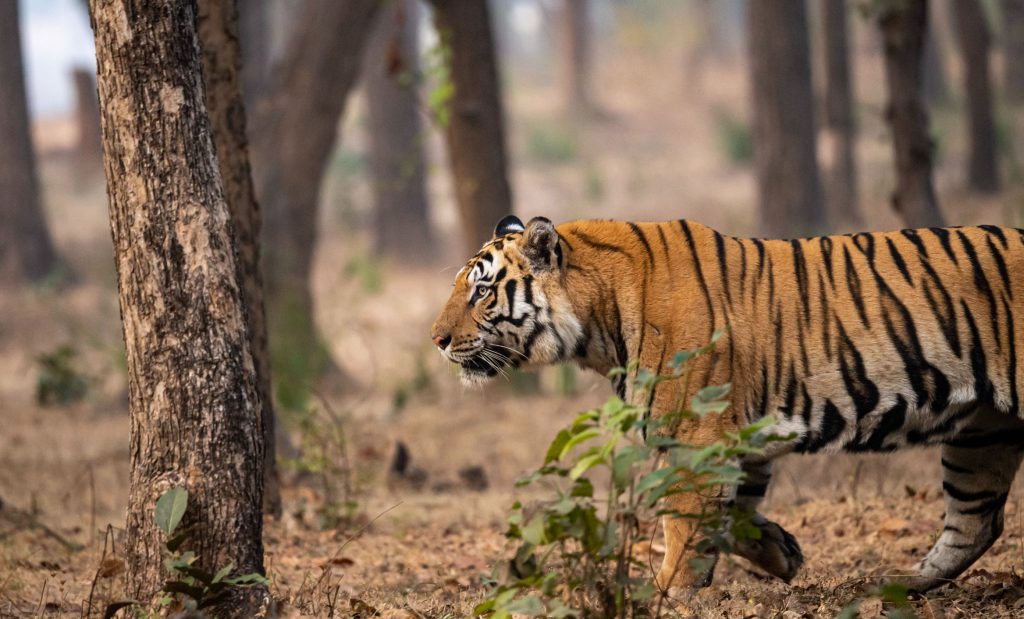
Madagascar opened yet another window to the wonders of nature. My first ringtailed lemur was sublime and I still can’t get enough of these fascinating arboreal primates. The two newest additions to my lemur life list were red ruffed lemur and the long-fingered aya-aye. The one a stunning rarity, the other an enigma. India was a revelation on so many levels. My first tiger sighting had a profound impact on me. Never in my wildest dreams had I anticipated finding a big cat which is even more majestic, more magical, than its African counterparts. My feeling of awe in the presence of a Bengal tiger has only grown stronger and more pronounced with each subsequent sighting of a ‘striped water god.’

This article, though, is about my favorite Africa trips so we will leave Madagascar and India for another time.

My favorite Africa destination is often the one I visited last. Over the years a few combinations of areas and properties have proven to be particularly appealing to me and other members of our team. Here are my top five in no particular order. 

Kenya:  a true classic

I like to think of Kenya as a safari destination as one would about an older model Rolls Royce automobile. It may have a few dings and 150,000 miles on the odometer but it’s rock solid and as dependable as the sun coming up tomorrow. Your Kenya trip – like ours before – is going to be fun, you’re going to see lots of animals without having to drive all day and you may very well be astonished with the incredible diversity on display. So many different animals and birds, so many beautiful vistas and landscapes, such rich culture and fascinating people. Plus a tried and tested tourism infrastructure which makes it one of the easiest of safari destinations to get around. 

For a trip of around 12 days or so, it’s hard to go wrong with a combination of Amboseli (for its elephants and the chance to see Kilimanjaro in the background), a conservancy like Lewa or Ol Pejeta (notably for rhinos and a few superb endemic mammals like reticulated giraffes) and ending with a few days in a private conservancy to the north of the Masai Mara. For some of the best game viewing in all of Africa with as many as seven different large mammals regularly seen at the same time. 

Unlike Southern Africa – which has significantly colder winter mornings and much hotter – sometimes broiling – summer afternoons, winter and summer days in much of Kenya are quite similar due to its proximity to the equator. Which makes Kenya a true year-round destination.  

I think a Kenya mega-trip which we did in early November 2023 rivals a Mashatu (Botswana) and Sabi Sand combination a year or two before that, as the two best safaris I’ve ever been on in terms of diversity and total numbers of mammals and sheer brilliance of sightings, guiding and overall impact. That particular Kenya trip had one really unique inclusion which was a few days spent at Galdessa, a Sheldrick camp set in an idyllic spot on the Galana River in Tsavo East. Galdessa and Ithumba are two of Sheldrick’s reintroduction units, where young elephants from their Nairobi orphan nursery spend a few more years before they are reintroduced into the wilderness in a peer group. These properties can be booked on an exclusive-use basis only so they really work best for a family or a group of friends from six to 10 or so. For visitors who are really fascinated by elephants and who want to support the wonderful work of the Sheldrick Foundation, a couple of days or so at one of these locations may very well be the experience of a lifetime.  

On every trip to Kenya we discover yet another place or activity which slips under the radar on so many ‘run of the mill’ itineraries. Most recently we spent a couple of enthralling days at Laikipia Wilderness observing a rare black leopard hunting in the early evening – on top of several other astonishingly good ‘regular’ leopard sightings. Another time we found a super tusker elephant (with more than 100 pounds of ivory left and right) with a research team from the Tsavo Trust on an outing from Satao, a Tsavo East camp which is as old school as it gets. We’ve also started to spend some time on Kenya’s Indian Ocean Coast at places like Diani Beach and the Vipingo Beach area. Of the resorts we’ve visited, Kinondo Kwetu and Cardamom House were standouts. 

Tanzania’s wildebeest calving season

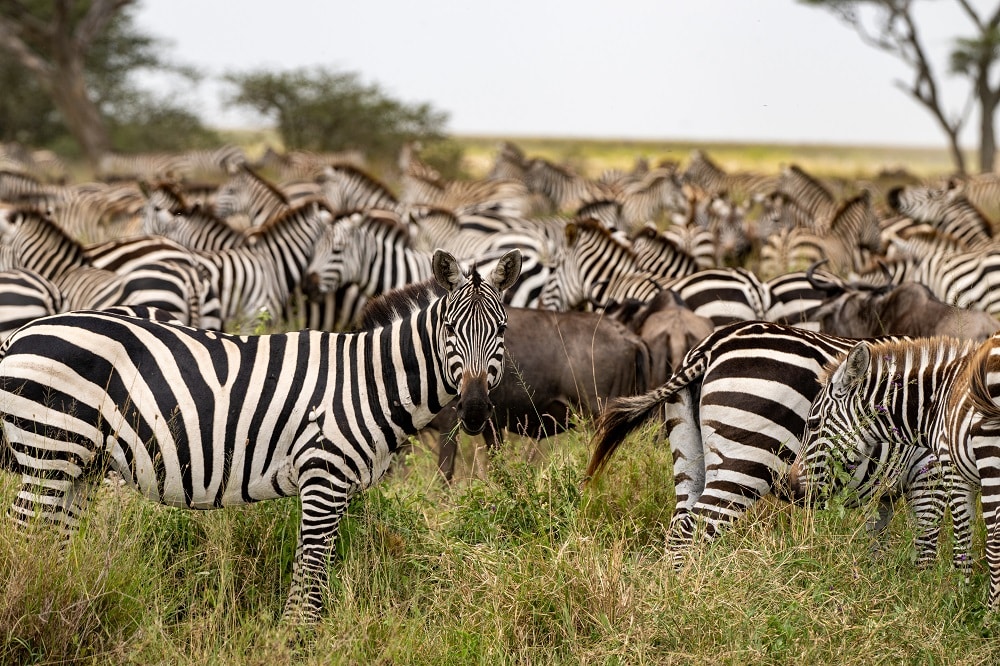
Whenever I browse through my photo albums in search of big cat photos  to illustrate a blog post or an article, I invariably come across photos which I’ve taken on one of several southern Serengeti trips which we’ve done during the calving season around February. Upon reflection, my southern Serengeti photos are among my best ever taken and there’s always something really extraordinary to be captured. Like one young leopard male who had three carcasses in ‘his’ tree in the Kusini area of the Serengeti, where Nomad Tanzania will be opening a camp soon. Or multiple lions taking to the trees around Lake Ndutu, some with stuffed bellies looking not at all comfortable, but clearly determined to be up there with the other members of the pride. The wildebeest themselves – with all their hundreds and thousands of babies stringing along – are of course the star attraction. I particularly like to see them mixed in with zebras (or maybe it’s the other way around) when the the glossy dark brown wildebeest and the vividly black and white zebras would just about combust with brilliance when they alternately blend and separate and create a nonstop series of dramatic photo ops. You just have to be there.  

I think my best advice for a calving season trip would be to spend 12 days to two weeks in Tanzania and split your time between the southern and central Serengeti. The south for the zebra and wildebeest clearly (and whatever else is around), and the central Serengeti for its superb resident wildlife, including more big cats. In the central Seronera area we recommend the more remote eastern properties such as Namiri Plains and Olmara. A great area for cheetahs – and by all means do a day outing to the Gol Kopjes, about as typical as it gets in the way of beautiful rolling hills with isolated inselbergs providing some contrast and points of interest. And big rocks for the lions to clamber onto!

To be sure, we’ve had our issues with Tanzania over the years, ranging from tsetse flies at certain times of the year, to inept or even incompetent visa handling and related immigration procedures. Best time to go: February – the height of the calving season – or a month or two earlier or later.

Botswana’s Okavango Delta

My colleagues remind me every now and then of something which I said a while ago, trying to illustrate just how remote and sparsely populated much of Botswana is. “In some (other) safari destinations, if you sit on a chair at night and look out into the darkness, you are going to see some lights in the distance. A village or town or informal settlement, a road or power lines or some other visual marker of human presence. Not so in Botswana. With few exceptions (such as maybe Chobe) you won’t see a thing. At night, there’s nothing there except the stars and the moon, maybe a satellite or two and a jet sliding by at 35,000 feet.” Those may not have been my exact words, but you get the drift. In the northern Botswana private concessions you have absolutely reached the end of the road. And it feels like it.  

Every now and then I break up with northern Botswana when the daily rate at one or two of the deluxe properties there reach another absurd amount. A few months later I would return and discover several camps which we had either overlooked earlier, or which are new to an area. This happened on my most recent visit when we spent time at Natural Selection Safaris’ Mokolwane Camp and also a couple of Machaba properties – Machaba and Monachira. On this trip, just like every northern Botswana trip, I re-discovered the singular appeal of the area – and specifically the private concessions. 

Quite often, you’ll be driving along a sandy road, occasionally driving into and through water – depending on the time of the year and the status of the annual flood. You’ll soon start to notice that many of the roads skirt the treeline which marks the border of high ground. All around you may be small palm-fringed islands, pretty lagoons replete with hippos, stands of papyrus and reeds, and sizable golden grassy floodplains broken up with patches of riverine forests, stands of leadwood trees, mopane forest and groves of Kalahari apple-leaf. Every now and then there will be a  conspicuous wild fig tree, sausage tree, baobab or jackalberry.

All of this makes for what is probably the most stunning setting for game-viewing anywhere in Africa. With the right selection of camps – for specific times of the year – you will find one after another absorbing wildlife sightings and be able to drive off-road where it makes sense to get closer to perhaps one of the smaller cats such as a leopard in a tree. Our last few Okavango Delta trips have delivered simply extraordinary game viewing at different times of the year. Lions, leopards, cheetahs, African painted dogs, hyenas, many elephants, superb buffalo sightings, various animals on the hunt, a hundred plus different birds in 48 hours, great morning and late afternoon light, and hardly ever more than a couple or so other vehicles to be seen.  

We work with exceedingly knowledgeable and resourceful destination management companies in Botswana – and elsewhere – who are constantly out there looking for the best deals and opportunities to provide value for our guests. It’s a fact that northern Botswana is expensive in the high season but don’t let that stop you from considering the area at all. There’s no steep dropoff in the experience in the shoulder season months and even the low-demand or green season holds fantastic appeal. Just spend a few days longer in fewer areas and you’ll be rewarded amply.  

At certain times of the year it makes sense to combine the Okavango Delta with the Linyanti area or Chobe ‘proper’ – maybe consider a houseboat cruise on the Chobe River – and in the summer months the Kalahari is at its best. Northern Botswana is easily combined with Victoria Falls and greater Zimbabwe – we stand ready to provide you with more information and recommendations. 

Zimbabwe east and west

I flat out adore elephants and can watch them for hours doing their thing which is mostly eating, occasionally finding water and of course being social. Elephants are animated and fun, with the youngsters often acting out just like naughty kids. They’re also social beings with the matriarchs in charge of tightly knit small breeding herds. Anywhere elephants congregate – notably around water in the dry season – their behavior becomes even more intense and more fascinating. And hardly anywhere reaches the fever pitch scenario that plays out in Hwange National Park in Zimbabwe in the dry season. Here thirsty, sometimes desperate elephants have to walk for miles and miles – often shepherding young babies – to reach a crowded water point where a few big bullies tend to at least try to dominate. The result: a wildlife experience which rivals the wildebeest migration for impact. It is often spellbinding, always fascinating and never ever dull. When there is a lull in between elephant herds coming to the water a solitary sable antelope might move in quickly or if you’re really lucky, a trio of skittish roan antelope.   

I have a long list of ‘favorite’ Hwange properties and my recommendation for any particular itinerary depends on the time of the year, whether we can get some long-stay discounts or perhaps a private vehicle at no additional cost, or on guests’ personal preference. If I absolutely had to pick just a couple of camps where I would love to hang out for a while, I’d have to say Little Makalolo and Jozibanini. I’m intrigued by Imvelo’s new Tum-Tum treehouse tented camp – and it is firmly on the soon to visit list. 

Hwange’s 40,000-plus elephants is reason enough to head to Zimbabwe on safari but don’t stop there. My best Zimbabwe trips have included at least one or two other national parks, such as Matusadona National Park on Lake Kariba and the atmospheric Mana Pools area along the Zambezi. On the edge of Lake Kariba at a camp such as Bumi Hills you’ll be able to do some boating safaris and try your hand at tiger fishing – a nice change of pace from bumpy game drives. And no dust. Then again, a late afternoon game drive into the Matusadona Park might very well provide you with some of your best views of elephants ever. With the Matusadona range creating the perfect backdrop, the golden light coming across the lake turns the elephants into movable paintings, the red dust on their hides causing them to glow like paper lanterns. 

Much has been written about Mana Pools, a near-legendary national park which lies along the lower Zambezi in far northeastern Zimbabwe. Renowned for its game-viewing (elephants, big cats, buffalo, plains game, African painted dog, hippo & crocodile), the area is highly atmospheric and for many seasoned safari goers, Mana Pools is the holy grail. Several of the safari camps there have stunning views across the Zambezi with the Zambia escarpment visible in the background. Driving through one of the beautiful Faidherbia albida forests, you’ll experience the unmistakable blue Mana Pools light filtering through the trees, the dust and dappled forest sunlight creating a scene that I have not seen anywhere else in Africa. The albida forests have little to no undergrowth which makes them ideal for walking – even in the warmer months – due to the shade cover of the trees. Walk there in the dry season and you won’t be alone. The albida seed pods are like candy for the elephants and they vie with baboons and antelopes to pick up the tasty, protein-laden snacks.  

Of course the Zambezi is a major presence in Mana Pools, so be sure to book one more day there than you think you might need to do some boating and perhaps canoeing. Or to try your hand at tiger fishing which is excellent there. The stable platform of a good-sized aluminum skiff provides the ideal vantage point for photographing any number of birds and mammals in and around the water, from elephants and hippo to crocodiles, carmine bee-eaters and African finfoot. The extensive floodplains along the Zambezi – covered with albida forests and stands of croton trees (which provide good cover for a variety of species during the warm parts of the day) form a giant safari hotspot, particularly in the dry season. Because of the good road network around safari camps like Ruckomechi and Little Ruckomechi, we have them at the top of our list of Mana Pools camps, but there are several other superb properties in the area in the Machaba, African Bush Camp and Great Plains stables. 

Mashatu and the Greater Kruger park

There are not many true ‘best kept secrets’ left in the safari arena, but I think Mashatu Game Reserve in southeastern Botswana does qualify. While it’s been around for many years, it is easily overlooked among the array of good Okavango Delta, Moremi and Chobe properties. It is also not that easy to reach and to combine it with other safari areas such as northern Botswana or the greater Kruger Park area often involves an overnight stay in Johannesburg. All of which has had a negative impact on the number of people traveling to this flat-out amazing area.  

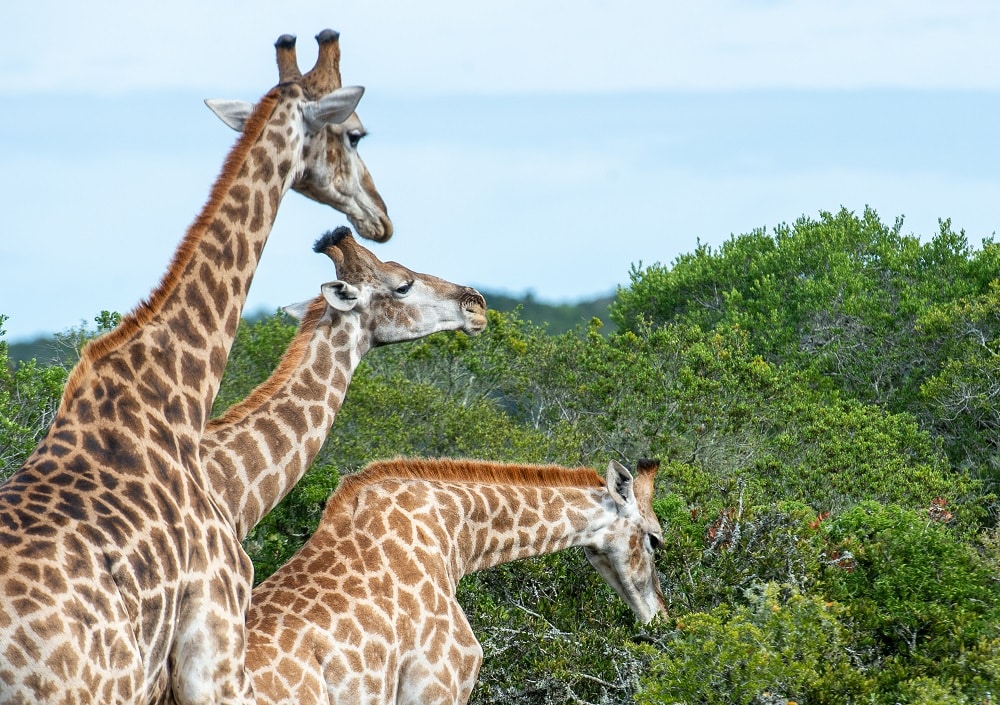
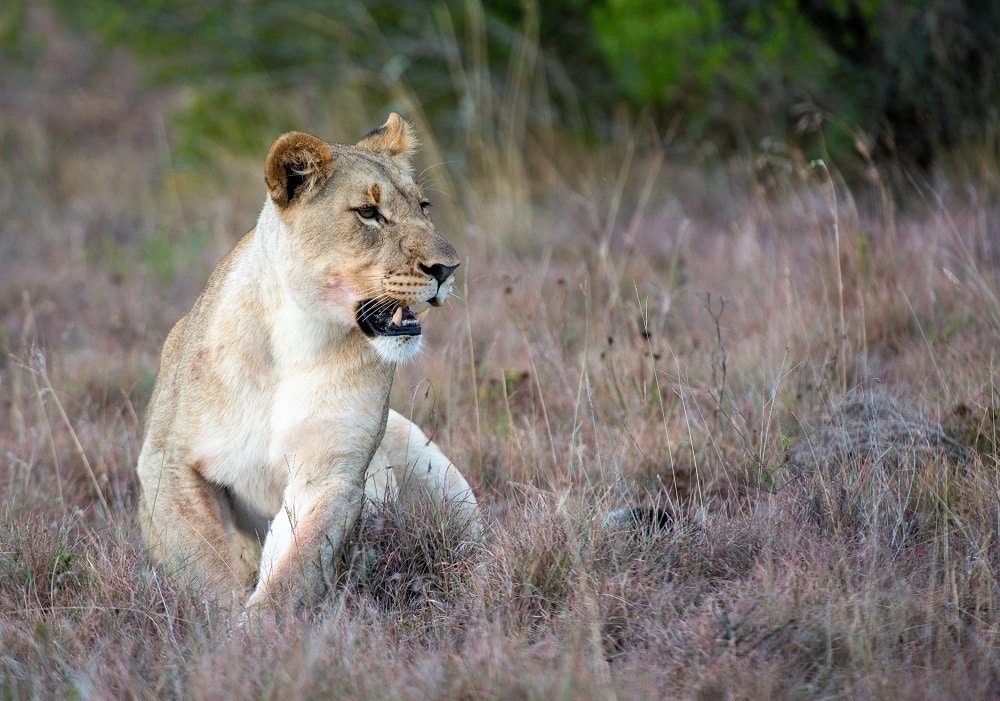
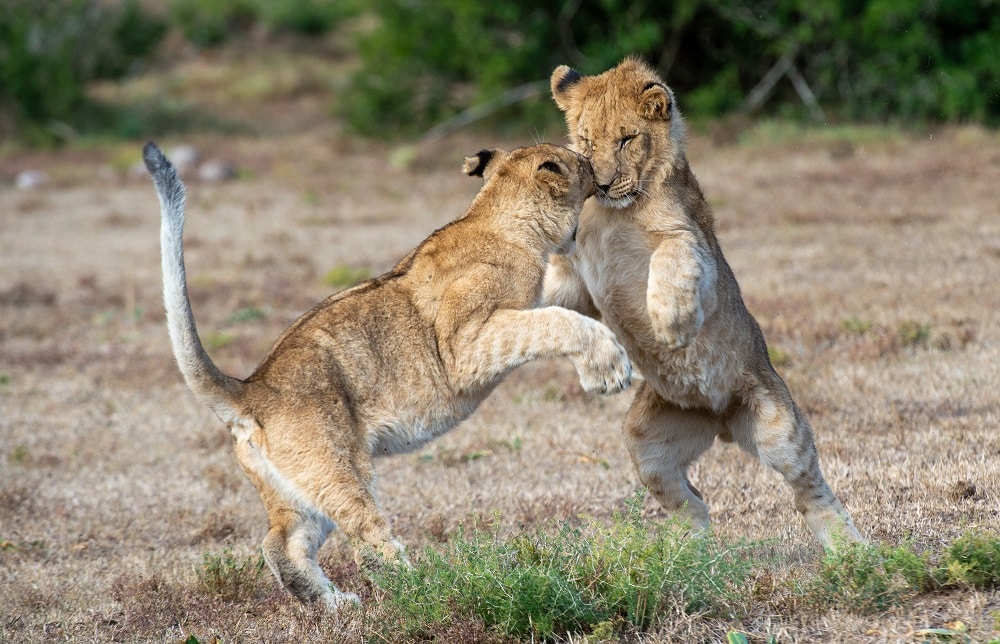
Mashatu’s #1 claim to fame is being one of just a handful of safari destinations where one can reasonably expect to see three of the big cats, namely lions, leopards and cheetahs. Which has happened to us several times at Mashatu. On a September trip a few years ago – when Mashatu was the first stop on a safari which also included the Sabi Sand Reserve in the Kruger Park area – we had three different cheetah sightings in addition to multiple lion and leopard sightings. It was phenomenal. Add to that some of the best elephant sightings in Southern Africa with breeding herds which are as relaxed as they come and which often walk right by the open vehicles. The general game viewing at Mashatu can be superb too with particularly high numbers of giraffes, plenty of eland, kudu, impalas, steenbok, blackbacked jackals and striped hyena with a chance of  brown hyena as well. 

There are several more compelling reasons to include Mashatu on your next Africa trip. The setting is very different from the northeastern South African bushveld with rocky hills and several dramatic drop-offs and vistas making it particularly appealing for hiking. Nothing better than starting a Mashatu trip with a three night hike staying at three different small bush camps, and then stepping it up in terms of accommodation and facilities at one of Mashatu’s camps and lodges. Several of which are family-friendly to boot. Another plus: the option to spend a morning or afternoon or even more than one, in a blind such as Mashatu’s well-known Mathebola or elephant hide. Get ready for some close-ups! I rank Mashatu right up there as one of the top three best Africa destinations for wildlife photography. Finally, Mashatu offers a range of light adventure activities including foot safaris, mountain biking and horseback safaris – so bring your boots or helmet and head out into the bush.  

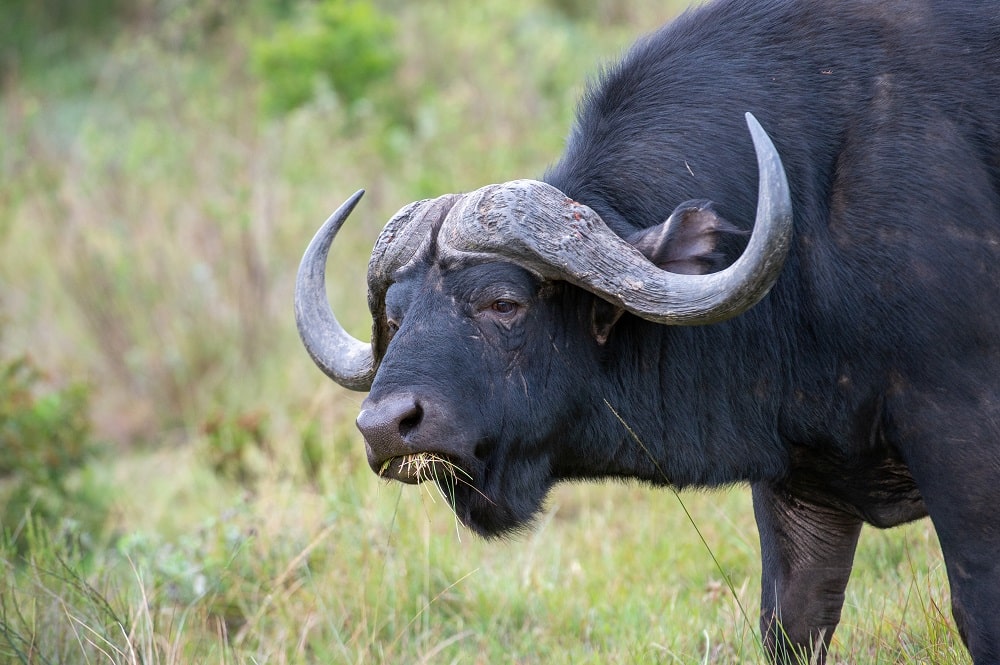
While Mashatu is a stunning reserve worth visiting as a stand-alone destination, it is best combined with South Africa’s greater Kruger Park area, specifically to add buffalos and rhinos to the list of ‘Big Five’ mammals to be seen. The last time we did just that, we added not only those two animals, but also African painted dog and pangolin at MalaMala in the Sabi Sand Reserve. That was a trip for the ages, and it’s an excellent choice any time from May through October and early November.  

The Sabi Sand Game Reserve alongside the southern part of Kruger Park is known for its phenomenal leopard sightings, with the thick brush providing perfect cover for them. Beyond that, there are good numbers of lions as well and an excellent chance to see the rare, spectacular African painted dogs. We do have our favorite properties in the area, headed up by MalaMala which is a standout because of the considerable stretch of the Sand River which runs through the property. Game drives are done on the western side of the river, an area which acts as a magnet to many species of animals which move closer to water during the dry season. Other Sabi Sand properties which we like to include in itineraries are Kirkmans, Sabi Sabi, Leopard Hill and Savanna. They are all special in their own way. Of course the Sabi Sand Reserve isn’t the only game in town in the way of private game reserves adjacent to the Kruger Park. The Timbavati Reserve is another major player where camps like Walkers Plains Camp, Kambaku River Sands and Kings Camp offer an excellent wildlife experience at a somewhat lower price point.  

Bert is always happy to talk about his past and future trips.  He will be returning from a Zambia and Malawi trip soon so by all means contact him at bert@fisheaglesafaris.com to ask about those two countries, or to get the ball rolling for your own visit to one of his favorite destinations. 

YOU MIGHT ALSO BE INTERESTED IN
Destinations
Zambia

10th September 2021

Chindeni and the Bushcamp Company, Zambia

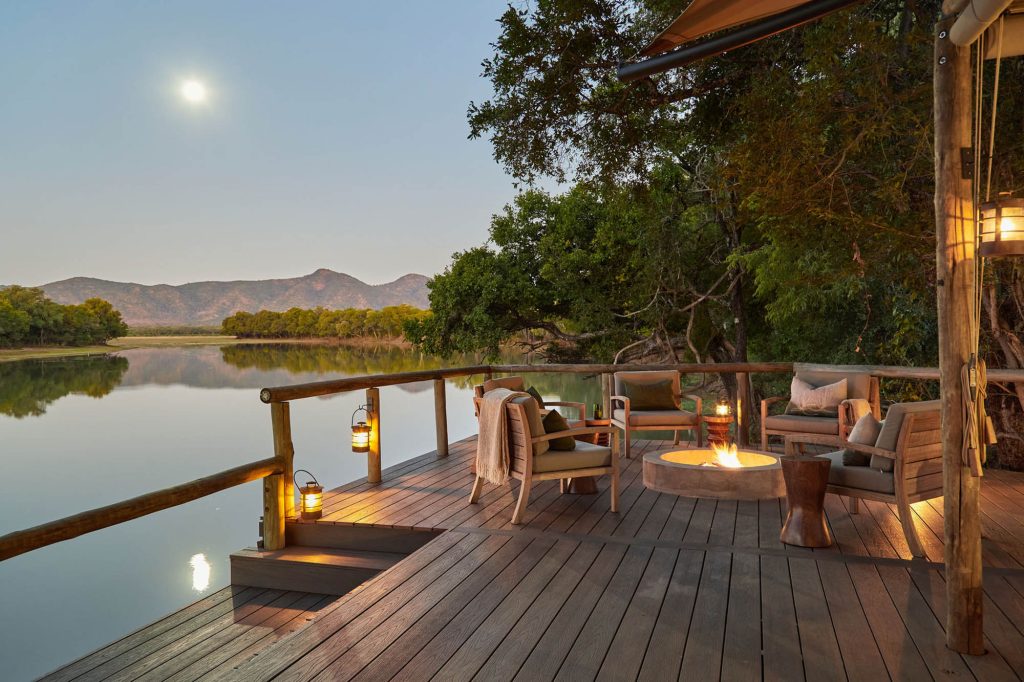
By late July we found ourselves at Chindeni, a small Bushcamp Company property
Read more
Botswana
Destinations
Okavango Delta

3rd October 2022

Camp Okavango, Botswana

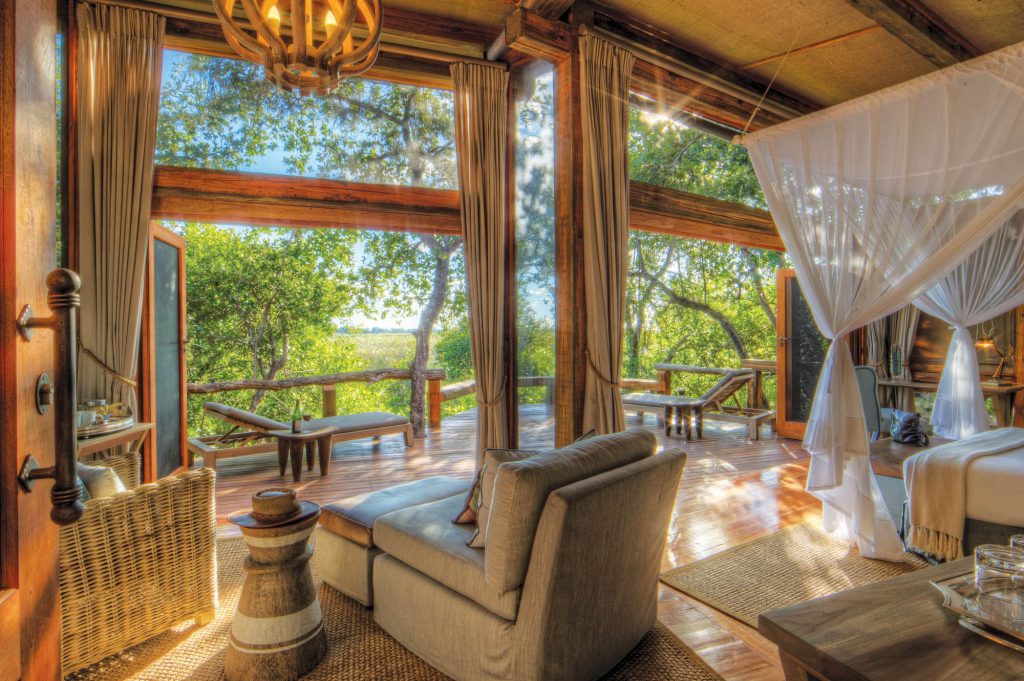
Camp Okavango is in the heart of the permanent part of the Delta. In this idyllic setting there are no vehicles, and it is just a short walk
Read more
Area
Destinations
Nyerere National Park
Ruaha
Tanzania

14th October 2023

From My Safari Notebook: Wildlife Photography

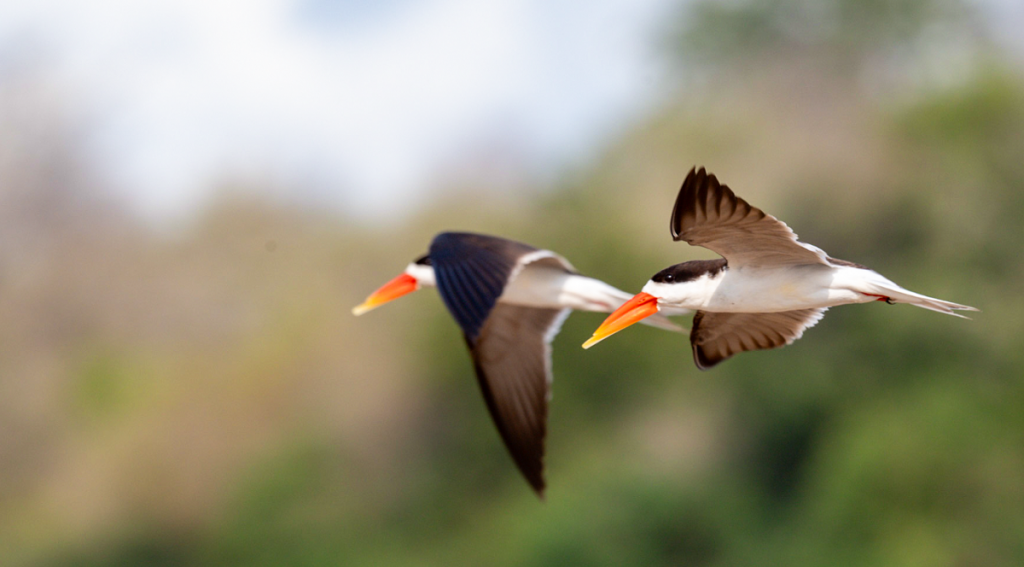
Birds in flight and wildlife photographers have an uneasy relationship. Things go wrong as often as they go right. Getting focus-lock on a moving subject

Read more

SUBSCRIBE TO OUR NEWSLETTER

READERS FAVOURITES
Destinations
India

27th May 2023

India

India’s tiger, mammals and birds.

Read more
Botswana
Destinations

4th August 2022

On Safari At Belmond Eagle Island Lodge, Okavango Delta

What is the ‘secret sauce’ for an unforgettable few days on safari in Botswana? It starts with the animals, of course. The elephants, lions, giraffes, hippos

Read more
Destinations
Zambia

10th September 2021

Chindeni and the Bushcamp Company, Zambia

By late July we found ourselves at Chindeni, a small Bushcamp Company property

Read more

A Visit to Cape Town, South Africa

31st October 2025

A Visit to Cape Town, South Africa

Between them, the members of the Fish Eagle team have visited Cape Town dozens of times, as recently as early September this year. Like everybody else, we are already looking forward to the next time we can look up towards Table Mountain from our hotel on the V & A Waterfront, squinting to see if we can observe the cable cars sliding up to the upper cable station. 

While Cape Town is not at its best in the winter months of June, July and August, it’s worth visiting any time of the year. A bit like San Francisco. Many of the activities are not weather-dependent and can be enjoyed regardless of wind, cold or rain. We do advise guests to think twice about visiting Cape Town over the high holiday time-frame from about mid-December to around the 10th of January. The city is literally jam-packed with up-country and foreign visitors to the point of distraction and frustration. Getting in and out of the V & A Waterfront becomes a major issue because of congestion, the wait at the lower cable car station runs into two hours plus and it’s difficult to get into the restaurant of your choice. I don’t have to spell it out. So yes December is a great time to be in the Cape as long as you don’t mind the crowds. Some 500,000 visitors flew into Cape Town last December and thousands of self-drivers joined the parade. 

The best time to visit the Cape is in the spring and early summer from September through the end of November and maybe early December and then again from around mid-January to the end of May. Regardless of when you can go, here are some of the many things that you can do and see in Cape Town – and of course we can help you plan your trip with our Cape Town partners Wilro Cape. Accommodation, touring, transfers, private guiding – and extensions to parts north for a safari.  

Take a cable car ride to the summit of Table Mountain. Be sure to do this at the first best opportunity, whenever the mountain is ‘open’ and the cable car is operating. The weather in Cape is fickle even at the best of times and the cable car operation is suspended when cloud cover and strong winds show up. Early mornings are best to avoid the crowds. Better yet, hike up the mountain and take the cable car down. 

Visit Kirstenbosch National Botanical Garden – it is a national treasure and Capetonians treat it like gold. Be sure not to miss the Boomslang canopy walk, the Cycad forest with life-size dinosaur sculptures, and the Protea garden. Figure on two hours minimum, three hours or half a day even better.  

Sign up for a private guided Peninsula tour to include Hout Bay, the magnificent Chapman’s Peak Drive, Kommetjie, Cape of Good Hope Nature Reserve (take the funicular to the lookout point), and the African Penguin sanctuary at Boulders.

If you’re not staying there, visit the Victoria & Alfred Waterfront complex. It’s a working harbor so check out the drydock, take a walk along the breakwater, enjoy one of the dozens of restaurants and pubs, and support the local economy at one of the high-end stores and shops. If you’re staying in a self-catering apartment in the Waterfront, there’s a full-service Pick ‘n Pay supermarket in the Victoria Wharf Shopping Center to stock your pantry. Or pick up something healthy in the prepared food section at Woolworths. Don’t forget to check out the Two Oceans Aquarium.

A stroll on the Sea Point Promenade is always fun and entertaining, from observing the hang gliders overhead to the people watching. You can start from the V & A Waterfront if you have an hour or two – it is quite a popular running and cycling route.   

Make some time for Cape Town’s beaches such as Clifton, Muizenberg and Camps Bay, particularly in the warmer summer months from October through April. The Atlantic seaboard beaches are all very impressive; the last one at Bantry Bay also has a pool. Clifton is the only spot which is shielded when a  strong southeaster (the most common wind) is blowing. Camps Bay is famous for its eateries and clubs and the tidal pool at the end of the beach is wonderful when the wind isn’t blowing. Bakoven is beloved by locals. Oudekraal beach and surrounding beaches are all spectacular. Llandudno is probably one of the most beautiful beaches. Muizenberg Beach has a definite surf vibe, and makes for a great visit. There are lots of surf schools, restaurants and the water is a touch warmer. The beaches towards Kalk Bay are also cool, with nice tidal pools to swim in.

Stroll the Company’s Garden area where there are several worthwhile museums, notably the Iziko South African Museum. You can enter the Company’s Garden from the top (just across the street from the Mt. Nelson Hotel) or from the main entrance on the corner of Adderley and Wale Streets. 

Museum and art enthusiasts have almost too many choices in Cape Town. Budget your time carefully if you want to include all of the major ones including the Zeitz MOCAA Museum (Silo Hotel); Irma Stern Museum, Iziko South African (Natural History) Museum, SA National Gallery, SA Jewish Museum and the District Six Museum.

Visit Groote Schuur Hospital’s ‘Heart of Cape Town’ Museum for a guided tour.  Groote Schuur  is where Dr. Christiaan Barnard performed the world’s first heart transplant in December 1967.  

Visit Robben Island by ferry boat. While this is a worthwhile trip, mostly to see the prison cell where Nelson Mandela spent 18 years of his life, the operation has been plagued by recurring management problems. Ferries sometimes  run late, some are even canceled at the  last minute. Even so this is a popular activity and it is advisable to book well in advance. The views of Cape Town and Table Bay – both coming and going on the approximate 30-minute ferry ride – is worth the price of admission.  

Browse the Long Street and Greenmarket Square markets; this can be done in conjunction with visiting the Company’s Garden. When it is crowded, beware of pick-pocketing. There are many other amazing markets all over Cape Town. Biscuit Mill Market in Woodstock on Saturday mornings gets hot and busy, but it has nice food and local goods. Oranjezicht City Farm market opposite the V&A Waterfront is a ‘must do’. It’s a great food market, so come hungry – it’s a great spot to buy fresh fruit and vegetables. This market takes place Saturday and Sunday until about 2pm as well as on some Wednesday evenings. A family-friendly outdoor market is the Mountain Market in Vredehoek on Saturday mornings.

Visit the Castle of Good Hope Museum. If the timing works out, take in the ‘changing of the guard’ and visit the William Fehr art exhibit inside the building, as well as the Cape Military Museum.

Take a guided walking tour of the Bo-Kaap area for colorful homes and delicious Cape Malay cooking.

Take a ride from Cape Town to Kalk Bay village for lunch at the famous Brass Bell; or include it in your ‘Go as you please’ arrangements.

Embark on a half- or full-day Cape Winelands tour; ideally a privately guided trip. In our opinion, Franschoek is the most interesting of the Winelands towns but Stellenbosch and Paarl are perfectly nice too. Enjoy lunch with a view at Delaire Graf and if you are an automobile aficionado, don’t miss the Franschoek Motor Museum on the Anthonij Rupert Wine estate. 

Visit Constantia Valley near Cape Town for wineries such as Constantia Glen and Groot Constantia, the latter of which was the very first wine estate to have been established in Cape Town. There are some excellent restaurants in the area for lunch. Leave some time for the Norval Foundation Art Gallery, opposite the US Embassy. 

Take a trip to the 12 Apostles Hotel on Victoria Road in Camps Bay for sunset drinks; it’s a great spot to see the sun settle over the Atlantic Ocean. 

Go hiking. Cape Town has many excellent hiking trails catering to almost every level of fitness. A good entry level hike is Lion’s Head. The Pipe Track hike along the contour line of the lower slopes of Table Mountain – below the 12 Apostles – is scenic and refreshing yet not overly strenuous at all.  

If you want to actually make it all the way to the summit of Table Mountain the shortest and least taxing option is the Platteklip Hike. While it’s far from being the most scenic of the summit hikes it is very much worthwhile and there’s no clambering or scrambling involved. You just have to have the basic leg strength and stamina to negotiate the large natural rock steps all the way up. It takes about 2.5 to 3 hours.   

If you are fit and can handle a bit of a challenge then I’d recommend the beautiful Skeleton Gorge hike, which starts in Kirstenbosch National Botanical Gardens. It is more strenuous and quite a bit longer, and will take from 3.5 to 5 hours. 

The Table Mountain Hike which is not for beginners – but which can be done by most people who are reasonably fit – is India Venster. When you are in the Cable Car going up or down the mountain and you look down at the slopes right below the cable car, you can see the hikers on the India Venster trail. There’s some scrambling involved and a few ladders and some ‘staples’ in the rock to help you across a few tight spots. Extremely rewarding.  

Importantly: don’t do your Table Mountain or Lion’s Head hike alone. Go with a properly qualified, experienced guide such as the ones associated with Mother City Hikers, whom we use for almost all of our Cape area hikes. You can accidentally stray off the path and get lost or injured, the weather is notoriously fickle and it is always good to have a local around – someone who knows the area and can make a good decision when needed.

Take a tour on the Hop On Hop Off City sightseeing bus.

Make a reservation at one of Cape Town’s many celebrated restaurants. I personally tend to shy away from the ones where you have to put down a deposit just to be able to make a reservation, but don’t let that stop you. Our two current  favorites are the Nelson’s Eye Grill (for steak lovers), right by the Mt. Nelson Hotel and Posticino, a relaxed Italian pizza and pasta restaurant at 323 Main Street in Sea Point.  

If you’d like to talk through the options of what you can do in Cape Town and how much time you’ll need to get it all done, our team at Fish Eagle Safaris is ready to assist you. Please contact Bert at bert@fisheaglesafaris.com, Lyndon at lyndon@fisheaglesafaris.com or Jason at jason@fisheaglesafaris.com for more information, or leave a message with our answering service at 1-800-513-5222.

YOU MIGHT ALSO BE INTERESTED IN

Destinations
Zambia

10th September 2021

Chindeni and the Bushcamp Company, Zambia

By late July we found ourselves at Chindeni, a small Bushcamp Company property

Read more
Botswana
Destinations
Okavango Delta

3rd October 2022

Camp Okavango, Botswana

Camp Okavango is in the heart of the permanent part of the Delta. In this idyllic setting there are no vehicles, and it is just a short walk

Read more
Area
Destinations
Nyerere National Park
Ruaha
Tanzania

14th October 2023

From My Safari Notebook: Wildlife Photography

Birds in flight and wildlife photographers have an uneasy relationship. Things go wrong as often as they go right. Getting focus-lock on a moving subject

Read more

SUBSCRIBE TO OUR NEWSLETTER

READERS FAVOURITES
Destinations
India

27th May 2023

India

India’s tiger, mammals and birds.

Read more
Botswana
Destinations

4th August 2022

On Safari At Belmond Eagle Island Lodge, Okavango Delta

What is the ‘secret sauce’ for an unforgettable few days on safari in Botswana? It starts with the animals, of course. The elephants, lions, giraffes, hippos

Read more
Destinations
Zambia

10th September 2021

Chindeni and the Bushcamp Company, Zambia

By late July we found ourselves at Chindeni, a small Bushcamp Company property

Read more

Family-friendly Safaris

30th October 2025

Family-friendly Safaris

By Jason Duplessis

Until recently, we didn’t really have any experience bringing children on our trips to Africa – at least not for the past three decades or so. Bert and Kathy brought us when we were younger but many things have changed quite significantly since then. As much as it hurts to admit, I’m now in my 40’s and I have had little reason to explore the idea of a family-friendly trip until just a few years ago when my son was born.

This year, we decided to bring him along to Africa to meet some of the family and to get a bit of the ‘family trip’ experience so we can better advise our future guests that are traveling with kids. Our adventure started with a few nights in Cape Town where the importance of a great guide really stood out. 

Our Wilro Cape Tours guide was Albert and, after the fact, I honestly couldn’t imagine traveling to Cape Town without a guide like him. He was welcoming upon our arrival in Cape Town, he had interesting knowledge to share, he was unimaginably flexible and he curated two full days of touring that worked for our little family of three. Between the visit to Alpaca Loom where our son Kai got to pet Alpacas and sheep, to the two vineyard visits where he (literally) wrangled our toddler for over an hour so we could have a moment alone. Even some piggy-back rides through a supermarket to grab some items we needed, Albert was the key to a successful trip. Even our son knew it, asking ‘Where’s Albert?’ as soon as he woke up in the morning.

Next, we left for our safari – admittedly without our toddler – but with a keen eye and a focus on what could potentially make a successful or unsuccessful trip with children. Sabi Sabi Bush Lodge was our first stop and it truly had all of the ingredients for a successful family trip.

Beyond having an electric fence to keep out certain animals for safety reasons, each property has guides that are prepared for the needs of a family with younger children. Our guide/tracker teams at each camp – Neo and Themba at Sabi Sabi and Millie and Walter at Walker’s Plains – have experience with families and children specifically.

A huge highlight at Sabi Sabi Bush Lodge would be the Elefun Children’s Center. This imaginative and educational space teaches kids about wildlife, conservation and the African bush through guided age-appropriate activities. It’s rare to find a safari property that embraces children so wholeheartedly. We were able to visit the center for a bit of an inspection – a maze, a jungle gym, arts and crafts, a big outdoor play area… I can see children of many ages having a blast here.

Beyond the Elefun Center, our guide Neo and tracker Themba have guided many families with children of all ages. Neo’s deep knowledge, calm confidence and contagious enthusiasm really brought the bush to life and I would trust her to be able to keep a child excited throughout the safari activities. A great guide is the soul of any safari, and for a family with younger children that really rings true.

Jason can be reached at jason@fisheaglesafaris.com for more information about family-friendly Africa trips options – or call us at 713-467-5222 and leave a message. 

Elefun Centre photo courtesy Sabi Sabi

YOU MIGHT ALSO BE INTERESTED IN

Destinations
Zambia

10th September 2021

Chindeni and the Bushcamp Company, Zambia

By late July we found ourselves at Chindeni, a small Bushcamp Company property

Read more
Botswana
Destinations
Okavango Delta

3rd October 2022

Camp Okavango, Botswana

Camp Okavango is in the heart of the permanent part of the Delta. In this idyllic setting there are no vehicles, and it is just a short walk

Read more
Area
Destinations
Nyerere National Park
Ruaha
Tanzania

14th October 2023

From My Safari Notebook: Wildlife Photography

Birds in flight and wildlife photographers have an uneasy relationship. Things go wrong as often as they go right. Getting focus-lock on a moving subject

Read more

SUBSCRIBE TO OUR NEWSLETTER

READERS FAVOURITES

Destinations
India

27th May 2023

India

India’s tiger, mammals and birds.

Read more
Botswana
Destinations

4th August 2022

On Safari At Belmond Eagle Island Lodge, Okavango Delta

What is the ‘secret sauce’ for an unforgettable few days on safari in Botswana? It starts with the animals, of course. The elephants, lions, giraffes, hippos

Read more
Destinations
Zambia

10th September 2021

Chindeni and the Bushcamp Company, Zambia

By late July we found ourselves at Chindeni, a small Bushcamp Company property

Read more

First Safari Experience

29th October 2025

First Safari Experience

By Katie Perry

Before my first trip to Africa, I assumed I would be on a ‘once-in-a-lifetime’ adventure – something to check off the bucket list. But from the moment I arrived, I realized that the experience has a way of changing you. As we left our final camp I wondered what the rest of the guests would see that same evening. Even on the flight home, I found myself longing to go back, as though I might miss something extraordinary happening.

It didn’t take long for Africa to work its magic. I became a morning person overnight – no small feat for someone who usually treasures a slow start on vacation. By 5:30am, I was awake and eager to explore. As I bundled up for the game drive on my first morning, I heard a deep, resonant roar outside. Jason smiled and said it was a male lion calling out to mark his territory. The sound was thrilling – wild and ancient – and set the tone for everything that followed. 

After a quick breakfast and with coffee to-go we were out on the vehicle with our guide Neo and our tracker Themba. Within an hour I found myself sitting in an open-air vehicle at sunrise, a warm water bottle on my lap, watching a pride of lions glide past. We were surprisingly close! I made eye contact with the lioness in front of the pride and I will never forget the feeling. A mix of excitement, fear and wonder. The lioness couldn’t have cared less – she and the pride walked within feet of our vehicle and found a shady spot to lie down with her cubs.

By the end of that first day I had seen all of the ‘Big Five’ mammals (lion, leopard, elephant, rhino and Cape buffalo), but more than the sightings themselves it was the connection to nature that stayed with me. I used to wonder how Jason could see the same animals time and again. How he could watch a wildlife documentary as if he hadn’t seen all of those animals before. Now I’m the one searching out the documentaries, the videos, the photos. I’m the one rooting for the lone, hungry leopard to make a kill – although I’m not entirely ready to see that part of the circle of life. Luckily the only kill witnessed on our safari was during the final morning game drive when we saw a predatory bird capture a mouse. There was enough obstruction in the trees to not see the worst of it, but we all knew what had happened.

All in all, this supposed ‘once-in-a-lifetime’ adventure became something far more meaningful. I know I’ll be drawn back to Africa again and again, as are many of Fish Eagle Safaris’ guests. The ‘Africa Bug’ bites and doesn’t let go.

If you’re ready to join the ranks of first-time Africa visitors – or to make a return trip to the continent – by all means contact Bert at bert@fisheaglesafaris.com for his recommendations. South Africa? Kenya? Botswana? It all depends on what you have in mind, and we love to talk about it. So leave us a message at 1-800-513-5222 and one of the team will be sure to call you back.

YOU MIGHT ALSO BE INTERESTED IN

Destinations
Zambia

10th September 2021

Chindeni and the Bushcamp Company, Zambia

By late July we found ourselves at Chindeni, a small Bushcamp Company property

Read more
Botswana
Destinations
Okavango Delta

3rd October 2022

Camp Okavango, Botswana

Camp Okavango is in the heart of the permanent part of the Delta. In this idyllic setting there are no vehicles, and it is just a short walk

Read more
Area
Destinations
Nyerere National Park
Ruaha
Tanzania

14th October 2023

From My Safari Notebook: Wildlife Photography

Birds in flight and wildlife photographers have an uneasy relationship. Things go wrong as often as they go right. Getting focus-lock on a moving subject

Read more

SUBSCRIBE TO OUR NEWSLETTER

READERS FAVOURITES

Destinations
India

27th May 2023

India

India’s tiger, mammals and birds.

Read more
Botswana
Destinations

4th August 2022

On Safari At Belmond Eagle Island Lodge, Okavango Delta

What is the ‘secret sauce’ for an unforgettable few days on safari in Botswana? It starts with the animals, of course. The elephants, lions, giraffes, hippos

Read more
Destinations
Zambia

10th September 2021

Chindeni and the Bushcamp Company, Zambia

By late July we found ourselves at Chindeni, a small Bushcamp Company property

Read more

In the Steps of Our Hominid Ancestors: A Guided Day Tour in the Cradle of Humankind

12th June 2025

In the Steps of Our Hominid Ancestors: A Guided Day Tour in the Cradle of Humankind

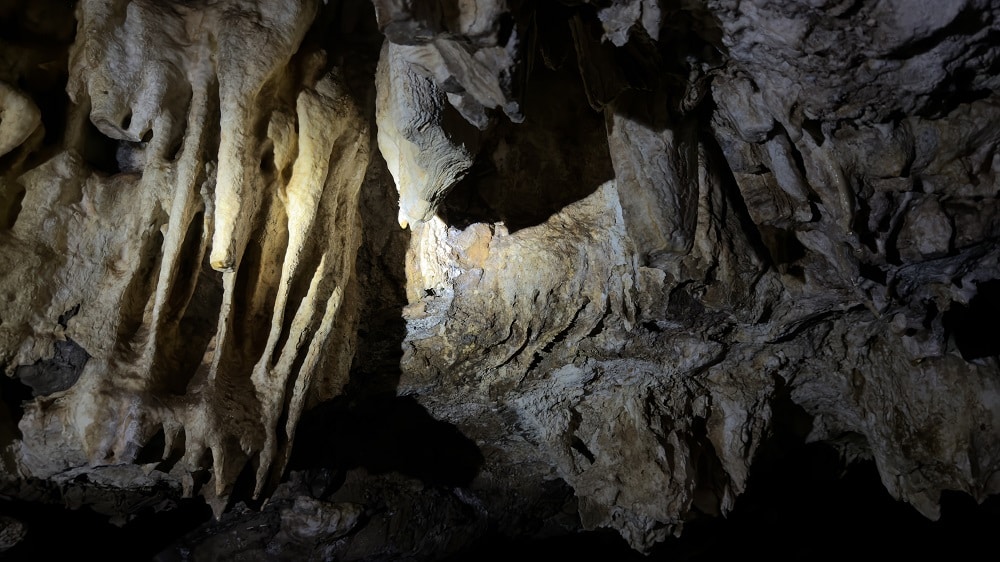
Less than 90 minutes northwest of the modern metropolis of Johannesburg in South Africa’s highveld region, hidden among some beautiful rolling hills lies a largely undiscovered treasure trove of paleontology. A vast area dotted with giant dolomitic  caverns, caves and natural sinkholes brought about by an event stretching back two billion years ago, when a giant meteorite hit earth at Vredefort, about 100 miles distant.  

The resulting upheaval and subsequent geological events led to a remarkable number of fossils being left behind in the mixture of limestone and other sediments (known as breccia) which characterize the area. 

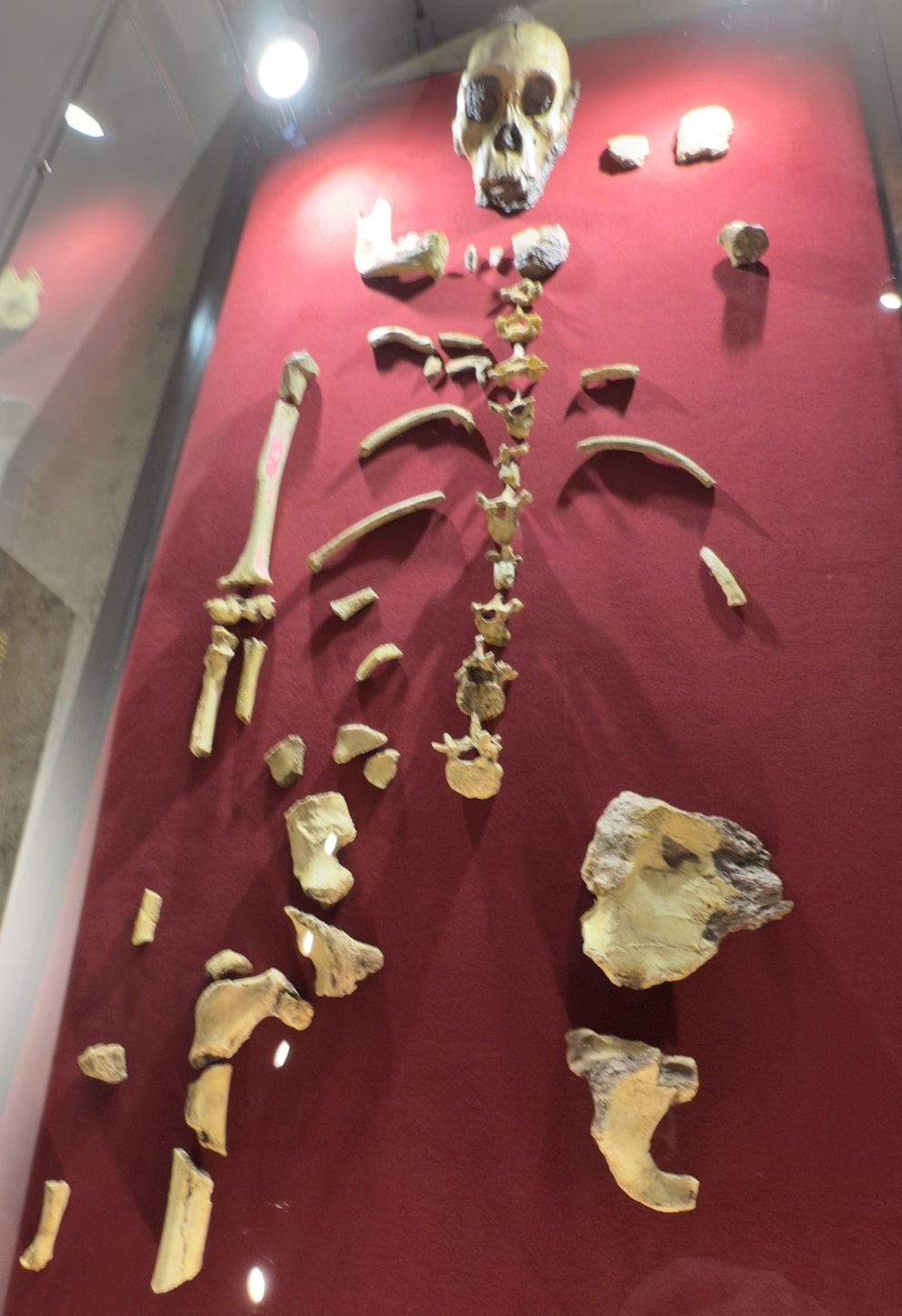
Were it not for some enterprising miners in search of limestone – a mineral much in demand in the gold rush which engulfed the city of Johannesburg in the 1880’s – all of this may have escaped notice altogether. But it was not to be. Blasting operations by limestone seekers exposed a wealth of animal and humanoid bones to curious eyes. Predictably this attracted attention from (now famed) scientists like Raymond Dart and Robert Broom. Prof Broom’s 1946 discovery of ‘Mrs Ples’ – the well preserved skull of a Australopithecus afarensis – caused a minor sensation and added the Sterkfontein caves to the pantheon of African paleontology, together with Taung, Olduvai and others. 

The hominin remains that fossilized over time at the Cradle of Humankind are found in dolomitic caves, and are often encased in breccia. Early hominids may have lived throughout Africa, but their remains are found only at sites where conditions allowed for the formation and preservation of fossils, as was the case here. 

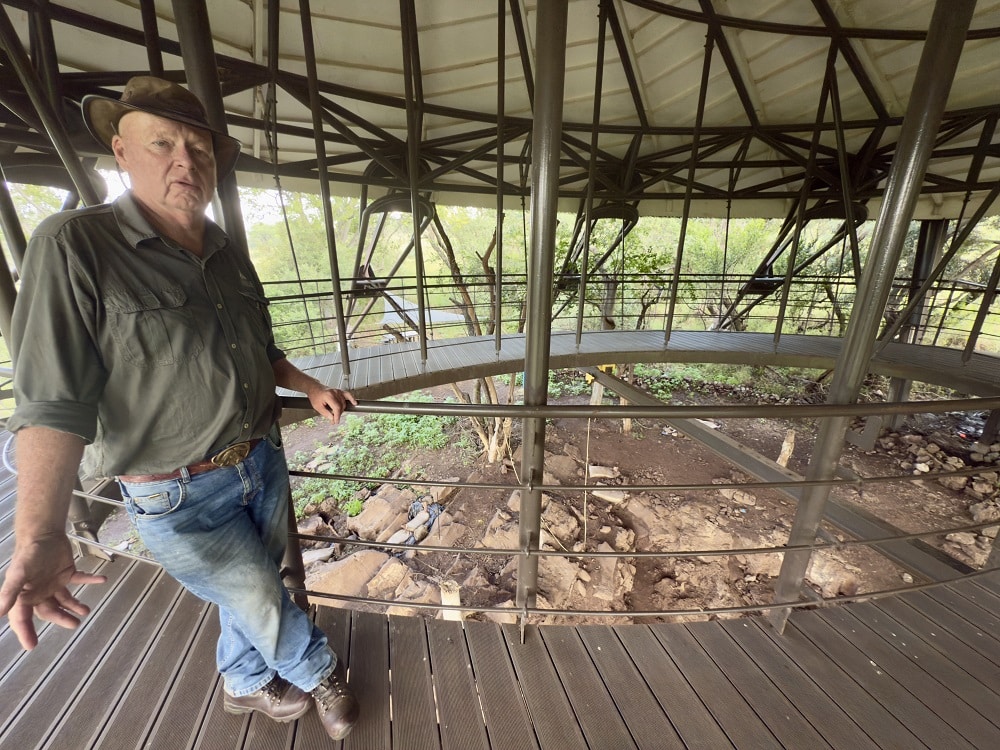
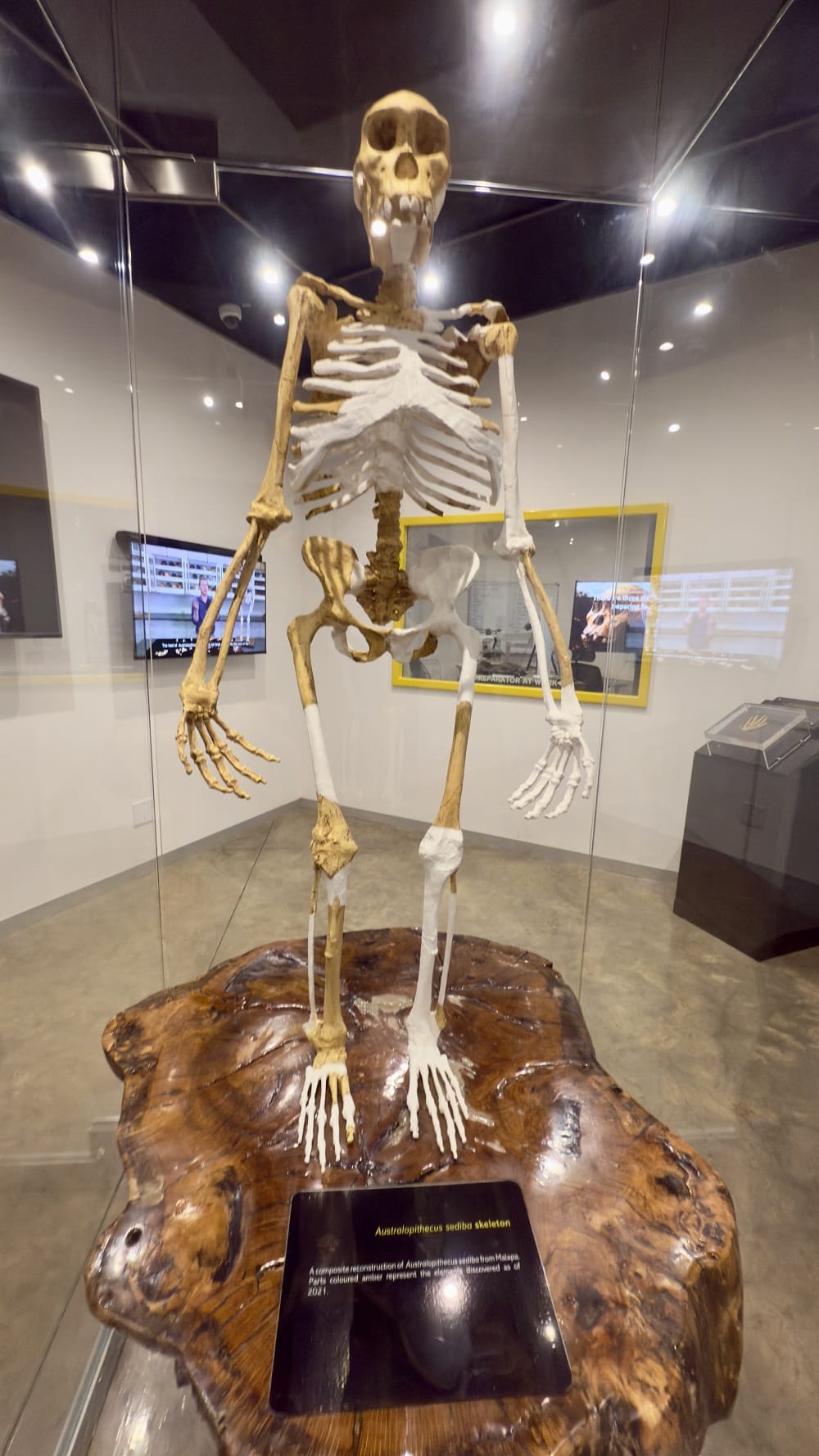
For a modern day visitor, there is much to be seen and learned here, particularly on a professionally guided discovery tour. Early this year Bert embarked on a half day ‘Human Origins’  tour which included visits to the Gladysvale cave and Malapa site, where ongoing active digging can be observed from an elevated spider-like metal platform. 

My driver and I were accompanied by professional guide Chris Green who displayed an encyclopedic knowledge of the area. Chris was able to provide crucial background information and insight into the sometimes complex story. 

The tour starts at the 30-room Cradle Boutique Hotel and can either be preceded or followed by a 30-minute or so audiovisual presentation, narrated mostly by American-born paleontologist Lee Berger. In addition to the videos there are several explanatory murals, maps, schematic renderings, fossil replicas and other artifacts. All telling a fascinating story of what transpired in the area over the eons.

Participants then board a 4-wheel drive vehicle, proceeding down a  well maintained gravel road. Two world-famous active fossil digs – Gladysvale and Malapa – are the key attractions visited on this tour. They are located within the John Nash and Malapa Nature Reserves which comprise the core of the UNESCO designated Cradle of Humankind World Heritage Site.

The discoveries at Rising Star Cave [Homo naledi] and at Malapa [Australopithecus sediba] were rated by The Smithsonian Magazine in the top ten scientific breakthroughs in the last decade. The Human Origins Tour is the only privately guided tour to visit the two sites. 

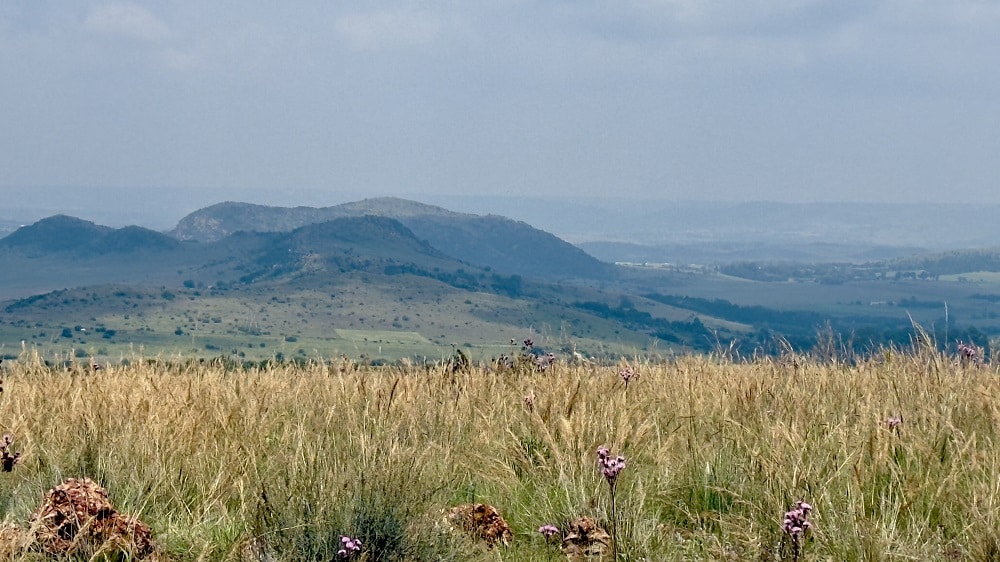
In addition to stops at Gladysvale cave and the Malapa dig site, we stopped along the way to observe the landscape from a high point. Both the Witwatersrand ridge to the south and the Magaliesberg range to the north could be seen.  

The high altitude dolomitic grasslands here are second only to the Cape Floral Kingdom (Fynbos) in terms of floral diversity. This protected area is also home to leopard, brown hyena and caracal. Antelope species like the magnificent eland, blesbok, kudu, blue wildebeest, zebra and red hartebeest are some of the other species to be seen. Amazingly, all within sight of the second largest urban area on the African continent. The two most memorable sightings we had were of giraffes and blesbok with their unmistakable white faces. On the day, there were good numbers of wildebeest, some impala, kudu, eland, warthogs and ostriches as well. 

What to expect on a typical tour::

  • 08:00 Pick-up from your Sandton or Johannesburg-area hotel. The drive to the Cradle Boutique Hotel will be around 90 minutes or so. 
  • 09:30 Transfer into open game drive vehicles. 
  • Visit the elevated viewpoint for an orientation talk which sets the scene and establishes a framework for what follows. 
  • Walk into the massive Gladysvale cave to visually observe what a fossil-rich environment looks like.
  • Snacks and soft beverages including water are provided
  • Walk up into the Malapa Beetle to observe an active dig site from an elevated spot. 
  • 13:30 Lunch at Cradle Boutique Hotel (for guests’ own account)
  • Visit the Malapa museum to check out the many displays and audiovisual presentations. The museum is closed on Monday and Tuesday. 
  • 16:00 Drop-off back at your hotel.

Fish Eagle Safaris will book the outing for you. Bert has done several local sightseeing outings in Johannesburg over the last few years, encompassing history, culture and art. Email him at bert@fisheaglesafaris.com for more information about touring options and for an updated Johannesburg sightseeing document.

YOU MIGHT ALSO BE INTERESTED IN

Destinations
Zambia

10th September 2021

Chindeni and the Bushcamp Company, Zambia

By late July we found ourselves at Chindeni, a small Bushcamp Company property

Read more
Botswana
Destinations
Okavango Delta

3rd October 2022

Camp Okavango, Botswana

Camp Okavango is in the heart of the permanent part of the Delta. In this idyllic setting there are no vehicles, and it is just a short walk

Read more
Area
Destinations
Nyerere National Park
Ruaha
Tanzania

14th October 2023

From My Safari Notebook: Wildlife Photography

Birds in flight and wildlife photographers have an uneasy relationship. Things go wrong as often as they go right. Getting focus-lock on a moving subject

Read more

SUBSCRIBE TO OUR NEWSLETTER

READERS FAVOURITES

Destinations
India

27th May 2023

India

India’s tiger, mammals and birds.

Read more
Botswana
Destinations

4th August 2022

On Safari At Belmond Eagle Island Lodge, Okavango Delta

What is the ‘secret sauce’ for an unforgettable few days on safari in Botswana? It starts with the animals, of course. The elephants, lions, giraffes, hippos

Read more
Destinations
Zambia

10th September 2021

Chindeni and the Bushcamp Company, Zambia

By late July we found ourselves at Chindeni, a small Bushcamp Company property

Read more

Lyndon Visits South Africa’s Eastern Cape Province

19th April 2025

Lyndon Visits South Africa’s Eastern Cape Province

South Africa’s Eastern Cape game reserves are located in a spectacularly beautiful, malaria-free area just off the Indian Ocean coast, about 500 miles due east of Cape Town. The area is easily accessible by air from Johannesburg (1 hr 45 minutes) and Cape Town (1 hr 15 minutes). Its beautiful green rolling hills, temperate weather and abundance of wildlife with all of the ‘Big Five’ mammals being present (lions, leopards, buffalo, elephant and rhino) make it an attractive destination for visitors wanting to add a safari to a Cape Town stay. It is also a great option for families who don’t want to take their children into a malaria area, or who may simply want to explore a different safari area, having previously visited the Sabi Sands or Timbavati or another area in South Africa.  

Jason and Bert have visited the Eastern Cape reserves a total of four times between them; Lyndon recently made it there for the first time; here is his personal account:  

“I spent four nights in two different camps in South Africa’s Eastern Cape in the middle of March with my family. It was my first time in the area and I must say I really enjoyed it. The first stop was Lalibela Treetops. We flew in the morning from Johannesburg to Port Elizabeth (now Gqeberha) and had a road transfer of about an hour to the camp. 

What were some of the highlights? I can start with the staff led by the manager Wynton Fortune – they were fantastic. Likewise our guide Desigan Naidoo – he goes by Des – was very engaging and skilled. The camp itself felt intimate and the rooms were canvas with a thatch roof. Plenty of room with all the necessities. Meals here are communal which is always fun.

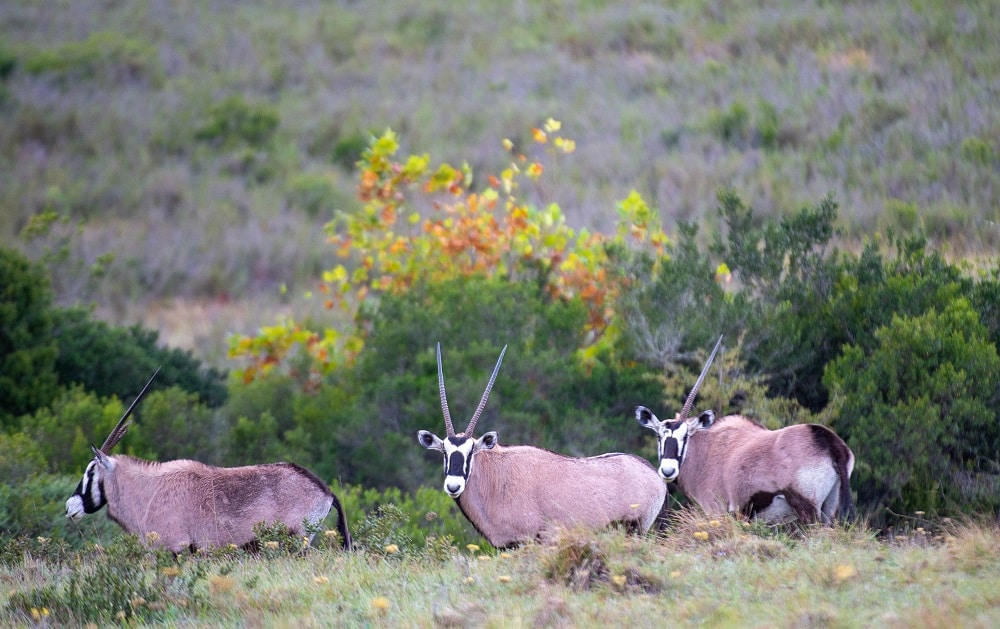
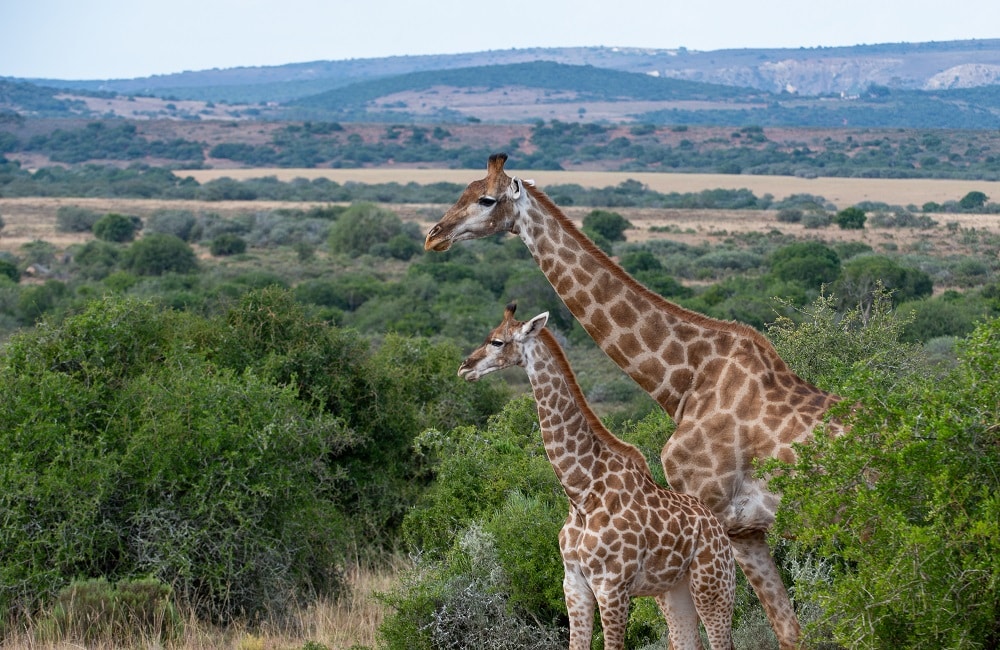
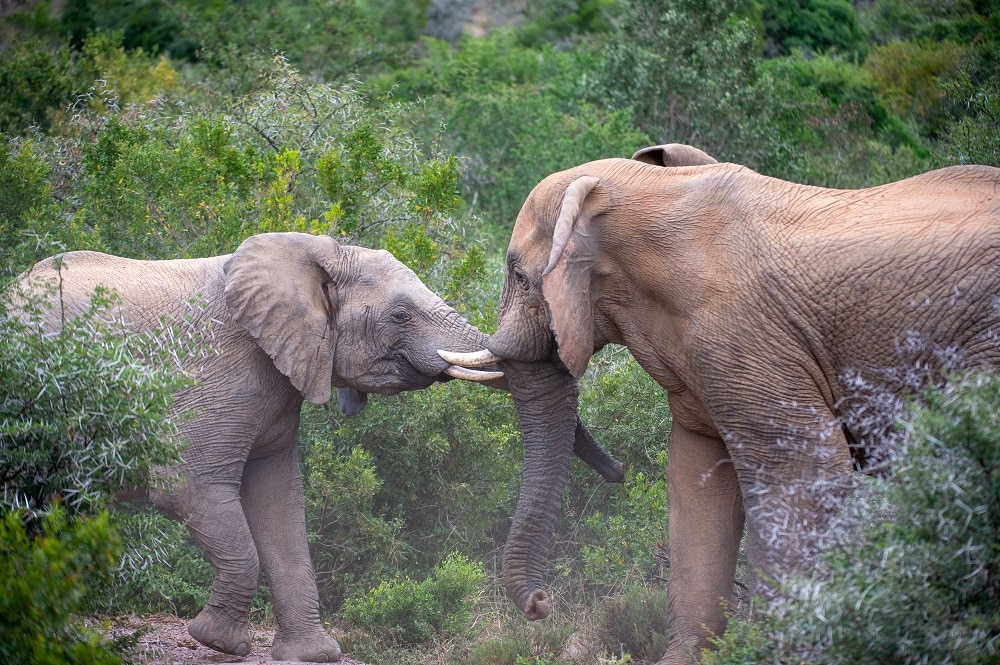
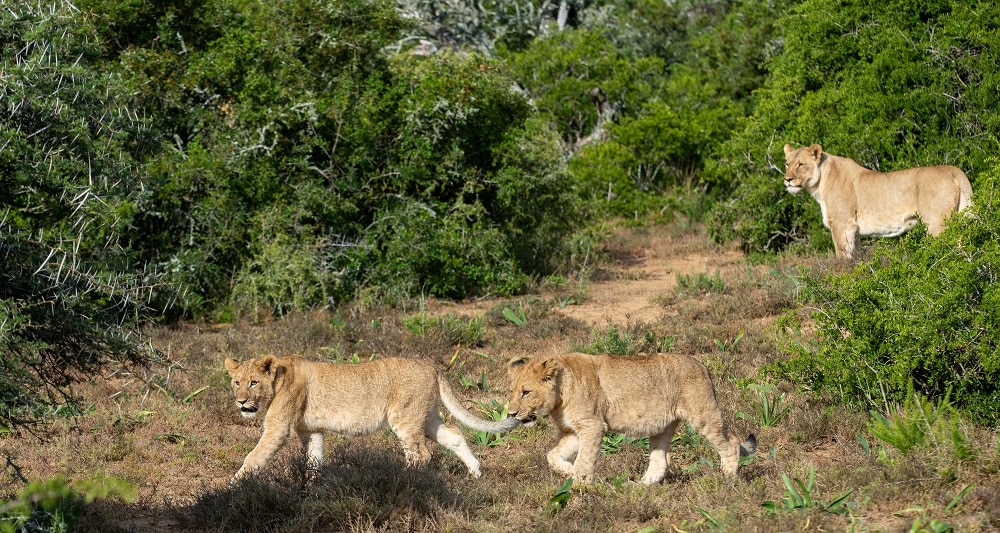
The area where you do your game drives is very interesting. The Eastern Cape is a Big Five destination but there’s no malaria which is great for families with kids, or just anybody who’s not keen on taking the malaria pills. The landscape is filled with rolling green hills with ample bushes and trees as well as open savannah. It very much reminded me of parts of Kenya, such as  Lewa and the Masai Mara. Lalibela has abundant plains game including blesbok, impala, zebra, wildebeest, nyala, amongst others. Also plenty of giraffes, good numbers of rhino and lion. We saw a herd of about 300 buffalo and on our last day we got a bit lucky and spent some time viewing a cheetah. There are probably about 50 elephants on the property as well.

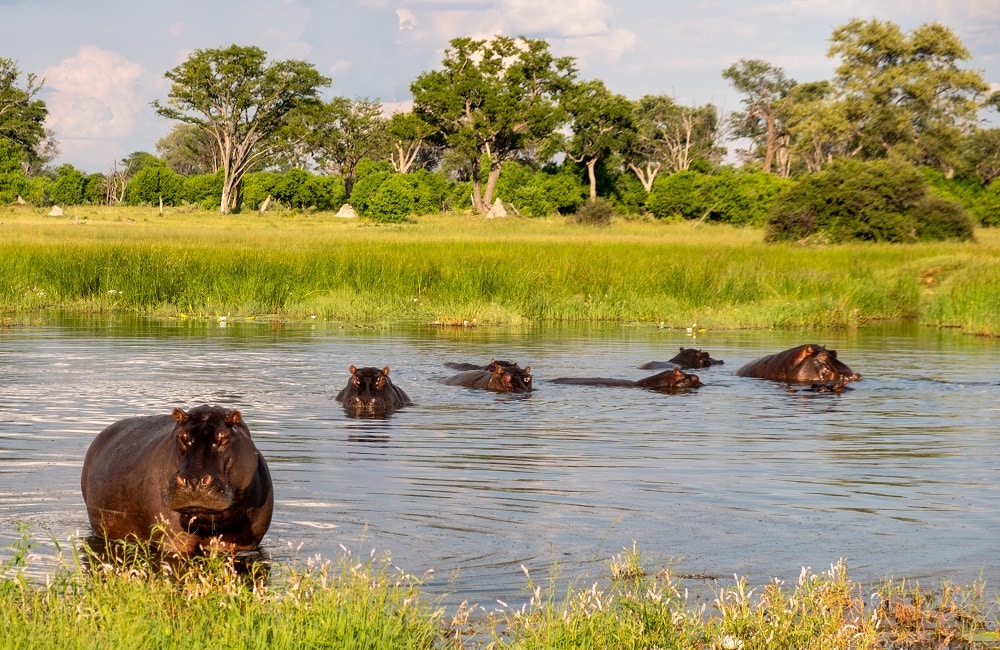
Lalibela is very interesting because it is essentially a conservation program being run as a safari destination. Their mission is to expand their acreage, rehabilitate the land, and then let the animals do their thing. It can be strange to be watching a pond full of hippos and then hearing a truck speed by on a nearby public road. I gave this some thought and although some people might find it distracting, I think it is commendable. Just as in Kenya where you’re likely to see the Maasai with their cattle grazing inside a conservancy or alongside a national park. Civilization is not something that can be easily contained but at the same time these wildlife sanctuaries can expand and thrive alongside human populated areas, creating more room for animals to inhabit. With the wildlife essentially repopulating the areas where they naturally occurred before humans displaced them.

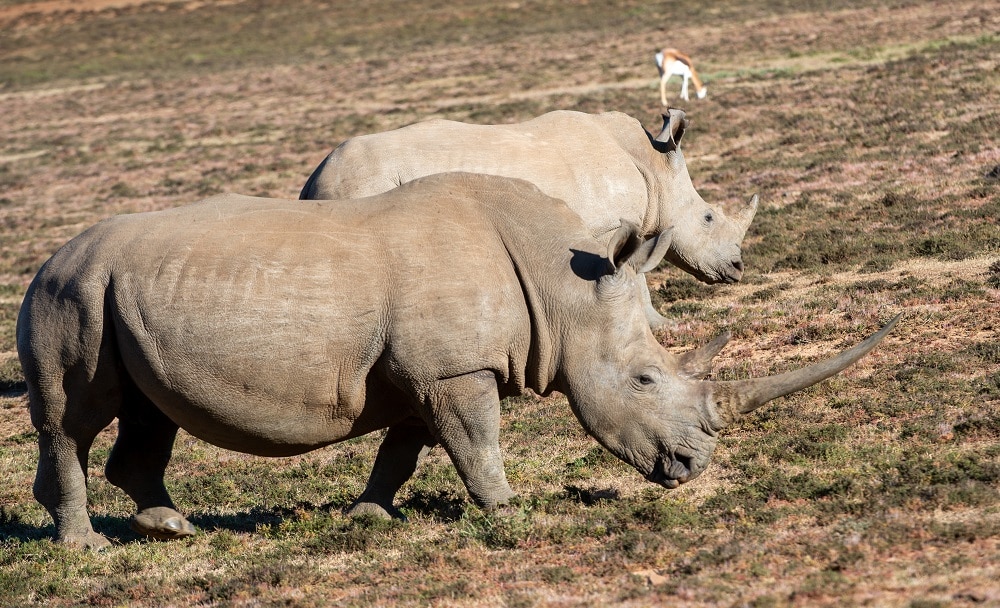
From Lalibela, we transferred by road to our next game reserve –  Kariega Ukhozi – and there were some distinct differences. Where Lalibela had rolling hills, Kariega had steep and mountainous ones. The relatively sparse bush and forest was replaced with dense, impassable sections. The open plains remained and just like at Lalibela, the wildlife were abundant. We had a great time with our guide Megan who really knew the area and the animals in it. On our first day we were able to see a mother rhino and her baby. The mother, Thandi, had survived a horrible poaching attempt some years ago. She still bore the scars of the incident but it hadn’t stopped her from giving birth to at least 6 (or maybe 7) calves. Some of whom have gone on to birth or father their own calves. That is the type of impact a place like Kariega can have. 

Just like Lalibela, Kariega was formerly farmland, devoid of many of the large mammals which have been thriving here for several decades now. At one point we were able to easily see at least eight different large mammal species from our game drive vehicle which is always a good sign. We saw plenty of kudu, nyala, blesbok, wildebeest, zebra, rhino, and probably more giraffes than I have seen anywhere else ever. We got to see lions a few times and the area, tucked between the Kariega and Bushman’s rivers, is possibly even more striking than Lalibela. 

Your guide joins you for breakfast and every third night they do a traditional meal in the boma where your guide joins you again. The food was excellent and our rooms were very spacious and included a plunge pool amongst other niceties. Overall both camps and areas impressed me.”

Lyndon and Jason can both assist with more information and trip ideas for Southern Africa, incorporating a few days in the delightful Eastern Cape reserves. Email lyndon@fisheaglesafaris.com or jason@fisheaglesafaris.com or leave a message at 1-800-513-5222 and one of us will be sure to call you back. 

YOU MIGHT ALSO BE INTERESTED IN

Destinations
Zambia

10th September 2021

Chindeni and the Bushcamp Company, Zambia

By late July we found ourselves at Chindeni, a small Bushcamp Company property

Read more
Botswana
Destinations
Okavango Delta

3rd October 2022

Camp Okavango, Botswana

Camp Okavango is in the heart of the permanent part of the Delta. In this idyllic setting there are no vehicles, and it is just a short walk

Read more
Area
Destinations
Nyerere National Park
Ruaha
Tanzania

14th October 2023

From My Safari Notebook: Wildlife Photography

Birds in flight and wildlife photographers have an uneasy relationship. Things go wrong as often as they go right. Getting focus-lock on a moving subject

Read more

SUBSCRIBE TO OUR NEWSLETTER

READERS FAVOURITES

Destinations
India

27th May 2023

India

India’s tiger, mammals and birds.

Read more
Botswana
Destinations

4th August 2022

On Safari At Belmond Eagle Island Lodge, Okavango Delta

What is the ‘secret sauce’ for an unforgettable few days on safari in Botswana? It starts with the animals, of course. The elephants, lions, giraffes, hippos

Read more
Destinations
Zambia

10th September 2021

Chindeni and the Bushcamp Company, Zambia

By late July we found ourselves at Chindeni, a small Bushcamp Company property

Read more
  • « Go to Previous Page
  • Page 1
  • Page 2
  • Page 3
  • Page 4
  • Interim pages omitted …
  • Page 8
  • Go to Next Page »

Footer

Design

  • About
  • Destinations
  • Blogs
  • FAQS
  • Team
  • Contact
All Rights Reserved ©Fish Eagle Safaris 2022 | Terms & Conditions | Privacy Policy
Designed & Developed by B Online

SUBSCRIBE TO OUR NEWSLETTER

SIGN-UP TO OUR NEWSLETTER

Subscribe Form

Footer Widget Header

Related Blogs