Northern Botswana Exploration
It has been several years since we’ve seen the Okavango Delta looking quite as pretty as it did in early July this year. Abundant rainfall earlier in the year had turned all of northern Botswana into a lush green paradise.
While the copious amounts of water in the Delta resulted in some minor logistical headaches, such as the temporary closure of a couple of airstrips, the widespread rain ended a severe drought. The rain recharged the entire region and we expect wildlife viewing conditions in northern Botswana and the greater Hwange area in Zimbabwe to remain excellent well into 2026.
On a weeklong familiarization trip in July Kathy and I visited a lodge in Chobe and three tented camps in the Okavango Delta. Overall the wildlife viewing exceeded our expectations and we enjoyed the guiding expertise, the remarkably good food and the spontaneity and warmth of the staff.

A & K Sanctuary Chobe Chilwero
A & K Sanctuary are one of a select group of safari operators whom we rely on to deliver a consistently excellent guest experience all the time, every time. Their standards are exceedingly high and whether it’s the guiding, the food and beverage, the accommodation or the front of house experience, A & K gets it right year in and year out.
It was no different on our recent visit to A & K Sanctuary’s Chobe Chilwero Camp which we include in many Botswana safaris, often as an extension from Victoria Falls. Right from the warm arrival experience, succinct new guest briefing through to a splendid private dinner on our patio to a couple of outstanding boating excursions in the Chobe River, our brief stay at Chobe Chilwero was impeccable.


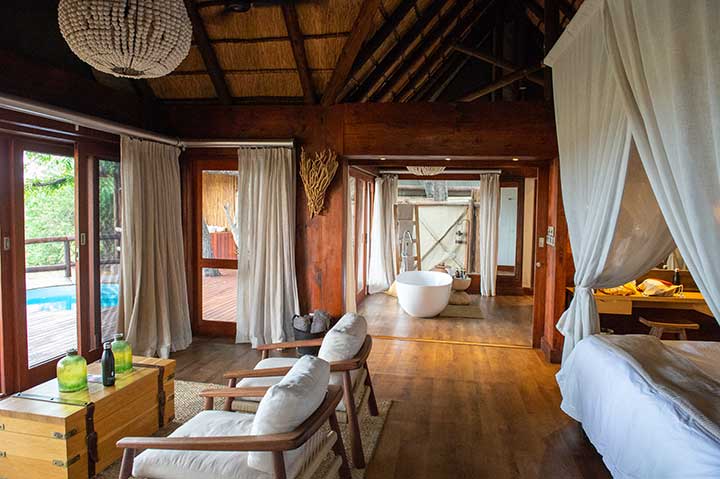
The imposing individual rooms are about as well appointed and comfortable as it gets in the luxury safari lodge category. Nothing is lacking, from a massive mosquito net clad king size bed to a huge standalone tub, indoor and outdoor shower, air conditioning and more.
Activities include game drives into Chobe National Park and boating excursions on the Chobe River. Our advice to all Chobe visitors is to prioritize boating on the Chobe River as it provides a different and novel alternative to game drives. From a boat, you’ll have a unique perspective looking out from a stable platform towards the shoreline and the animals and birds usually congregating there. In the dry season you’re likely to see large numbers of elephants right at the water’s edge and often in the water, sometimes swimming to some of the islands between Botswana and Namibia. It was no different this time. We managed to fit in two boating trips while at Chobe Chilwero and both were entertaining and fun. We had some of our best views ever of elephants walking – and swimming – in the river and with the light at our backs the photographic results were stellar.

Brave Africa
On our first night with Brave Africa on a mobile tent safari in the Khwai region of northern Botswana, we sat around the campfire prior to dinner and one after another we started to hear the old, familiar night sounds of Africa, rising above the crackling of the igniting mopane wood. The sharp clinking of several painted reed frogs emanating from the reeds lining a small stream right in front of camp. The call of a barred owlet announcing the start of its day. Two hippos honking. First just one and then two hyenas exchanging their whooping calls. And finally, from across the Khwai River in the Moremi Game Reserve, the unmistakable roar of a lion. Memories of past experiences came flooding back into our conscious minds and just like that we were on safari, without budging from our camp chairs.
So often on safari nowadays the sounds of the wilderness are silenced by the hum of air conditioning or shut out by walls and window panes. Not so on a mobile tented expedition. Nothing more than canvas between you and whatever you can imagine is out there. Soft footsteps close by, shrill elephant arguments in the background – it’s a new script every night and you’re in it.

It had been a while since Kathy and I experienced a proper camping safari. We enjoy a touch of luxury as much as anyone but we’ve never quite lost our affection for a more spare, back to basics experience. With less in the way of luxury trappings and more contact with the wilderness. A pure safari experience, some might say.
Lately we’ve had several travelers ask us about low-cost/high-adventure safari options. Of the type where you spend a few nights in basic tents but with a flush toilet, a more than comfortable bed with proper cushions and most importantly – top notch guiding.
We think we found just that in Brave Africa, a Botswana owned company headed up by head guide, president and owner Tabona Wina. ‘Just call me Wina’. Brave Africa’s mobile tented safaris range from 3 nights in one area such as Khwai to as many as 9 nights in three areas including Xakanaxa, Khwai and Savuti.


Praise from all of our guests who have spent time on safari with Brave Africa over the last few months has been effusive.
“Brave Africa with its mobile tents and no wifi or electricity was exactly what we wanted for part of our trip. One night a fleeing animal ran head-long into my tent and another night lions made a kill about +/-50 yards from our campsite. The owner/guide Wina had a crew that he’d managed to keep through COVID and that was fiercely loyal to him. The entire setup was everything any guest could hope for including a chef that made bread that I still dream about.”
***
“If you ever decide to go on safari, I highly recommend spending time in a remote, mobile camp, most specifically Brave Africa. Aside from the exhilaration of seeing very large, dangerous beasts in their natural environments, the tranquility, serenity, and pure joy you will experience off the grid is priceless.”
Wina is the Owner/Guide/Elephant Whisperer of Brave Africa. If I had only one word to describe Wina, it would be passionate. His affinity for elephants is palpable, even down to the sterling silver elephant charm he wears around his neck. However, his incredible knowledge of Botswana’s animals, reptiles, and birds does not stop there.”


We think that Brave Africa and a couple of other mobile camping operators in Botswana will appeal to guests who are keen to experience the wilderness under canvas in an authentic, classic manner. Where the focus is mostly on what happens outside the tent.
Our two-night stay was certainly memorable and mostly so because of Wina and his crack staff. They keep things interesting by moving guests around for meals and pre dinner drinks; even the fireplace was in a different spot on day two. Wina is affable, witty and knows how to impart knowledge in an entertaining, non-pedantic manner.
Game viewing in the Khwai community area is predictably good and the highlights were getting really close to many large bull elephants and several small breeding herds. There were pretty good numbers of zebras and wildebeest around and we were most fortunate to also see and photograph some African painted dog pups at their den. We also came upon the aftermath of a small group of the dogs taking down an impala. Some close up views of a young rock python in a tree livened up a quiet morning drive.

Machaba Camp
Our first afternoon game drive from Machaba Camp into the Moremi Game Reserve was the stuff that safari dreams are made of. The experience that makes up for the slow days. That keeps you coming back for more. And makes you realize once again just how special northern Botswana is.
The start of the drive was inauspicious at best, with the road passing right by the fairly busy Khwai village with pedestrians afoot and vehicles coming and going. We were not too concerned, knowing that the objective of the drive was to reach a large pride of lions; the ones we heard from camp the previous night.
Once we had entered the Moremi Game Reserve, everything changed. For the next hour plus we drove through a simply stunningly beautiful area, a series of golden-hued grassy pans slowly filling up with water. Sticking close to the treeline, one and then another and another huge expanse of untouched floodplain slid by. Each as beautiful as the one before.
Quite remarkably, for just about the duration of the drive within the reserve, we were never beyond sight of wildlife. Most prominent were the elephants. Several large herds of them, moving mostly out of the floodplain on our left and into the woodland on the right. At one point a recalcitrant matriarch blocked the path and we had to take five. Elephant delay.


In addition to the elephants, an impressive array of plains game vied for our attention. Reedbuck. Lechwe. Zebra, wildebeest, warthogs, impala and waterbuck. Many of them perfectly lit in the soft afternoon light. Ground hornbills, hyenas and giraffes in the far background. We had a few Australian guests in the vehicle with us and they were as thrilled as we were. Not only with the abundance of animals and birds but even more so the grandeur of the Moremi landscape after a bumper rainy season. It was simply spectacular and reminded me a lot of driving through the Mara Triangle in Kenya a couple of years ago.
When we finally reached the pride of lions, the light was deteriorating rapidly but we managed some good exposures nonetheless, particularly of a young cub clambering on top of a termite mound. The adult lions were either obscured by bushes or facing the wrong way or just not in the right spot. Just as I was starting to think that a golden opportunity was slipping away, the truly unthinkable happened.

As our guide was backing up the vehicle to turn around for the long drive back to camp, we saw a female lion biting down on what looked like a dark round object. “Stop! Stop!,”we yelled. “It’s a pangolin!”! Of all the clearings in all of Botswana, this hapless pangolin had emerged from a thicket and walked straight into a pride of 20-something lions. A female and then a male lion took turns, giving it their best shot to pierce the pangolin’s hard scales. A pangolin rolled up in a tight defensive ball is all but impregnable, as we could clearly see. Despite one or two ominous cracking sounds, the pangolin withstood the onslaught. By the time we had to leave for camp it was still tightly rolled up and our guide predicted that it would survive the ordeal. The Australians had not only seen their first pangolin: they had seen it in the jaws of a lion.

Machaba camp turned out to be right in our wheelhouse in terms of style and substance. It was a comfortable ‘classic plus’ category tented camp with a friendly, easy-going atmosphere and exceptionally helpful staff members. The food was excellent and varied for both lunch and dinner. The king size bed in the large tented room was super comfortable with soft pillows and the room had a separate shower and toilet. The water pressure was off the charts which scores any camp major bonus points in my book. There was a standing fan and a desk as well, and more than adequate lighting.
On our last morning Machaba surprised us with a delightful bush brunch complete with food laden tables and comfortable couches.

Mokolwane camp
In search of a reasonably priced Botswana property with consistently good to excellent big cat viewing and a realistic chance to see African painted dogs? Look no further than Natural Selection’s Mokolwane Camp in the southwestern part of the Delta. Mokolwane is an adventure style, basic tented camp, essentially constructed of khaki-green canvas supported with sturdy round poles. In addition to a compact main area split between a small lounge and dining room, there are 6 good sized rooms with en suite showers and separate toilets, as well as one family room. From our room (#7), which is the furthest one from the main area, we had a good view over the seasonally inundated floodplain in front of camp. A sturdy boardwalk connects the main area with the tents.
We thought the food at Mokolwane was excellent throughout, starting with some vegetarian quesadillas for afternoon tea on the day we arrived.

Painted dogs on the hunt
On our first afternoon in camp, we set out for an African painted dog den after a short boat ride from the camp to where the game drive vehicles were parked. As always the painted dog experience did not disappoint. There were about 5 or 6 tiny two-and-a-half-month-old pups excitedly running around, trying to join the pack on a hunt. It wasn’t going to happen. Ever so gently but firmly they were herded back to the den to join their younger (one-and-a-half-month-old) siblings.


A painted dog chase is the holy grail of wildlife viewing. Theater of nature. On this day the drama unfolded slowly at first. The pack of 17 dogs split up into groups, trotting and sometimes bounding through the floodplain, woodland and brush. Two of them pausing on a hillock, perfectly lit, looking left and right. Others circling back, employing every ounce of their instinct and razor sharp senses to locate their prey. We followed as best we could with our guide demonstrating remarkable skill as he somehow managed to stay within striking distance of the action. It was fast and furious with blurred blobs of black, white and gold often the only indication of the state of the hunt. The end came swiftly for one hapless impala. Fortunately we were just far enough away to be able to experience the thrill of the chase without having to be confronted with its harsh outcome.


The big cats of Mokolwane
The big cats of the Mokolwane area of the southwestern Okavango Delta have been featured in a couple of highly acclaimed wildlife documentaries such as Big Cats 24/7 (BBC and PBS) and the Netflix documentary ‘Living with Leopards’ directed by Brad Bestelink. Bestelink and his team as well as a BBC wildlife documentary team are still filming in the area.
It took us a while to find them (the grass in the Mokolwane area being quite high after the bumper rainy season) but an hour or so into our first game drive I had the Z-9 pointed at two extraordinarily beautiful male lions in the prime of their lives. We ended up spending the better part of an hour with the two dominant males of the Xudum pride. Two of the adult females of the pride were not far away. In all that time, not another vehicle showed up for the sighting. This was very much representative of our experience at Mokolwane. Guests can look forward to having few other cars and people around in a vast and beautiful area of the Okavango Delta.
On our afternoon game drive we came across the slender Xudum female leopard emerging from a thicket where she had been concealing her 1.5 month old cub. The sleek leopard, clearly totally nonplussed by our presence (she’s a movie star after all), calmly walked back to the tree where she had stashed an impala carcass the previous day.

The following morning we went off in search of cheetahs but found the two dominant male lions again. Stealing the show, a powerful and very vocal female lion showed up, calling loudly several times while walking steadily through the bush, apparently on her way back to her cubs. We enjoyed yet another sighting of the famous female leopard on the way back to camp.
Overall, and based only on our one brief 2-night early July stay, it seems that Mokolwane is a great choice for guests who want to maximize their chances of seeing lions, leopards and cheetahs. As well as painted dogs with at least one thriving pack of dogs being present in the area.
We did see a fair number of elephants and general wildlife in the area but we think that the best reason to include Mokolwane on any itinerary is definitely its abundance of predator species.

Monachira Camp
Say ‘Botswana safari’ and almost invariably ‘Okavango Delta’ comes to mind. Understably and predictably so as the Okavango Delta is the crown jewel of northern Botswana tourism. As it turned out our last stop on the July familiarization trip was Monachira, Machaba’s newest camp. Monachira is named after the Monachira channel which flows right by the camp, year round. Which makes Monachira a good choice if you want to experience typical water activities such as mokoro outings and boating, any time of the year.
The rooms and common areas at Monachira were excellent and the staff were super friendly and accommodating. There’s a pool and camp guests can make use of the services of a massage therapist. While they don’t have air conditioning, the rooms are well ventilated with a large fan right over the bed.

On our first afternoon, we enjoyed a quiet scenic boat ride along the strong flowing Monachira River. It was a quiet outing, with impressive stands of papyrus, reeds and pampas grass lining the edges of the channel. While we only saw some giraffes and red lechwe from the boat, other guests – who had spent several days at Monachira – were thrilled with the quality of the game viewing. The upper deck of the boat provides a good vantage point for bird photography, notably at a nearby heronry where we had some good views of marabou storks. The heronry is at its most active later in the dry season. Notably, there was only one other boat in the channel (also from Monachira) and there was no sign of human habitation or presence. With Monachira camp being inside the Moremi Game Reserve, fishing is not allowed.

The following morning we came across a coalition of two male lions around 7 years old. The two handsome, black maned cats – the dominant lions in the area – were not in an ideal spot for photography, but I captured a couple of profile pics nonetheless. The area right around Monachira camp was quite productive that morning, with several giraffes, herds of wildebeest and tsessebe and small groups of zebras. We were happy to see a pair of side-striped jackals, not as commonly seen as the blackbacked jackals. While we missed them on our short stay, leopards are being seen in the Monachira area as well. So all in all Monachira is a good bet for a mixed activity experience in an area of the Okavango Delta where boating and canoeing are not affected by seasonal fluctuations in water levels.

For more information about traveling to Botswana, email Bert at bert@fisheaglesafaris.com or call and leave a message with our answering service at 1-800-513-5222 or 713-467-5222.

Molokwane camp photo courtesy Natural Selection, Machaba Camp photo courtesy Machaba
YOU MIGHT ALSO BE INTERESTED IN
10th September 2021
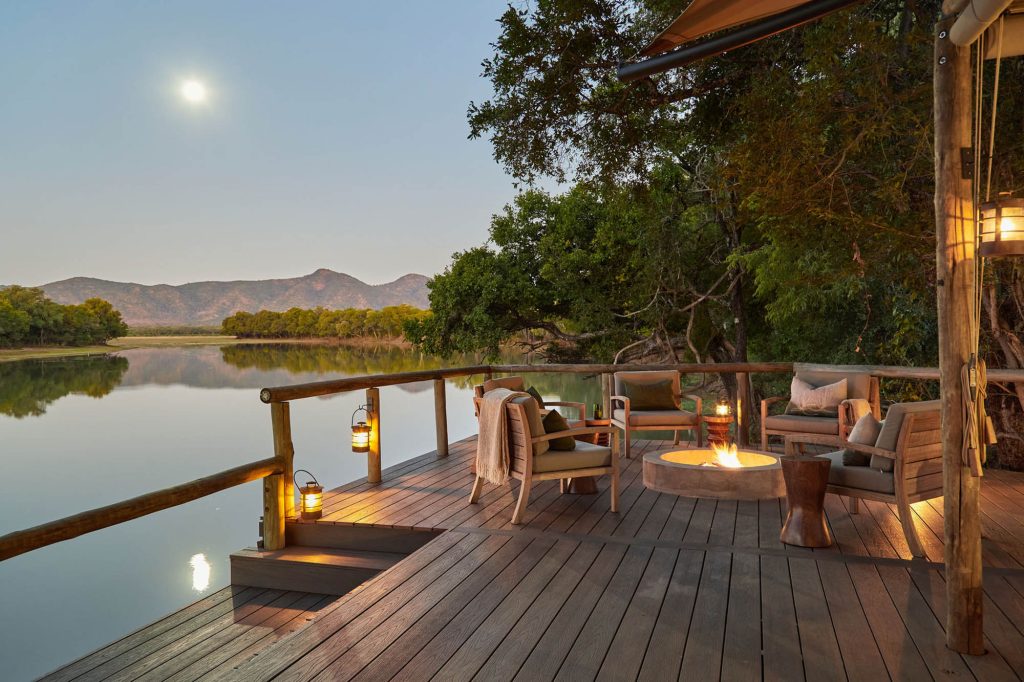
Chindeni and the Bushcamp Company, Zambia
By late July we found ourselves at Chindeni, a small Bushcamp Company property
3rd October 2022
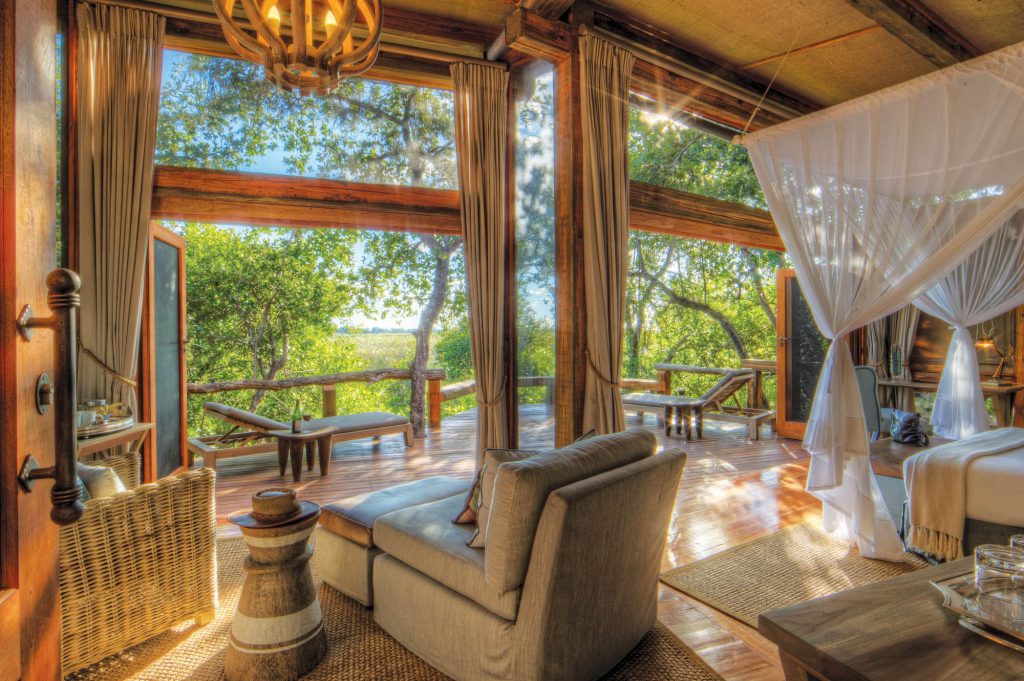
Camp Okavango, Botswana
Camp Okavango is in the heart of the permanent part of the Delta. In this idyllic setting there are no vehicles, and it is just a short walk
14th October 2023
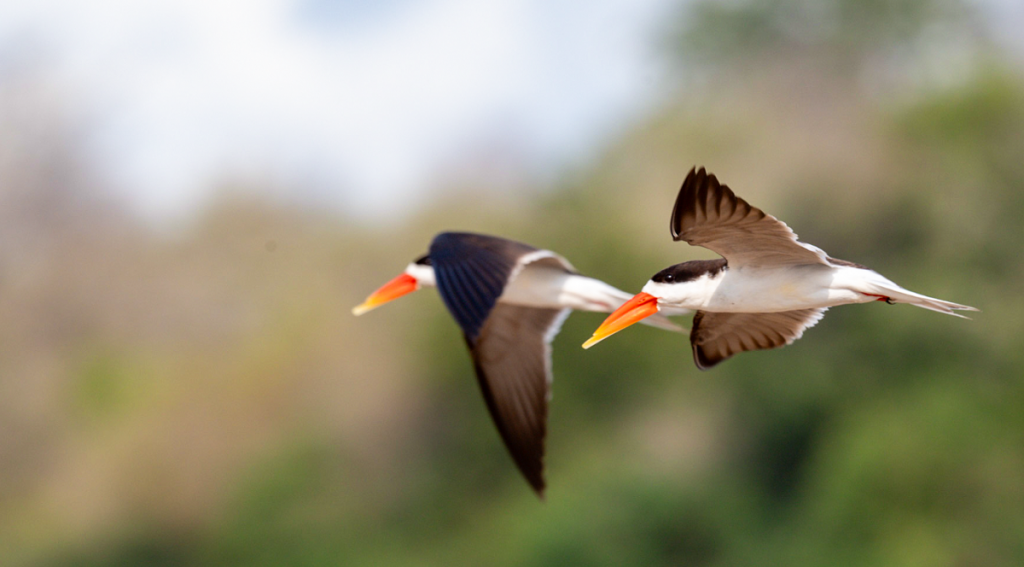
From My Safari Notebook: Wildlife Photography
Birds in flight and wildlife photographers have an uneasy relationship. Things go wrong as often as they go right. Getting focus-lock on a moving subject

SUBSCRIBE TO OUR NEWSLETTER
READERS FAVOURITES
4th August 2022
On Safari At Belmond Eagle Island Lodge, Okavango Delta
What is the ‘secret sauce’ for an unforgettable few days on safari in Botswana? It starts with the animals, of course. The elephants, lions, giraffes, hippos
10th September 2021
Chindeni and the Bushcamp Company, Zambia
By late July we found ourselves at Chindeni, a small Bushcamp Company property