• Skip to primary navigation
  • Skip to main content
  • Skip to footer

Fish Eagle Safaris

Fish Eagle safaris

Contact

Logo
  • About
  • Destinations
  • Blogs
  • Newsletter
  • FAQS
  • Team
  • search
  • Contact
  • About
  • Destinations
  • Blogs
  • FAQS
  • Team
  • Contact

Eastern Cape

A Return to Samara Karoo

31st July 2026

A Summer Winter in Africa: Part 7

A Return to Samara Karoo

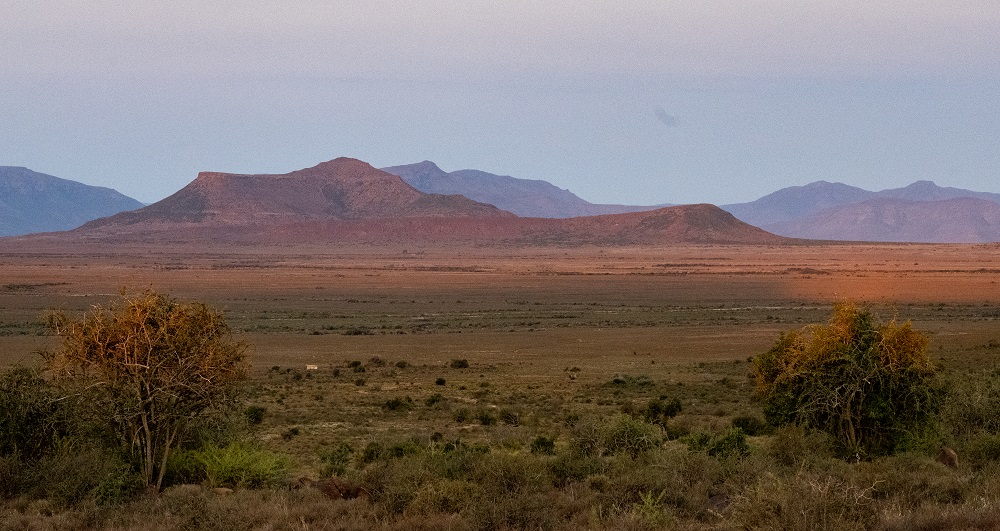
A few of my Samara Karoo photos from our second (June 2026) visit to the stunning  Karoo Lodge looked like they were taken on Maui. The area had experienced abundant rainfall over the last several months which turned the ordinarily sparsely vegetated semi-desert area into a lush paradise, particularly along the rivers and streams. Even the shallowest of depressions turned into mini-lakes. 

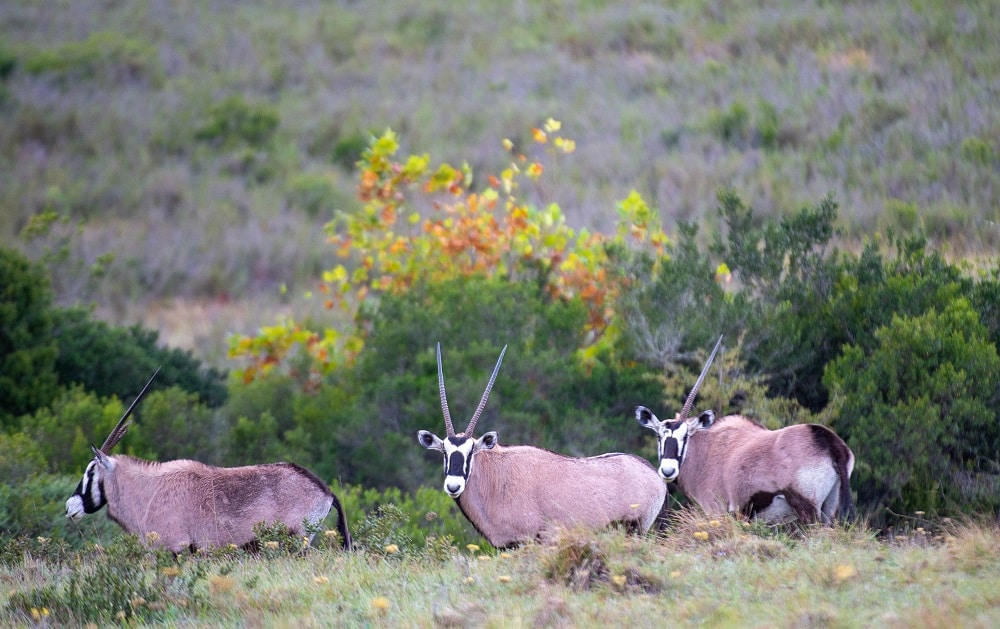
What really set the photos apart though, was the backdrop. The beautiful Camdeboo Mountains of the Great Karoo. Almost immediately I started seeing mammals with mountains in the background. Great big beautiful blue painting-worthy mountains just sitting there. There’s not more than a handful of other safari locations anywhere in Africa where photos and videos like these can be taken. Elephants, giraffes, oryx, waterbuck and – wait for it – cheetahs with mountains behind. Next time – lions.  

Cheetahs on foot

The signature Samara Karoo experience is seeing cheetahs on foot. On our first visit in 2024 we ran out the clock looking for them, the issues being too little time (a 2-night visit) and a particularly windy day which resulted in the cheetahs seeking cover in the hills. The second time was the charm. It took a couple of hours but our capable team of Mzi (naturalist guide) and Michael (tracker) located a female cheetah with six cubs along the far eastern edge of the reserve.  

Alighting from the Land Cruiser, we approached the cats on foot, quietly and slowly so as to not alarm or disturb them. The sun was already high in the sky so the light was quite harsh. Even so I managed a few captures of the mother and one or two of the 7-month old youngsters.  

Being on foot quite close to them was a novel experience. Cheetahs are pretty special cats to see under any circumstances and to be able to approach them like this was next level. Getting right down in the damp Karoo vegetation, I had several furry faces casually looking in my direction at their eye level. Mostly, to be sure, they ignored the camera and focused on being cheetahs in the Karoo. The activity is done in a circumspect manner so as not to alarm or displace them.
Picnic on the Kondoa Plateau

From the cheetahs on the Camdeboo plains we drove right up into the slopes of Kondoa Mountain along a gravelly, at times bumpy, track taking us about 2,000 feet up into a quite different habitat: montane grassland. Sometimes referred to as the Samara Mara, the Kondoa Plateau is a haven for animals such as the Cape mountain zebra, black wildebeest, eland, springbok and gemsbok. On a previous trip up to the same spot, we came upon a fresh lion kill (an eland) just off the mountain track. Not so this time, but we had several good sightings of the very special mountain zebras and black wildebeest.

Unbeknownst to us a culinary team from Samara had set up an elaborate al fresco lunch for us and all the other Samara guests, complete with tables and chairs, umbrellas, a wash-up station and a small bush loo. What they didn’t have to set up or bring from camp was the view. It was there and waiting in every direction. The most stupendous views one could ever hope to see, over the Camdeboo valley to the left and Honey Mountain in the far distance. The food was pretty good too: beef kabobs, curried chicken sandwiches, mini quiches, apple crumble mousse and a mixed green salad.

Walking with giraffes – and more cheetah photos

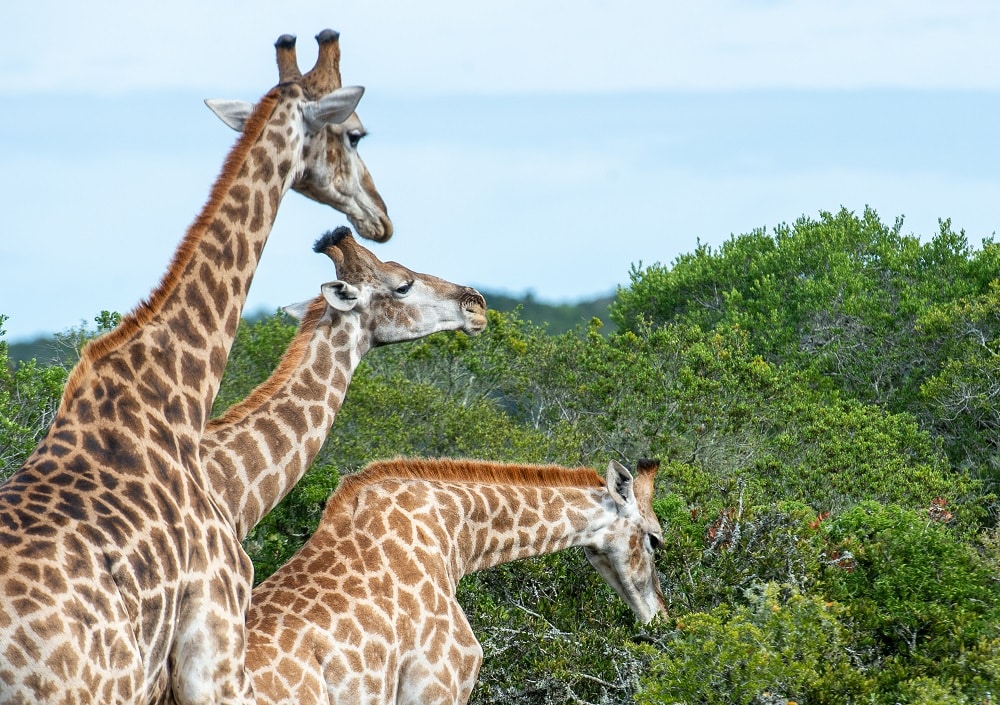
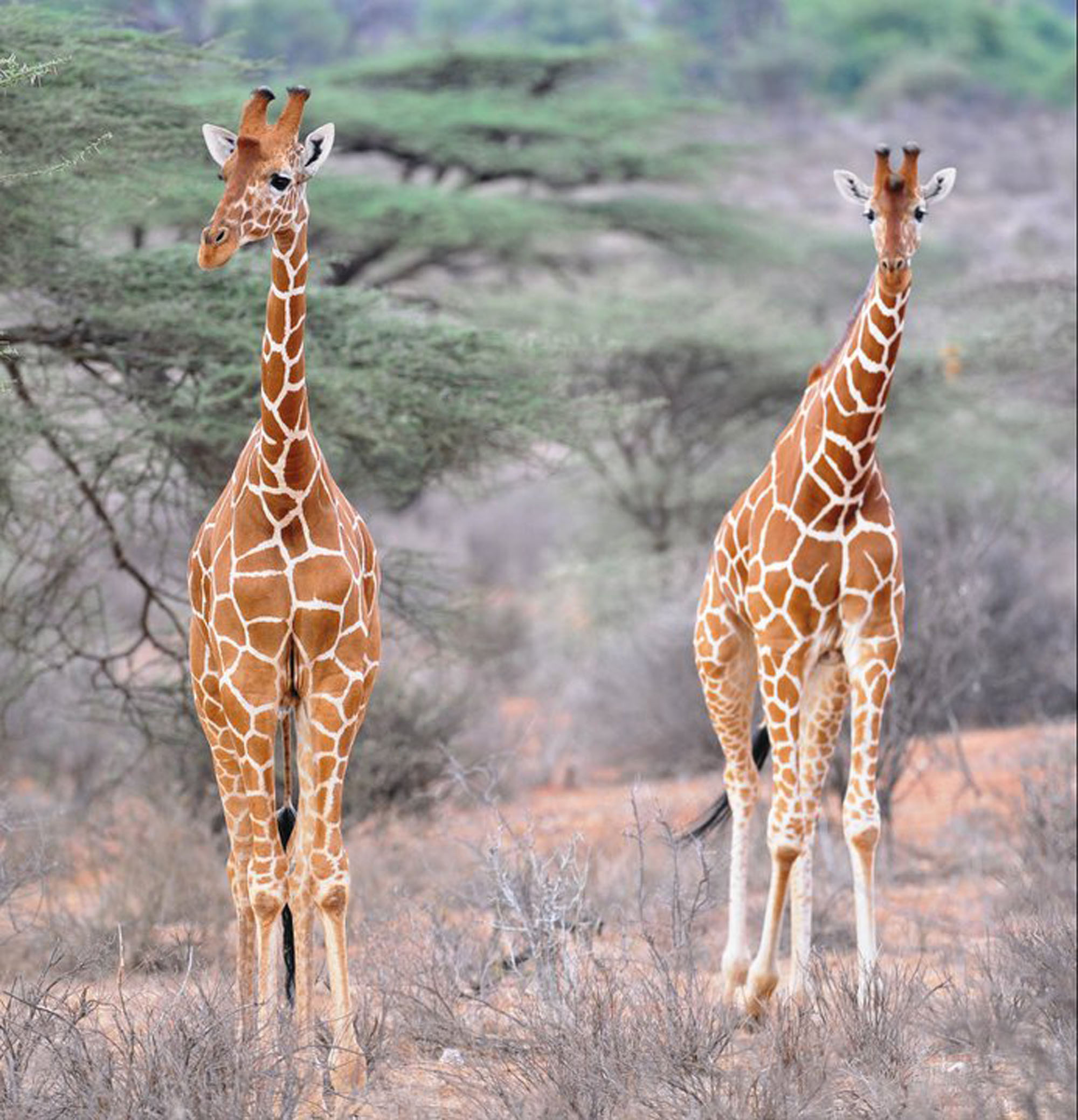
Back on the plains we bumped into a journey of nine giraffes. I was on a quest to get a few more Samara mammal images with mountains in the background and this looked like a good opportunity. To get the right angle, I asked Mzi to stop the vehicle and I hopped off, walking some 50 meters or so to the left of the track. The moment we got out of the vehicle, every single one of the giraffes stopped and turned their heads in our direction. I was quietly hoping that they would move closer together  which they promptly did. In the end I managed a few good exposures with more than just one long neck in the frame. And, as importantly, with mountains in the background!

After promptly dealing with a flat tire, we made our way back to where we’d last seen the family of cheetahs. This time around the late afternoon light was ideal. Spending almost an entire hour observing them with nobody else around was one of the highlights of our stay at Samara. While the cheetahs were not particularly active or highly mobile there were plenty of photo opportunities. As close as we were to them, we were able to truly appreciate the close bond between siblings and collectively with their mother. They were purring and snuggling up to each other and the strength of the familial bond was quite apparent.  

Lions in every direction

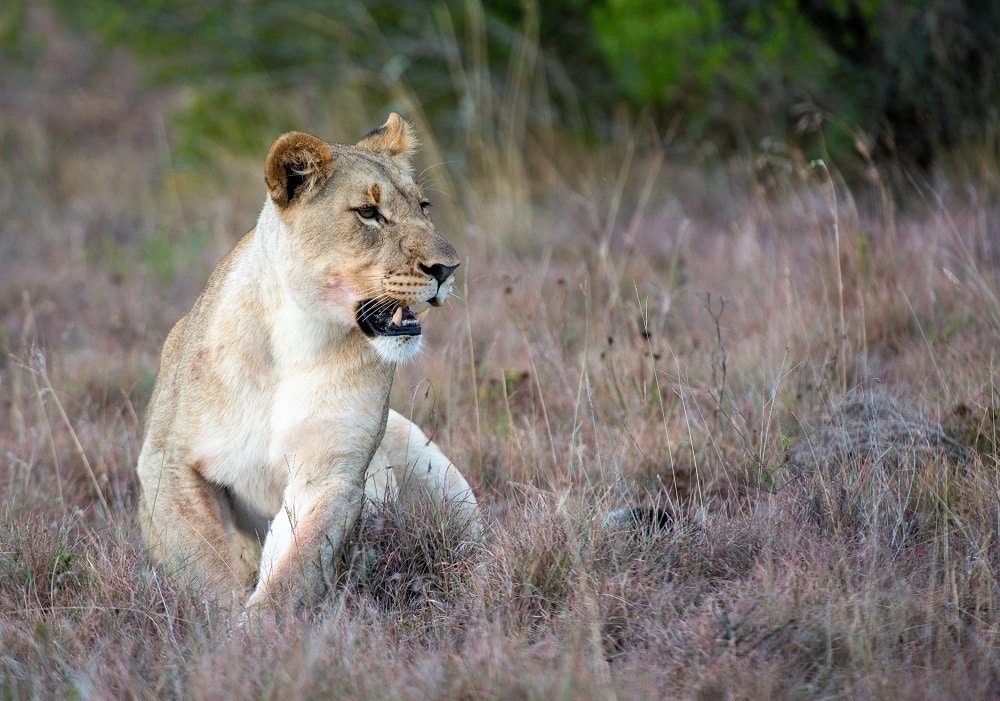
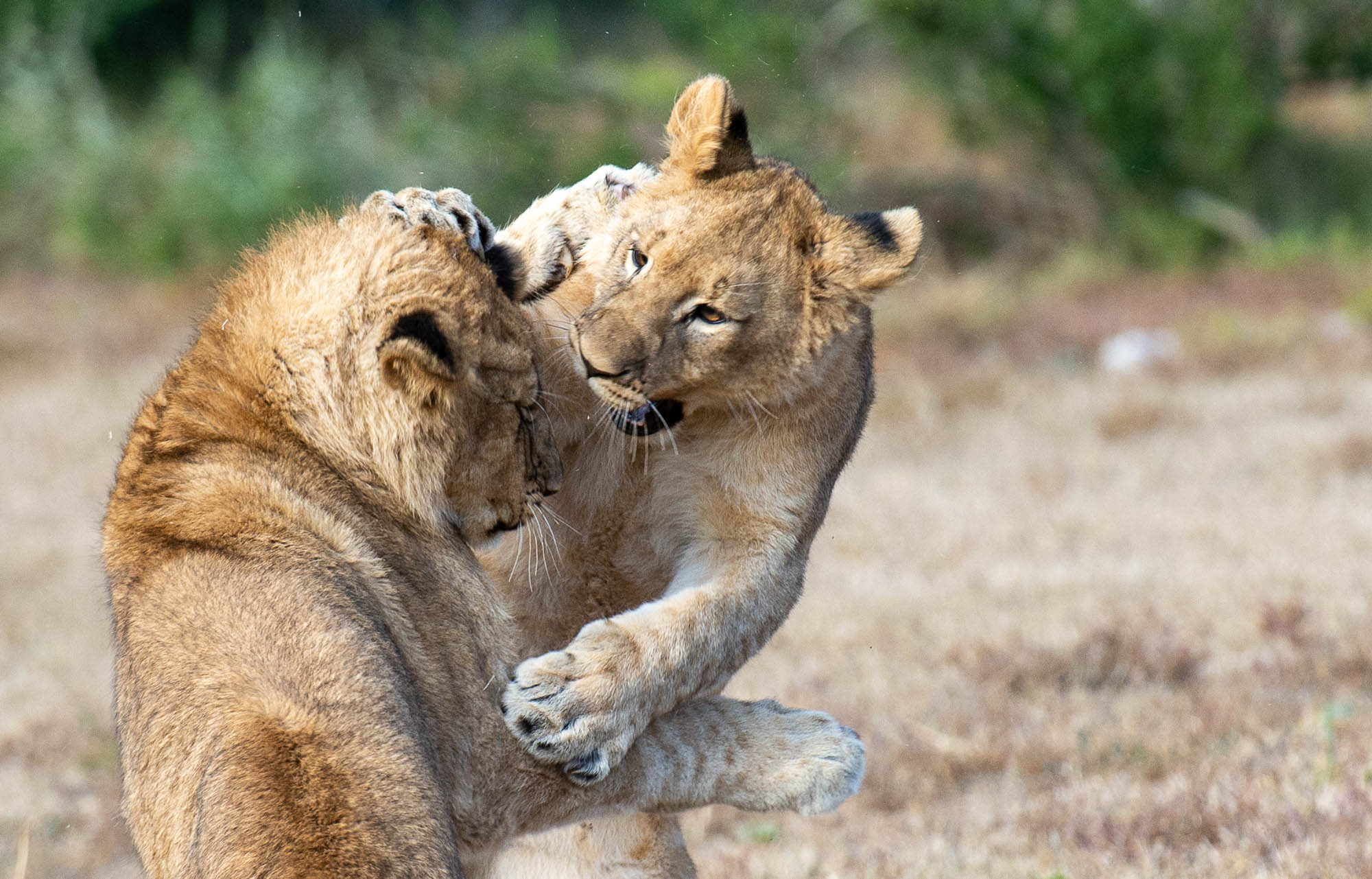
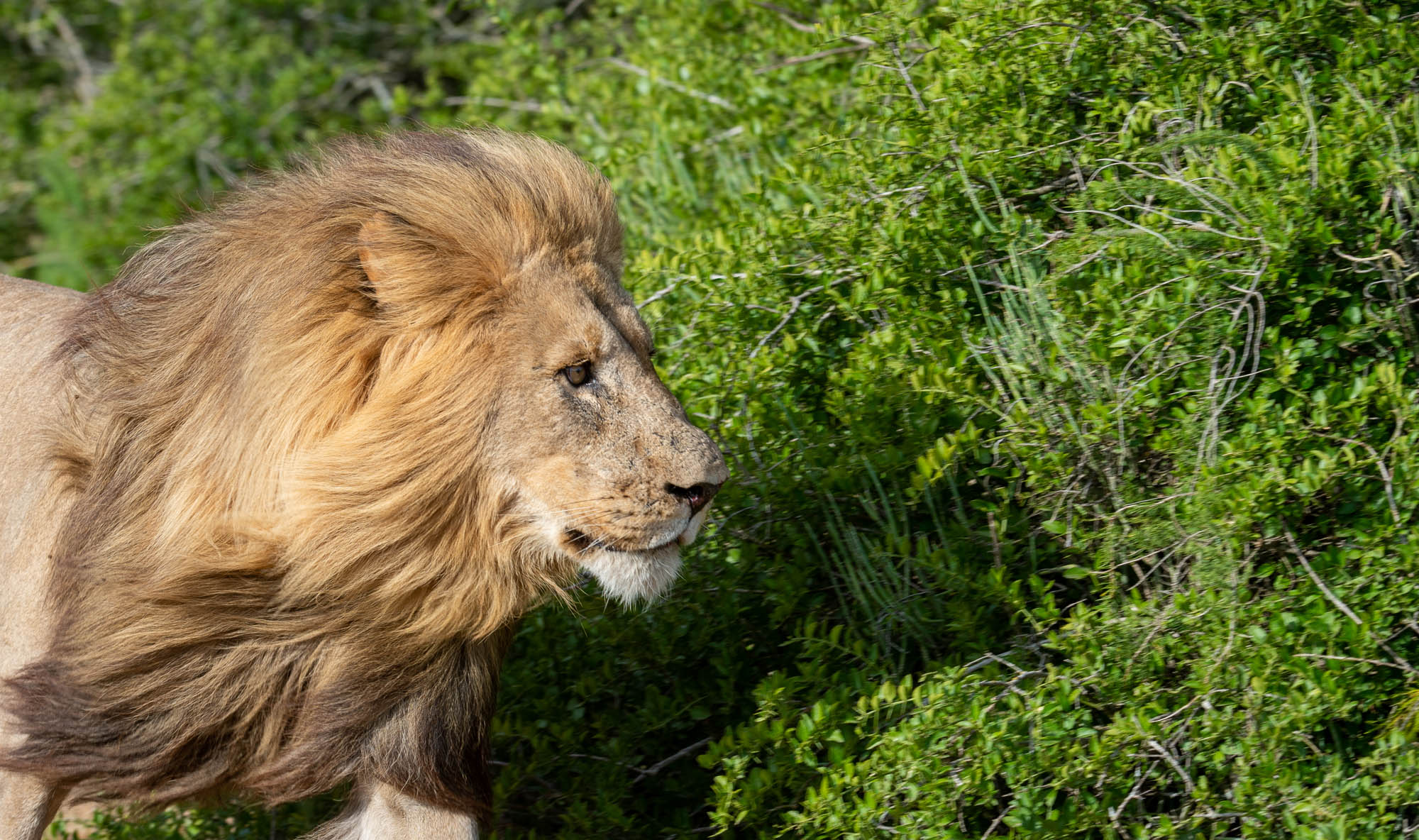
No African safari is truly complete without a lion sighting. On our second full day at Samara we were all geared up for a walking safari when two male lions caught our attention. They made it quite impossible for us to ignore them with a ‘competitive roaring’ display like none we’ve ever heard before. First the dominant black-maned Kalahari lion – which had the run of the reserve the last few years or so – started roaring not far from camp. This was shortly followed by an equally vociferous roaring display by an interloper, an equally impressive tawny male which had recently expanded his range. The new arrival was now challenging the established male for mating rights with the female lions, creating an ongoing conflict, which is what we inadvertently stumbled into. We promptly pivoted from walking to following roaring lions around. An easy decision. Anticipating a clash, we followed the dominant male as he stalked through the woodland, determinedly marking his territory. 

When the dominant male suddenly veered off in a different direction our focus shifted to the intruder. To be sure, this powerful male lion was not acting like an intruder at all. He was lying on a rocky slope in broad daylight, roaring away at the top of his clearly powerful lungs. It was a territorial roaring display for the ages. At one stage he was roaring and continued to do so while lying on his side and rolling over on his back. All of which were signals  to his rival that he was not about to back down. The saga continues.

A different group of cheetahs

On our final afternoon game drive at Samara, we came upon a different group of four subadult cheetah siblings. It ended up being an equally good sighting with the four cats moving from our right to our left in beautiful light, and with mountains in the background. Watching them gracefully move through the grass, barely glancing in our direction, was nature at its finest. Eventually they moved right by us toward an old brick structure, a relic from pre-Samara days when the area was a sheep farm. Clambering up the crumbling structure, the cheetahs did what cheetahs do: found a high spot to check for potential prey animals in the distance. It was getting dark so we left them behind and started the trip back to camp. It was the end of a great day on safari. 

A fence is not just a fence

Fences have been coming down in wildlife sanctuaries all over Africa and elsewhere for many years now. There is general agreement that wildlife does better and survives better when they can move around freely. When mammals are able to move from one area to another for grazing or browsing, it allows grasses and other vegetation to recover and it prevents long-term damage to the environment which can take decades to recover.  

At Samara, internal fences separating former livestock farms were likewise dismantled to allow seamless animal movement. The reserve’s high perimeter game fences – which visitors see when entering and leaving and occasionally during game drives – were erected to prevent human-wildlife conflict on neighboring livestock properties. If Samara’s wild lions or elephants were to make it onto neighboring farms, the consequences could be severe, perhaps even leading to retaliatory killing. In an environment like the Karoo and elsewhere, it makes effective conservation virtually impossible without perimeter separation. 

It’s understandable, even predictable, to instinctively dislike high fences in natural landscapes. Superficially, it creates an impression of a private enclosure which runs contrary to the idea of “wild” Africa. However, it is best to think of a fence as a temporary shield. Right now, in many places all over Africa, wildlife surrounded by farms or towns won’t survive without a border to stop poaching and retaliatory killing. These fenced reserves serve as safe refuges where ecosystems recover. The ultimate goal isn’t to lock the animals  in forever. Rather, the long-term objective is  to secure these pockets today so they can be linked into open corridors later.  

In an increasingly fragmented world, these protected, isolated pockets are a vital element in the future of conservation. Samara’s overarching vision is to establish ecological corridors connecting the reserve to three nearby national parks, namely Camdeboo, Mountain Zebra, and Karoo National Park. When this comes to fruition it will form a massive 1.3-million-acre protected area. Sufficient conservation space to restore historical wildlife migrations while allowing sustainable agriculture alongside protected wilderness.  
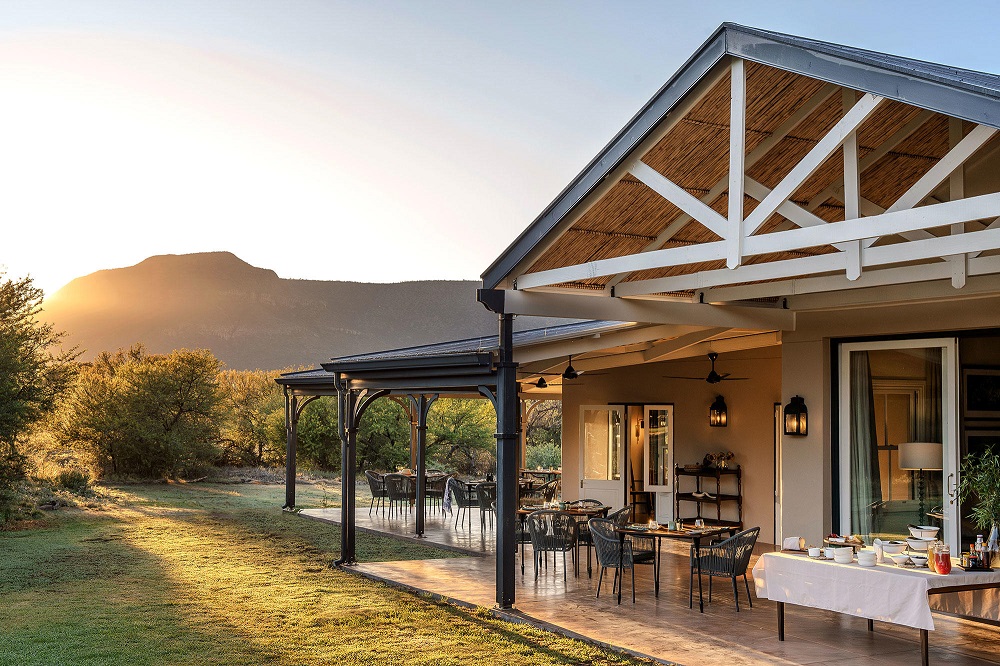
Breakfast with Samara GM Marnus Ochse

Over breakfast on the large covered stoep at Karoo Lodge with Samara’s genial General Manager Marnus Ochse, the discussion ranged from lion dynamics on the reserve (a hot topic during our stay), to Samara’s world class coffee offerings, to brown hyenas and leopards. Being an accomplished amateur photographer himself, Marnus and I had plenty of stories to share. From dropping cameras to getting lions framed with the Camdeboo Mountains in the background. 

Marnus also talked about the reserve’s core principles which broadly center around the global “4 C’s” framework (Conservation, Community, Culture and Commerce) and  Samara’s partnership with The Long Run. The bottom line: one cannot successfully run a luxury eco-tourism business or protect a landscape without actively integrating and supporting all four. 

Marnus was particularly proud of  the role of the Samara staff members, describing it as fundamental to its rewilding mission. He considers every team member – from management and guides to kitchen staff – to be equal parts of the mission. As we have noted during conversations with staff members on both our visits, everyone understands why the reserve exists and what it strives to accomplish.
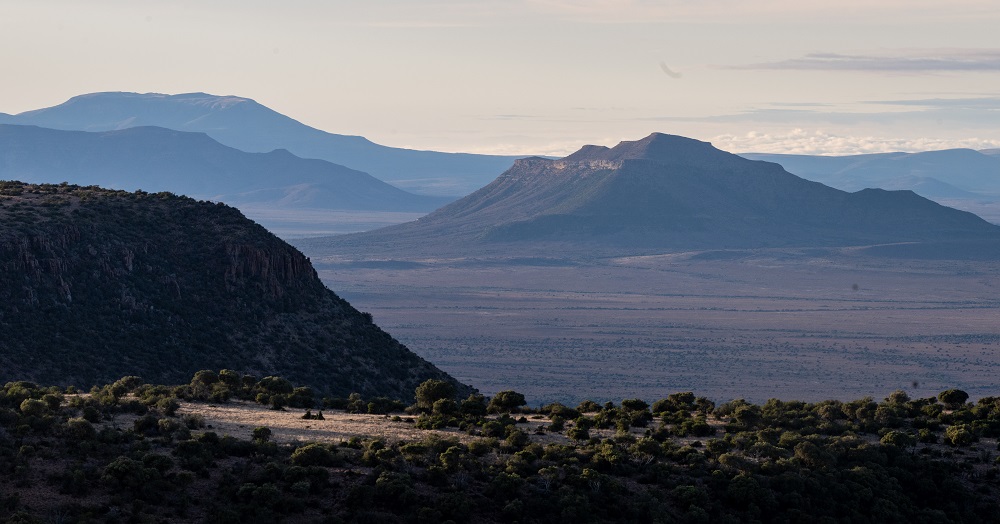
In a previous blog post I wrote in some length about Samara’s history and about the Tompkins family who set this monumental conservation project in motion. Their ambitious aims for restoration of biodiversity in the Great Karoo are now a reality. Several large mammals long absent from the area, some for as many as 180 years, are now back and thriving. Wild lions, elephants, cheetahs and buffaloes once again roaming the Karoo. What’s next? If and when the reserve reaches 100,000 acres (it currently stands at 67,000 acres) one might expect to see a few African painted dogs  join the predator mix.  

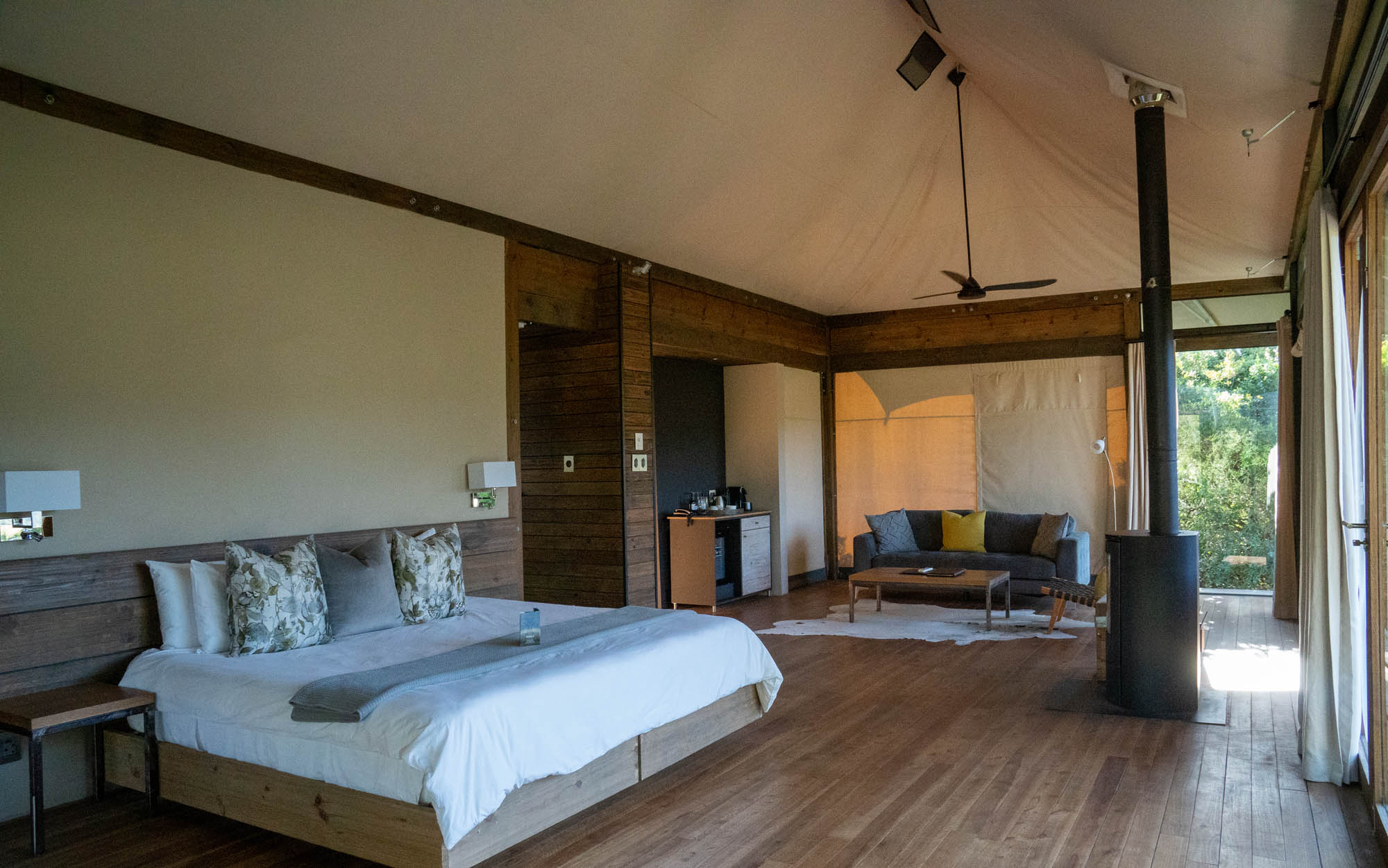
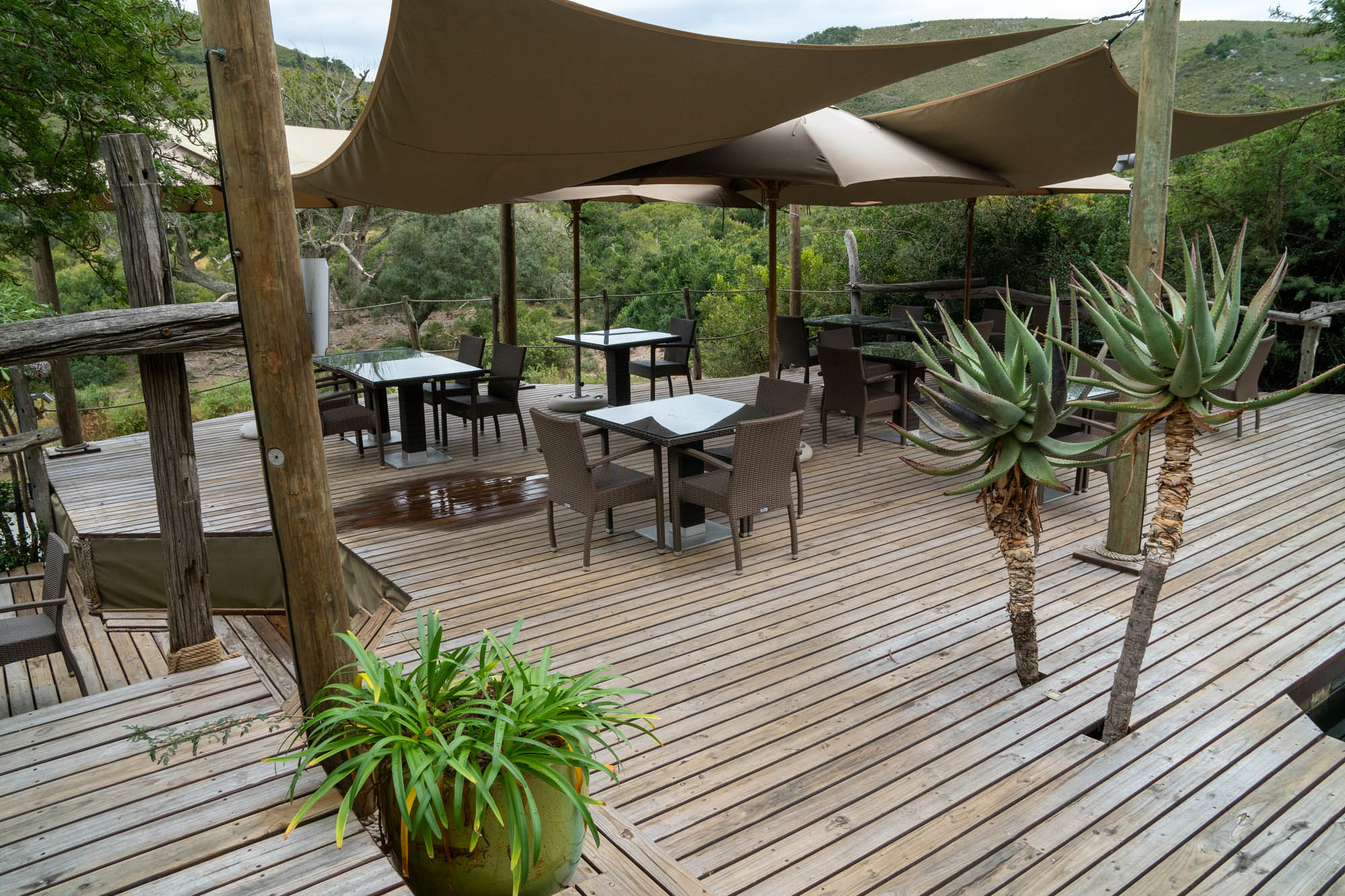
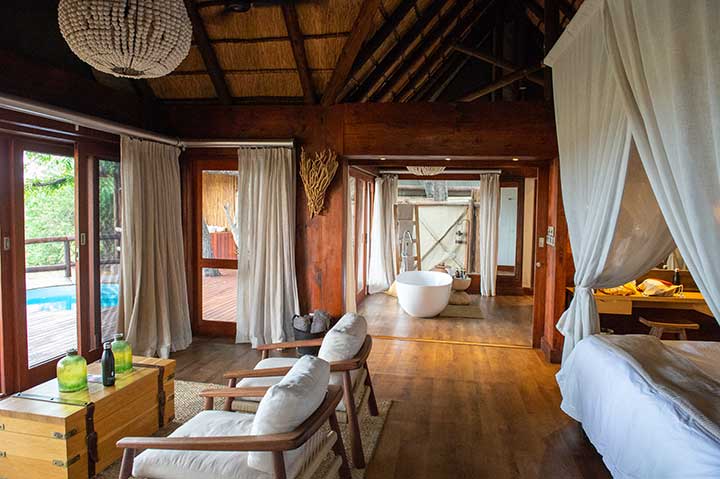
Beyond the wildlife, Samara offers a consistently excellent guest experience all round. From its accommodation options (Karoo Lodge, Plains Camp and the exclusive-use Manor) to food and beverage offerings, activities and amenities. Even more so than during our first visit, the entire experience was flawless with every staff member being warm and approachable and making us  feel truly welcome. 

Samara is currently offering an attractive long-stay deal (Stay 3 nights, pay for 2) through the end of September 2026, as well as other special offers which include free commercial flights from and back to either Johannesburg or Cape Town, and inclusive of r/t road transfers from Port Elizabeth Airport to the Reserve. For more information about these or for recommendations regarding combining Samara with other South Africa safari properties such as Tswalu Kalahari or one of the Eastern Cape reserves like Kwandwe or Shamwari or Lalibela, contact Bert at bert@fisheaglesafaris.com or leave a message with our answering service at 1-800-513-5222 or 713-467-5222.

Property photo courtesy Samara Karoo

YOU MIGHT ALSO BE INTERESTED IN
Destinations
Zambia

10th September 2021

Chindeni and the Bushcamp Company, Zambia

By late July we found ourselves at Chindeni, a small Bushcamp Company property
Read more
Botswana
Destinations
Okavango Delta

3rd October 2022

Camp Okavango, Botswana

Camp Okavango is in the heart of the permanent part of the Delta. In this idyllic setting there are no vehicles, and it is just a short walk
Read more
Area
Destinations
Nyerere National Park
Ruaha
Tanzania

14th October 2023

From My Safari Notebook: Wildlife Photography

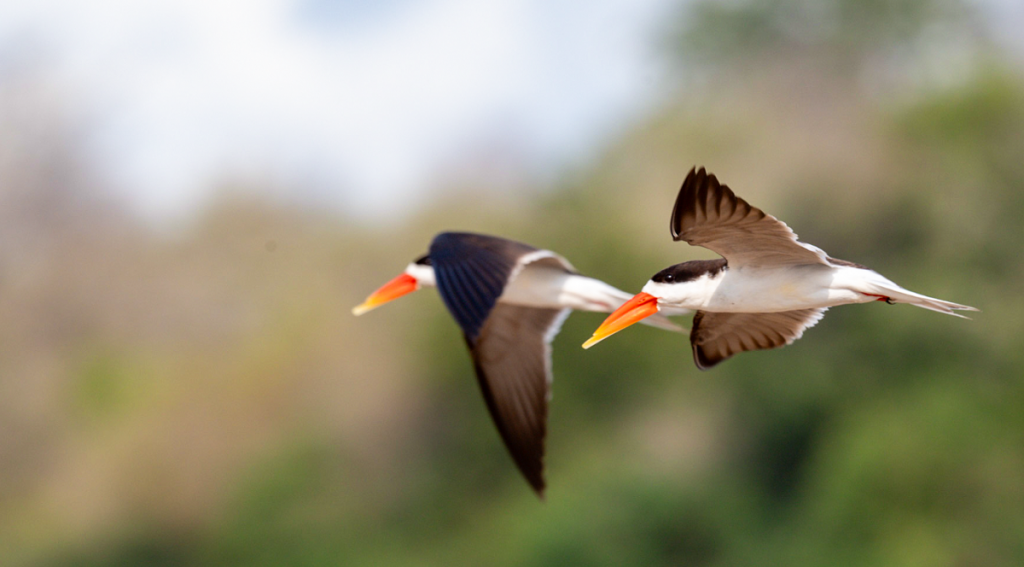
Birds in flight and wildlife photographers have an uneasy relationship. Things go wrong as often as they go right. Getting focus-lock on a moving subject

Read more

SUBSCRIBE TO OUR NEWSLETTER

READERS FAVOURITES
Destinations
India

27th May 2023

India

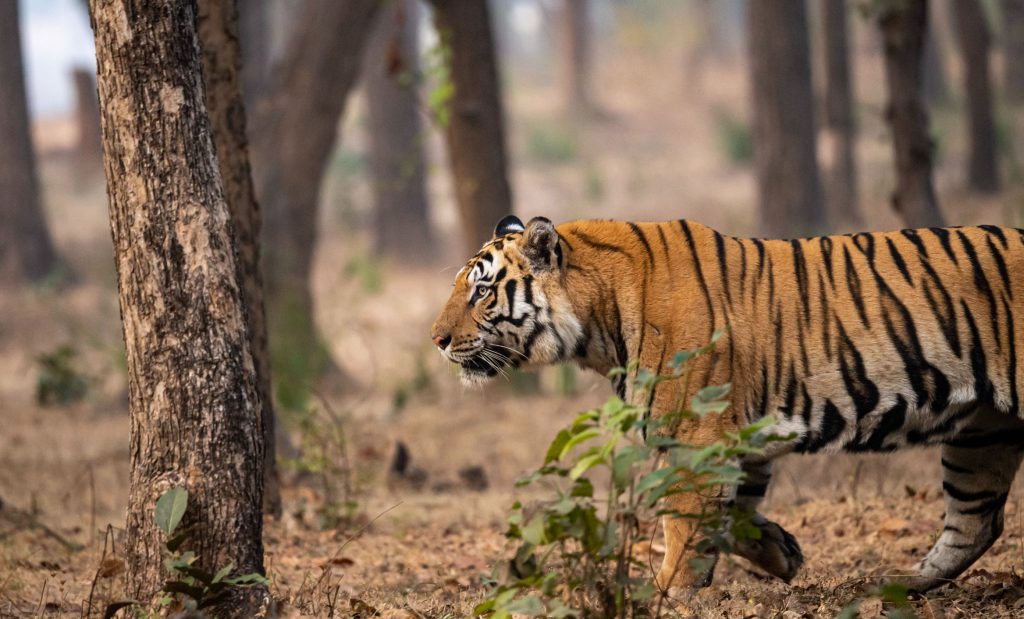
India’s tiger, mammals and birds.

Read more
Botswana
Destinations

4th August 2022

On Safari At Belmond Eagle Island Lodge, Okavango Delta

What is the ‘secret sauce’ for an unforgettable few days on safari in Botswana? It starts with the animals, of course. The elephants, lions, giraffes, hippos

Read more
Destinations
Zambia

10th September 2021

Chindeni and the Bushcamp Company, Zambia

By late July we found ourselves at Chindeni, a small Bushcamp Company property

Read more

Lyndon Visits South Africa’s Eastern Cape Province

19th April 2025

Lyndon Visits South Africa’s Eastern Cape Province

South Africa’s Eastern Cape game reserves are located in a spectacularly beautiful, malaria-free area just off the Indian Ocean coast, about 500 miles due east of Cape Town. The area is easily accessible by air from Johannesburg (1 hr 45 minutes) and Cape Town (1 hr 15 minutes). Its beautiful green rolling hills, temperate weather and abundance of wildlife with all of the ‘Big Five’ mammals being present (lions, leopards, buffalo, elephant and rhino) make it an attractive destination for visitors wanting to add a safari to a Cape Town stay. It is also a great option for families who don’t want to take their children into a malaria area, or who may simply want to explore a different safari area, having previously visited the Sabi Sands or Timbavati or another area in South Africa.  

Jason and Bert have visited the Eastern Cape reserves a total of four times between them; Lyndon recently made it there for the first time; here is his personal account:  

“I spent four nights in two different camps in South Africa’s Eastern Cape in the middle of March with my family. It was my first time in the area and I must say I really enjoyed it. The first stop was Lalibela Treetops. We flew in the morning from Johannesburg to Port Elizabeth (now Gqeberha) and had a road transfer of about an hour to the camp. 

What were some of the highlights? I can start with the staff led by the manager Wynton Fortune – they were fantastic. Likewise our guide Desigan Naidoo – he goes by Des – was very engaging and skilled. The camp itself felt intimate and the rooms were canvas with a thatch roof. Plenty of room with all the necessities. Meals here are communal which is always fun.

The area where you do your game drives is very interesting. The Eastern Cape is a Big Five destination but there’s no malaria which is great for families with kids, or just anybody who’s not keen on taking the malaria pills. The landscape is filled with rolling green hills with ample bushes and trees as well as open savannah. It very much reminded me of parts of Kenya, such as  Lewa and the Masai Mara. Lalibela has abundant plains game including blesbok, impala, zebra, wildebeest, nyala, amongst others. Also plenty of giraffes, good numbers of rhino and lion. We saw a herd of about 300 buffalo and on our last day we got a bit lucky and spent some time viewing a cheetah. There are probably about 50 elephants on the property as well.

Lalibela is very interesting because it is essentially a conservation program being run as a safari destination. Their mission is to expand their acreage, rehabilitate the land, and then let the animals do their thing. It can be strange to be watching a pond full of hippos and then hearing a truck speed by on a nearby public road. I gave this some thought and although some people might find it distracting, I think it is commendable. Just as in Kenya where you’re likely to see the Maasai with their cattle grazing inside a conservancy or alongside a national park. Civilization is not something that can be easily contained but at the same time these wildlife sanctuaries can expand and thrive alongside human populated areas, creating more room for animals to inhabit. With the wildlife essentially repopulating the areas where they naturally occurred before humans displaced them.

From Lalibela, we transferred by road to our next game reserve –  Kariega Ukhozi – and there were some distinct differences. Where Lalibela had rolling hills, Kariega had steep and mountainous ones. The relatively sparse bush and forest was replaced with dense, impassable sections. The open plains remained and just like at Lalibela, the wildlife were abundant. We had a great time with our guide Megan who really knew the area and the animals in it. On our first day we were able to see a mother rhino and her baby. The mother, Thandi, had survived a horrible poaching attempt some years ago. She still bore the scars of the incident but it hadn’t stopped her from giving birth to at least 6 (or maybe 7) calves. Some of whom have gone on to birth or father their own calves. That is the type of impact a place like Kariega can have. 

Just like Lalibela, Kariega was formerly farmland, devoid of many of the large mammals which have been thriving here for several decades now. At one point we were able to easily see at least eight different large mammal species from our game drive vehicle which is always a good sign. We saw plenty of kudu, nyala, blesbok, wildebeest, zebra, rhino, and probably more giraffes than I have seen anywhere else ever. We got to see lions a few times and the area, tucked between the Kariega and Bushman’s rivers, is possibly even more striking than Lalibela. 

Your guide joins you for breakfast and every third night they do a traditional meal in the boma where your guide joins you again. The food was excellent and our rooms were very spacious and included a plunge pool amongst other niceties. Overall both camps and areas impressed me.”

Lyndon and Jason can both assist with more information and trip ideas for Southern Africa, incorporating a few days in the delightful Eastern Cape reserves. Email lyndon@fisheaglesafaris.com or jason@fisheaglesafaris.com or leave a message at 1-800-513-5222 and one of us will be sure to call you back. 

YOU MIGHT ALSO BE INTERESTED IN

Destinations
Zambia

10th September 2021

Chindeni and the Bushcamp Company, Zambia

By late July we found ourselves at Chindeni, a small Bushcamp Company property

Read more
Botswana
Destinations
Okavango Delta

3rd October 2022

Camp Okavango, Botswana

Camp Okavango is in the heart of the permanent part of the Delta. In this idyllic setting there are no vehicles, and it is just a short walk

Read more
Area
Destinations
Nyerere National Park
Ruaha
Tanzania

14th October 2023

From My Safari Notebook: Wildlife Photography

Birds in flight and wildlife photographers have an uneasy relationship. Things go wrong as often as they go right. Getting focus-lock on a moving subject

Read more

SUBSCRIBE TO OUR NEWSLETTER

READERS FAVOURITES
Destinations
India

27th May 2023

India

India’s tiger, mammals and birds.

Read more
Botswana
Destinations

4th August 2022

On Safari At Belmond Eagle Island Lodge, Okavango Delta

What is the ‘secret sauce’ for an unforgettable few days on safari in Botswana? It starts with the animals, of course. The elephants, lions, giraffes, hippos

Read more
Destinations
Zambia

10th September 2021

Chindeni and the Bushcamp Company, Zambia

By late July we found ourselves at Chindeni, a small Bushcamp Company property
Read more

Seeing and photographing Giraffes on safari in Africa

14th October 2020

Seeing and photographing Giraffes on safari in Africa


Image

Seeing and photographing Giraffes on safari in Africa

As long-time safari planners and regular African travelers, giraffes are often on our minds, or in front of our camera lenses.  Other than perhaps elephants, it is the one mammal that we get the  most questions about.  Everybody wants to see giraffes on safari.   Just like the big cats, these quintessential African mammals are high on everyone’s must see list. It is easy to see why.  They are simply spectacular in so many ways.  There’s the sheer size of them, their stilt-like elongated necks and unmistakable ‘horned’ heads literally towering above the landscape and everything else.  There’s the way they feed, drink, stare at you and run.  Pretty much everything about a giraffe is weird and worth a second look.


Image

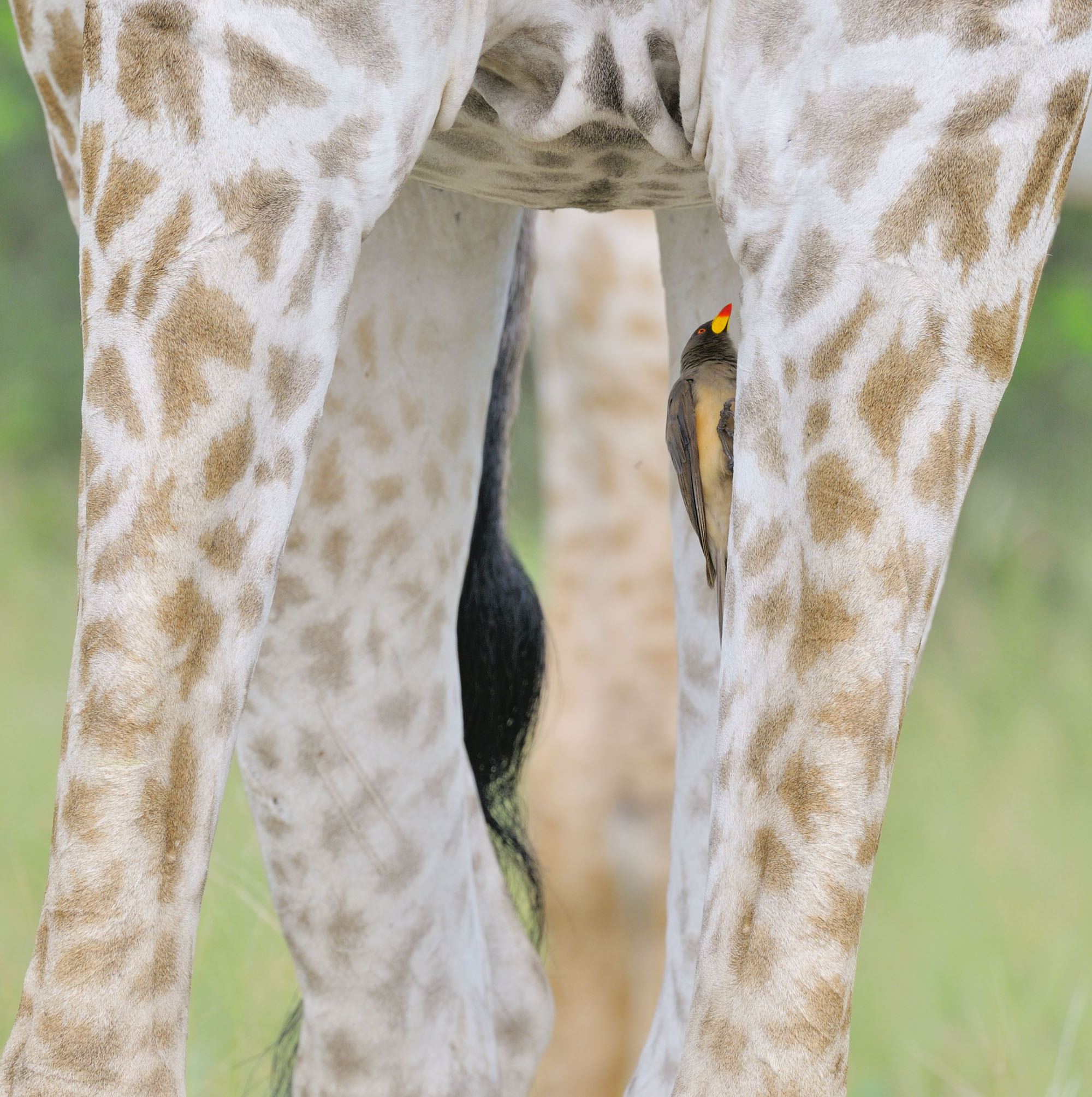
Linyanti floodplain, Botswana

This photo, taken in the Linyanti area in Northern Botswana, illustrates a couple of things about giraffes and about getting useful images of them.  Be ready with the right lens.  If all you have available is a big telephoto lens, this is all you might get.  A portion of a giraffe.  Legs.  Or a head, maybe a neck and head.  So either shoot them at a good distance where they can fill the frame or use a shorter zoom lens to frame them properly.  On this day I was fortunate to have a yellow-billed oxpecker bail me out of the tight photo spot.  These birds have a symbiotic relationship with giraffes, helping them to get rid of disease-carrying ticks, food for the birds.  Even ill-equipped photographers can be the beneficiaries of symbiosis, with a bit of luck. 


Image

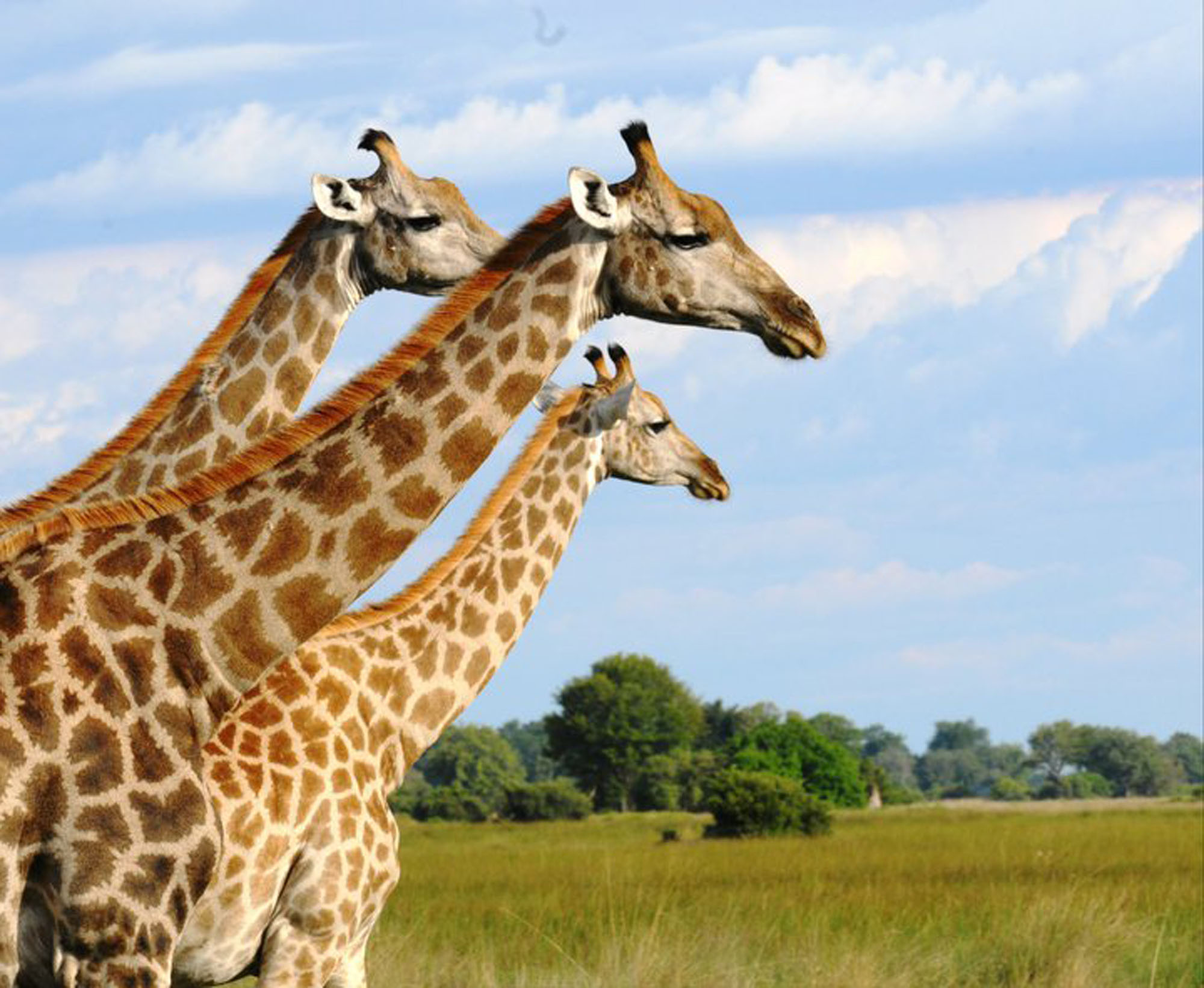
Kwara concession, Okavango Delta

When it is not possible to get the entire giraffe – or more than one – inside the frame, consider grouping together a few giraffe necks, heads or upper bodies.  Sometimes, you can get lucky and three giraffes will be facing in the same direction, with a nice cloudy background.  It doesn’t happen all the time but keep looking for such an opportunity to present itself.  Some years ago in the Kwara concession in Botswana’s Okavango Delta, I did just that, got lucky and succeeded in getting a visually pleasing shot of these three giraffes.


Image

Kwandwe Game Reserve, Eastern Cape

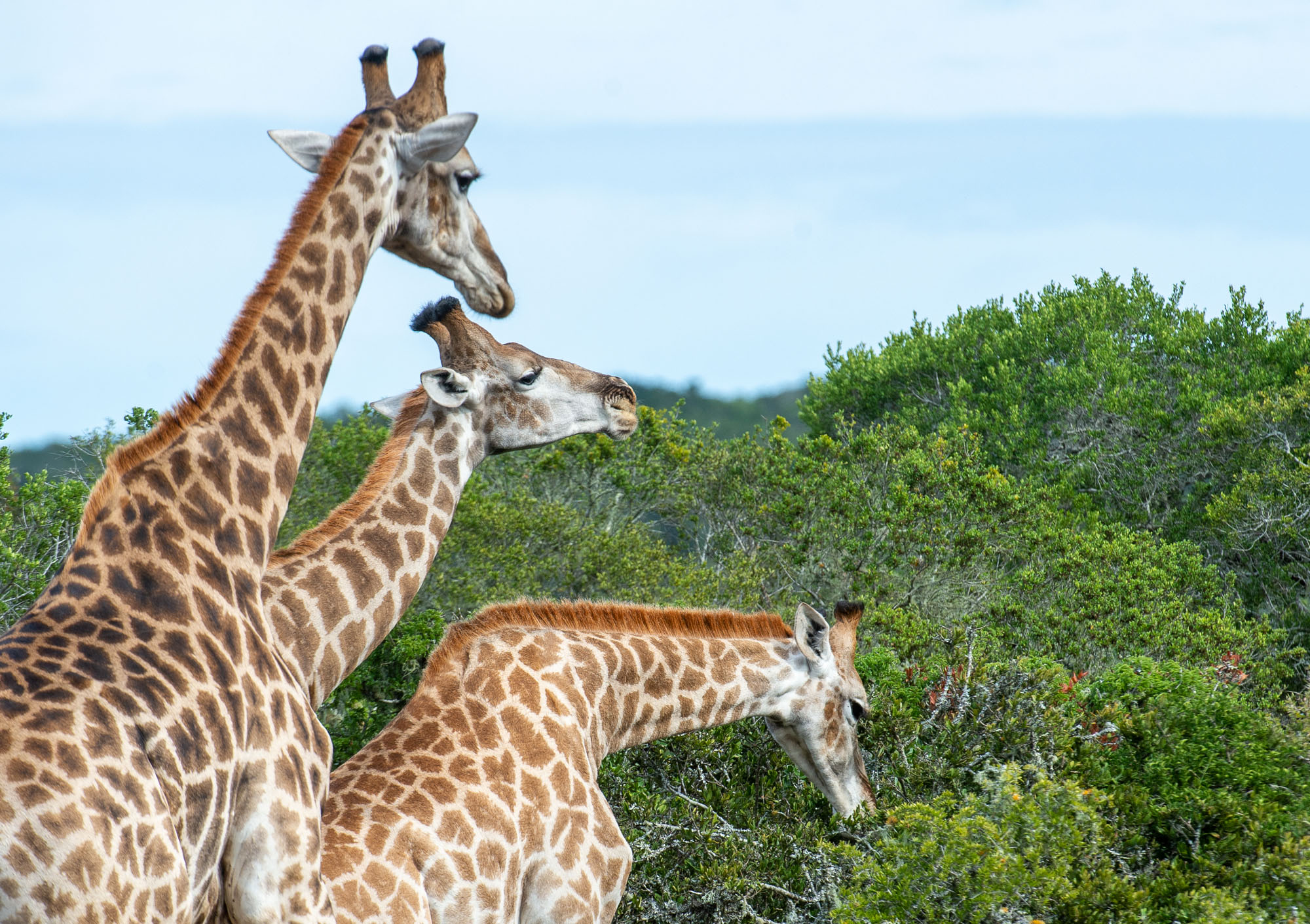
I captured this photograph of three plains giraffes feeding at Kwandwe in the Eastern Cape Province of South Africa.  It is another example of framing more than one giraffe in the same photograph, by isolating their necks and heads.  The more giraffes, the better.  Four necks may even be better than three; I’ve just not come across a suitable opportunity to try that!


Image

Samburu region, Kenya

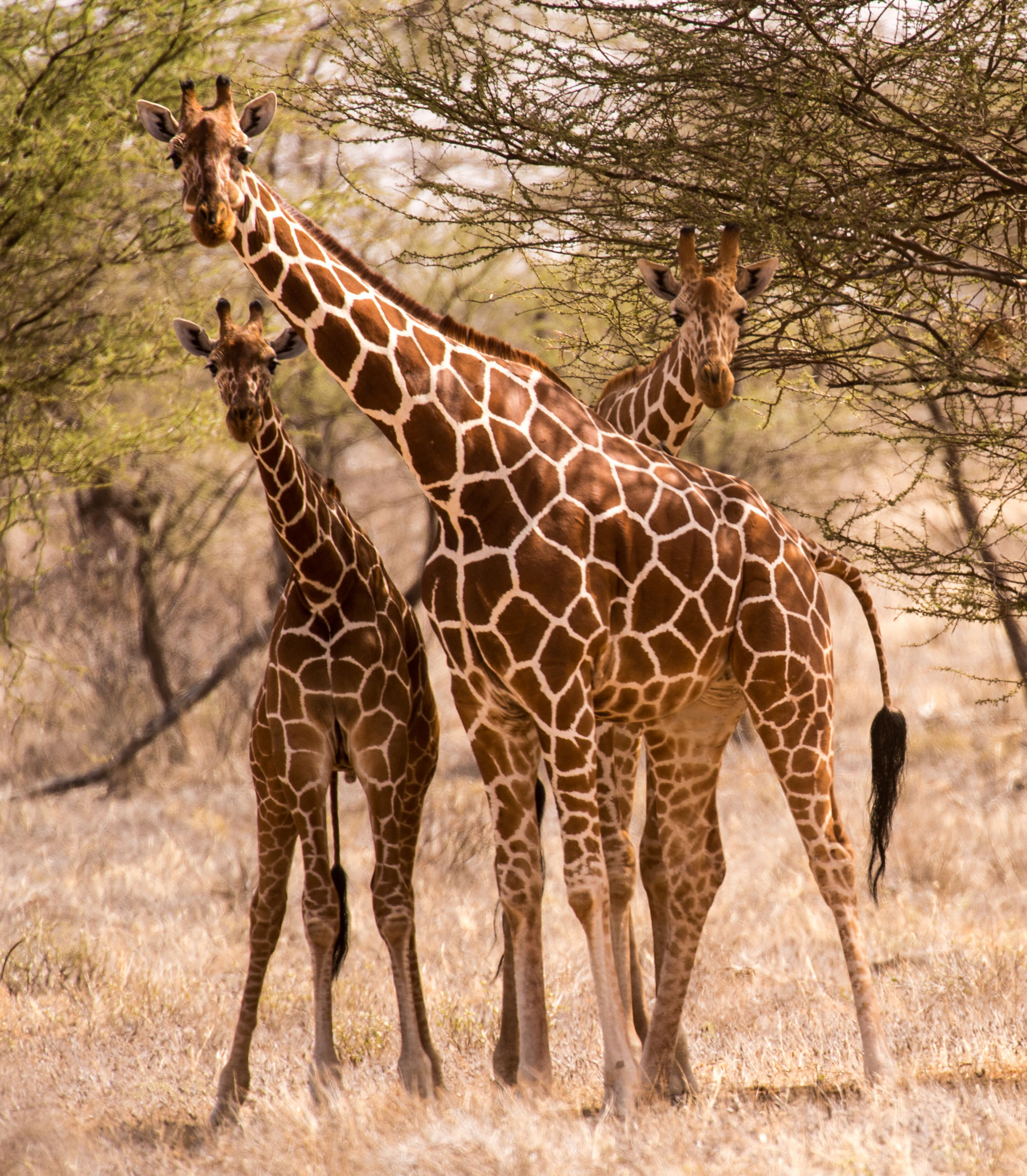
There are several species of giraffe in Africa.  The three photos above have been of the most common of these, the Southern giraffe.  In north-eastern Kenya one finds what I consider to be the most handsome of the giraffe species, the Reticulated giraffe.  This photo of a few of them was taken in Samburu, a mostly stark, arid area where a good number of these endangered animals co-exist with a couple of other northern Kenyan endemics such as Grevy’s zebra and Beisa oryx. I’ve always described the Reticulated giraffe as the oil painting of giraffes, compared with the more washed out – ‘watercolor’ – Southern giraffe.  If you’ve seen Reticulated giraffes in nature, I think you will agree.  Their spots are a vivid, dark burnt orange which make the white stripes stand out even more.  Another good place to find and observe Reticulated giraffes is the Lewa Wildlife Conservancy. 


Image

Lewa Wildlife Conservancy, Kenya

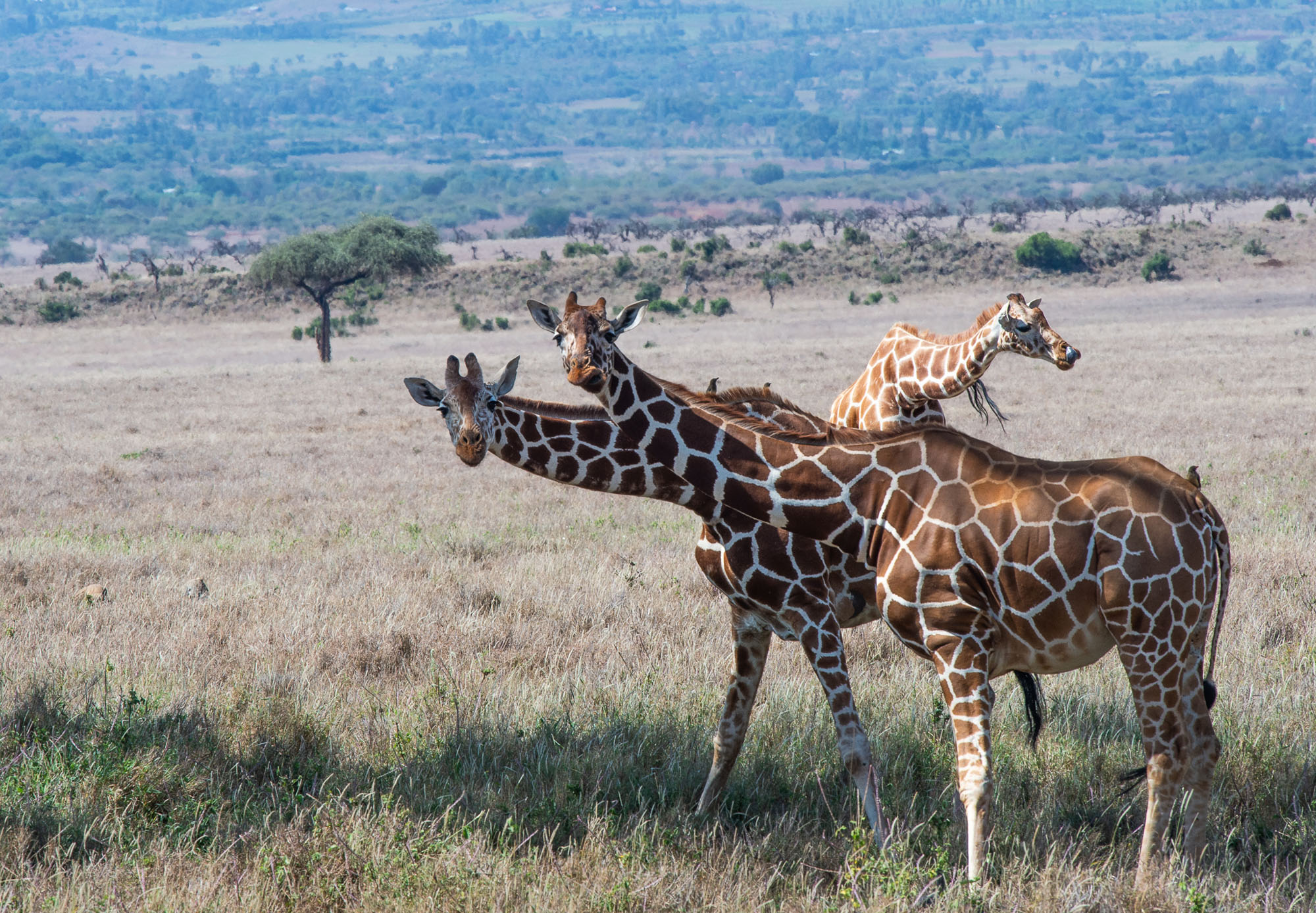
Taken in the Lewa Conservancy in northern Kenya, this photo of three Reticulated giraffes also illustrates their striking color pattern.  And my penchant for trying to get  several giraffe necks and heads in the same photo…


Image

Lake Nakuru National Park, Kenya

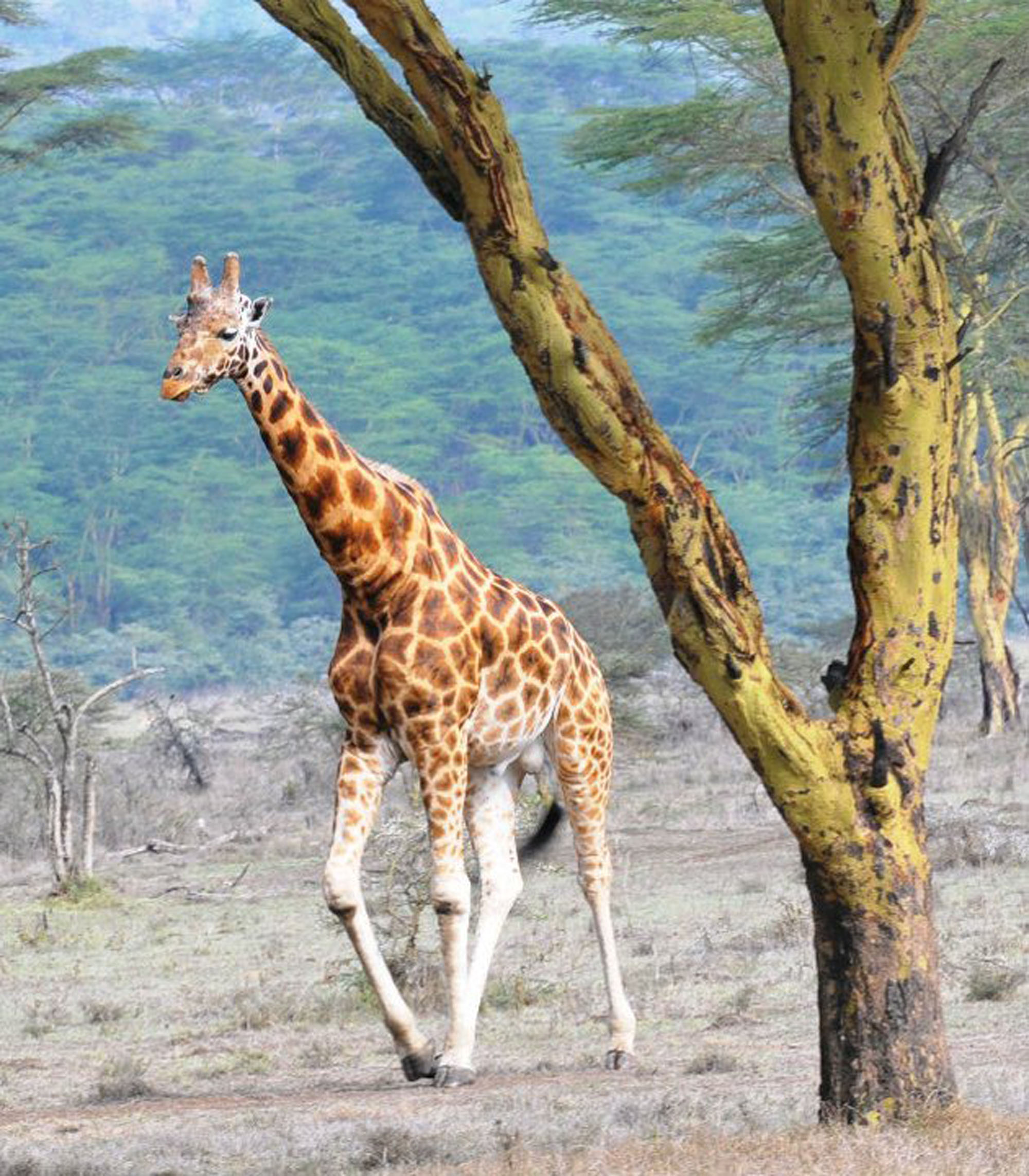
There is considerable disagreement among scientists as to the specific number of giraffe species.  Some maintain that there’s only one ‘giraffe’ with several subspecies.  Others contend that there are as many as eight distinct species.  A giraffe that is widely considered to be a subspecies is the Rothschild’s or Nubian giraffe.  I photographed this one walking in a yellow-barked acacia forest on the edge of Lake Nakuru in Kenya.  Full species or not, it is certainly a handsome beast with its characteristic white ‘sox’.


Image

Giraffe Center, Nairobi

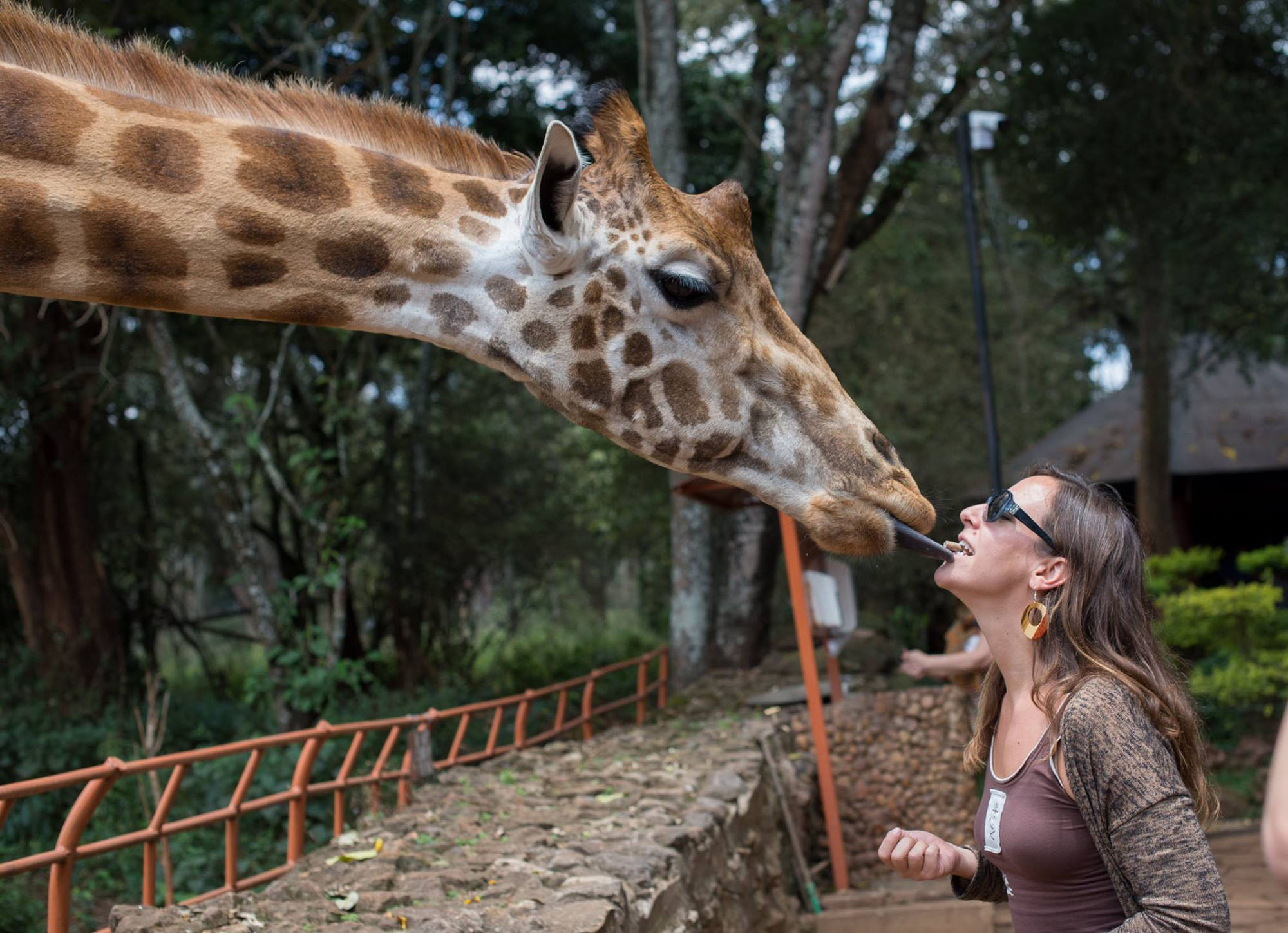
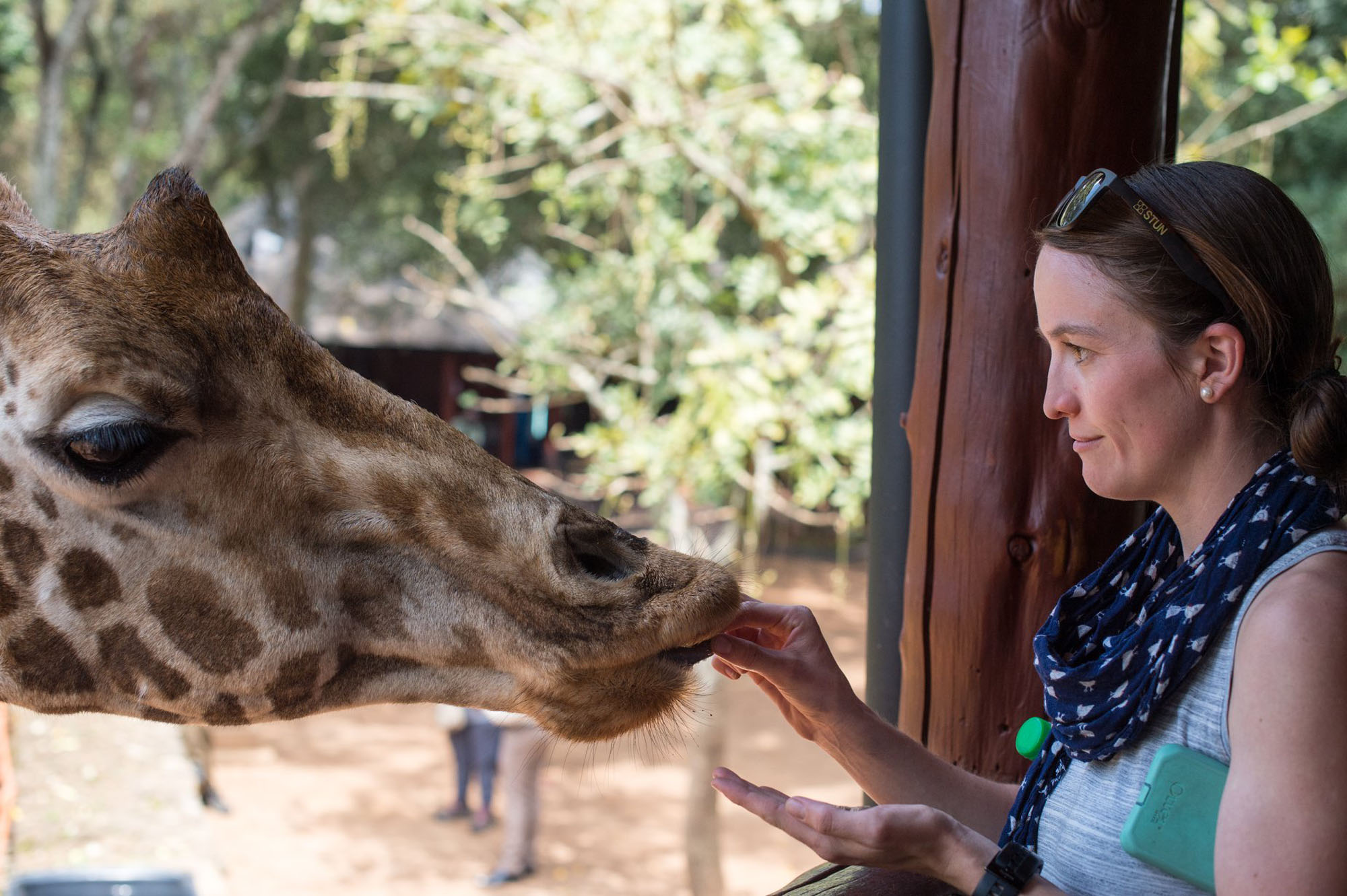
There are several Rothschild’s giraffes at the popular Giraffe Center in Nairobi, Kenya.  The Giraffe Center is operated by the African Fund for Endangered Wildlife, to educate Kenyan youth about the country’s wildlife and environment and to provide visitors an opportunity to come into close contact with the giraffes. ‘Armed’ with a handful of giraffe pellets, visitors walk up a ramp to a balcony from where they can feed the giraffes at eye-level.  The giraffes know the game.  Whenever there are visitors, there are giraffes ready to stick out their crazy long tongues to retrieve a treat and be photographed.  All for a good cause.  Funds raised by the Giraffe Center have helped with efforts to re-establish the endangered Rothschild giraffe in several wilderness areas elsewhere in Kenya.


Image

Royal Malewane, Thornybush Reserve – South Africa

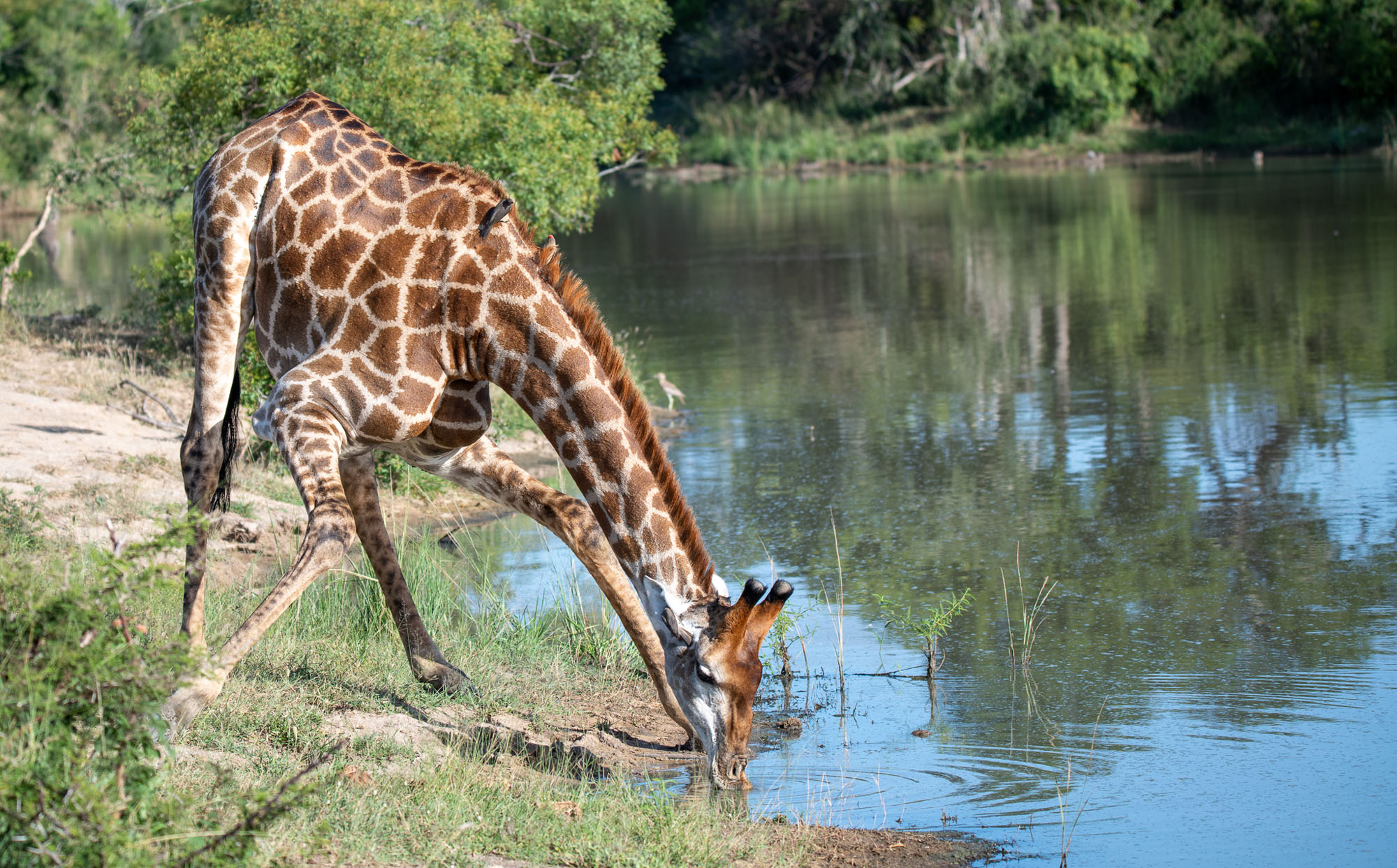
A giraffe drinking is quite a sight to behold.  This photo which I took on a game drive from Royal Malewane in South Africa illustrates the peculiar posture which a giraffe has to adopt in order to get its mouth down low enough to drink water from a pond or river.  The exact mechanism by which a giraffe gets enough water in its mouth and up its massively long neck, isn’t entirely clear. What is clear is that  giraffes are vulnerable to predation when they are drinking and they are always careful to look around for lions, before assuming the position.


Image

Skeleton Coast area, Namibia

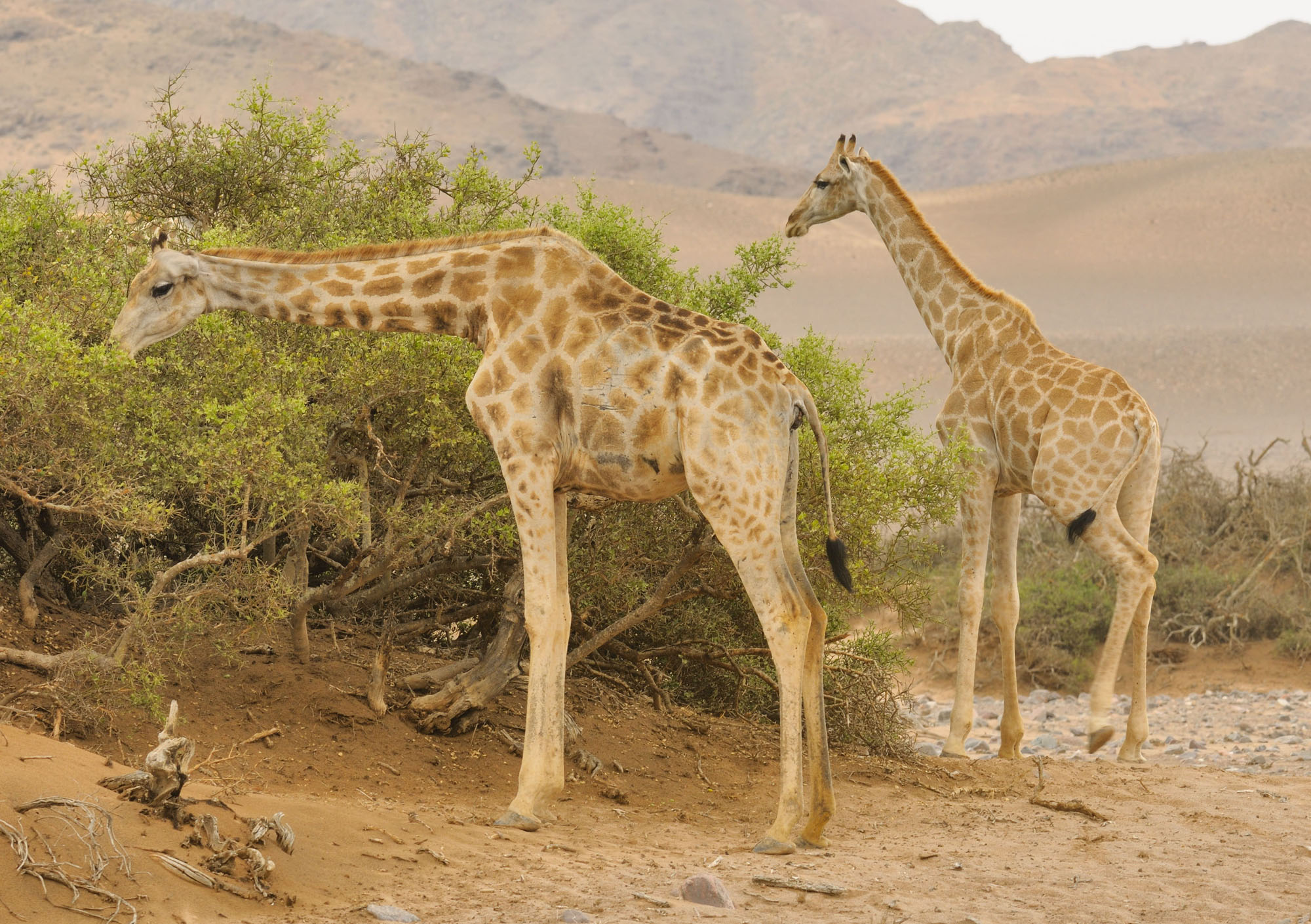
A little known fact about giraffes is just how adaptable they are. As a result giraffes are widely distributed in most habitats throughout Africa, even in some areas which are inhospitable to many life-forms. On two separate visits to Namibia’s Skeleton Coast we saw several groups of desert-adapted Angolan giraffe, a sub-species concentrated around ephemeral or seasonal rivers such as the Hoarusib, Huab and Hoanib.  Wherever you see groves of acacia albida (Ana) and acacia erioloba (Camelthorn) trees, you can expect to find these giraffes.  This photo was taken on a game drive out of Wilderness Safaris’ Hoanib Skeleton Coast Camp.


Image

Okavango Delta, Botswana

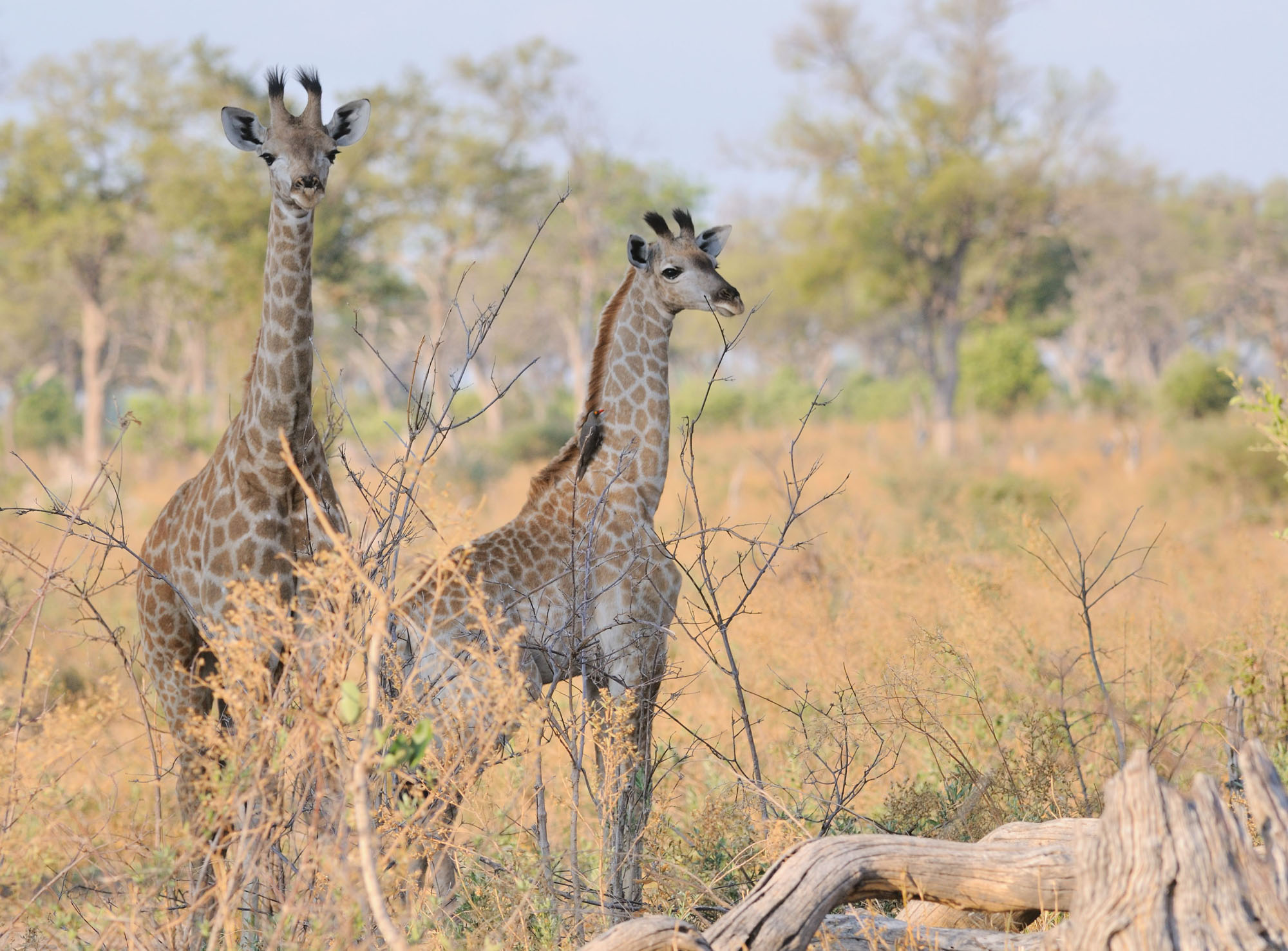
Baby giraffes are cute.  Like most other animals.  These two youngsters were photographed on a game drive out of Wilderness Safaris’ Abu Camp in Botswana’s Okavango Delta.  Even at a young age, giraffes adopt the typical habits of the species like being inquisitive and observant.  They can see you long before you can see them, and they fully utilize their special advantage,  always looking and staring.  When safari guides are out on game drives searching for predators, they make a point of checking out where the giraffes are looking.  If giraffes are standing still and staring consistently in the same direction, it is always a good indication that a predator is around.


Image

Samburu, Kenya

Giraffes are relatively common in many areas in Africa.  We always expect to see some – and sometimes many – in places like Mashatu in south-eastern Botswana, in Zimbabwe’s Hwange National Park, pretty much all over northern Botswana, the north-eastern lowveld of South Africa including all but the far northern part of Kruger Park, and in most East African parks and game reserves.  While it is still fairly easy to see giraffes on a trip to Africa, it is a disturbing reality that giraffe numbers have decreased by 30% over the last three decades, with about  110,000 remaining.  Even though giraffes as a species are not endangered, they are considered threatened and the situation could get worse, if current trends persist.  Mostly, their numbers are dropping because of habitat loss, which happens when woodlands are converted into farms and ranches. Trophy hunting and poaching also play a role in their steady demise.  Some of the species – or subspecies – such as the Reticulated Giraffe are in fact endangered, with their numbers down more than 90% compared with earlier times.  These Reticulated giraffes photographed in Samburu in northern Kenya are nowadays found mostly in a few wildlife sanctuaries, with less than 10,000 of them surviving.

In our blog post next week, we will take a look at Africa’s signature mammal:  the African elephant.  With plenty of photographs and a few of our most indelible memories of interacting with these behemoths in all parts of Africa over the years.  

More Info

Email bert@fisheaglesafaris.com

Email jason@fisheaglesafaris.com

@fisheaglesafarishouston

#FishEagleSafaris

YOU MIGHT ALSO BE INTERESTED IN

Destinations
Zambia

10th September 2021

Chindeni and the Bushcamp Company, Zambia

By late July we found ourselves at Chindeni, a small Bushcamp Company property
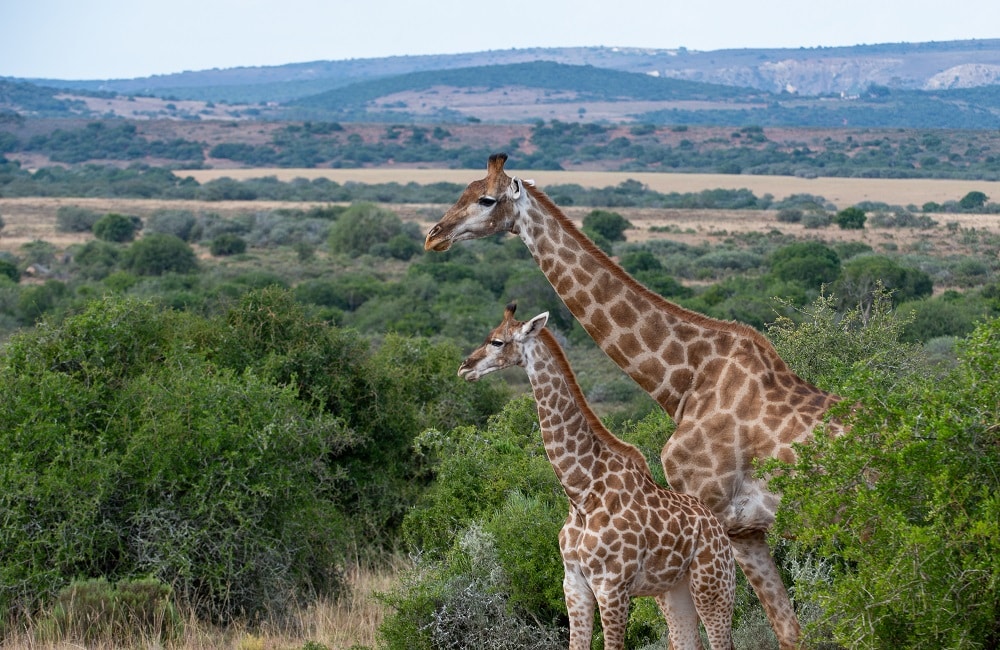
Read more
Botswana
Destinations
Okavango Delta

3rd October 2022

Camp Okavango, Botswana

Camp Okavango is in the heart of the permanent part of the Delta. In this idyllic setting there are no vehicles, and it is just a short walk

Read more
Area
Destinations
Nyerere National Park
Ruaha
Tanzania

14th October 2023

From My Safari Notebook: Wildlife Photography

Birds in flight and wildlife photographers have an uneasy relationship. Things go wrong as often as they go right. Getting focus-lock on a moving subject

Read more

SUBSCRIBE TO OUR NEWSLETTER

READERS FAVOURITES

Destinations
Zambia

10th September 2021

Chindeni and the Bushcamp Company, Zambia

By late July we found ourselves at Chindeni, a small Bushcamp Company property
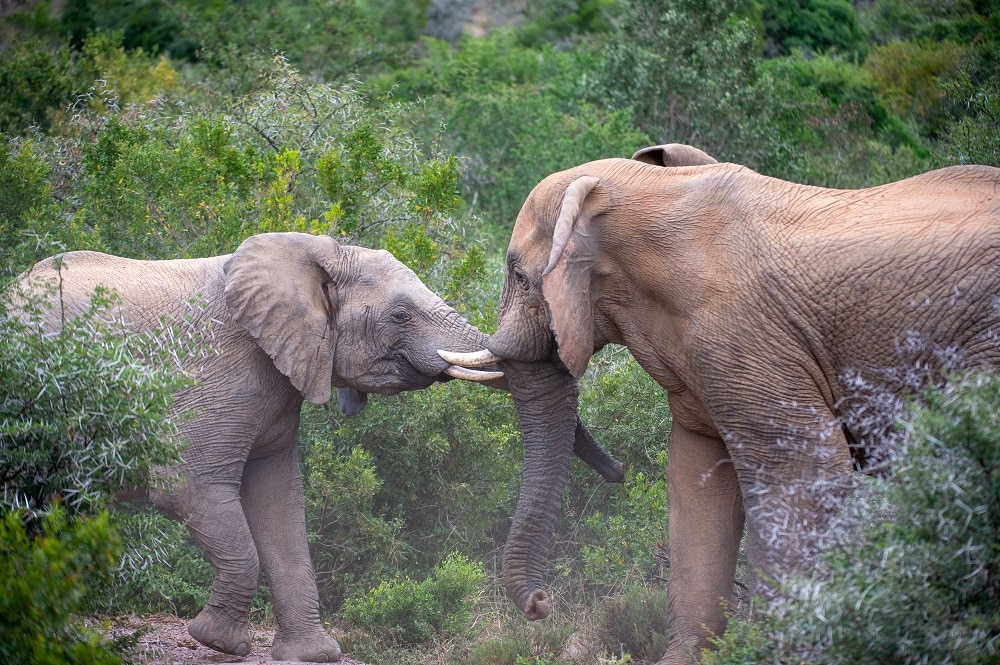
Read more
Botswana
Destinations

4th August 2022

On Safari At Belmond Eagle Island Lodge, Okavango Delta

What is the ‘secret sauce’ for an unforgettable few days on safari in Botswana? It starts with the animals, of course. The elephants, lions, giraffes, hippos

Read more
Destinations
India

27th May 2023

India

India’s tiger, mammals and birds.

Read more

A Visit to South Africa’s Eastern Cape Province

28th July 2020

A Visit to South Africa’s Eastern Cape Province


Image

A Visit to South Africa’s Eastern Cape Province

On what was my second trip to South Africa’s eastern Cape Province in two years, I learnt more about the area and what makes it special.  There are several good reasons to consider the Eastern Cape for a safari trip:

  • It has lots of animals and birds and more diversity than anywhere else in South Africa.  Readily seen animals include elephants, buffaloes, rhinos, lions, giraffes, zebras, kudus, impala and even cheetah, springbok, eland and gemsbok in some reserves like Shamwari.
  • The eastern Cape is one of the best places in South Africa to see both black and white rhinos.
  • The scenery is spectacular, with sometimes amazing views of hills, valleys and ravines. The vegetation ranges from Karoo scrubland to dense montane forest, Cape fynbos, dense thickets, and areas of open savannah and grasslands.  
  • The entire area is malaria-free which makes it ideal for families with children, pregnant women and for anybody who does not want to take antimalarial drugs.
  • The eastern Cape reserves are easy to get to, just over an hour from either Johannesburg or Cape Town, by air.  Also within drivable distance from Cape Town, along the Garden Route.
  • Compared with destinations like Botswana and the private reserves along the Kruger National Park, the Eastern Cape reserves offer considerably better value for money, particularly in the cooler winter months from May through August and September.
  • The area is quite unlike anything you’d see in Botswana, Zimbabwe, Namibia or the ‘bushveld’ region of South Africa, notably the Kruger Park.  It is mostly undulating, often with patches of thick bush which provide cover for animals such as leopard and black rhino.


Image

RIVERBEND LODGE

My first stop on the Eastern Cape educational trip was Riverbend Lodge which we had used several times in the past – always with good results – for the Addo Elephant Park area.  Riverbend Lodge is just outside the main Addo National Park, but the lodge has direct access – a few kilometers away – to its own private area of the park. The accommodation, dining (fantastic!) and general hospitality and guiding at Riverbend were impeccable.  With its special focus on the needs of families with young children, Riverbend is an ideal family safari spot.  Be sure to spend no less than three nights here as some of the mammals like the rhinos can be tricky to see, because of the thick vegetation.  In fact this is true of most of the eastern Cape reserves.  If you spend as many as 4 nights in a camp you will see ‘everything’ and have a fun and relaxing time in the process.


Image

The water hole close to the lodge can be surprisingly good and while I did not happen to see any rhino there during my stay, it does happen.  More often than not, there are elephants coming around to drink, and we also saw some zebras and warthogs take their turn.  


Image

KARIEGA

Kariega’s Settlers Lodge was all-round one of the best lodges I had seen in a long time, with beautifully designed, huge rooms and an unusually impactful main lodge building with glass, stone and canvas beautifully melded.

An added bonus here is the option of doing some boat trips along the Sunday’s River, a nice change of pace with time to relax and take in the natural beauty of the area.  Kariega’s Homestead Lodge would be perfect for a family or friends group of up to 12 or so, with 2 vehicles and guides and a staff catering to the needs of young and old.

River Lodge is yet another good option at Kariega with the same mix of activities as at Settlers.  It has a bit more of a ‘traditional safari’ or classic African safari lodge feel.  A nice value add here is that guests who spend 3 nights or more at Kariega River Lodge have the option to take an included boat trip (open aluminum skiff with sun canopy) of about 40 minutes or so, to the Sunday’s River mouth on the Indian Ocean.  


Image

The guiding at Kariega Settlers was great and importantly, they do not take more than 6 or 7 persons in a vehicle, meaning nobody ends up in a middle seat.  

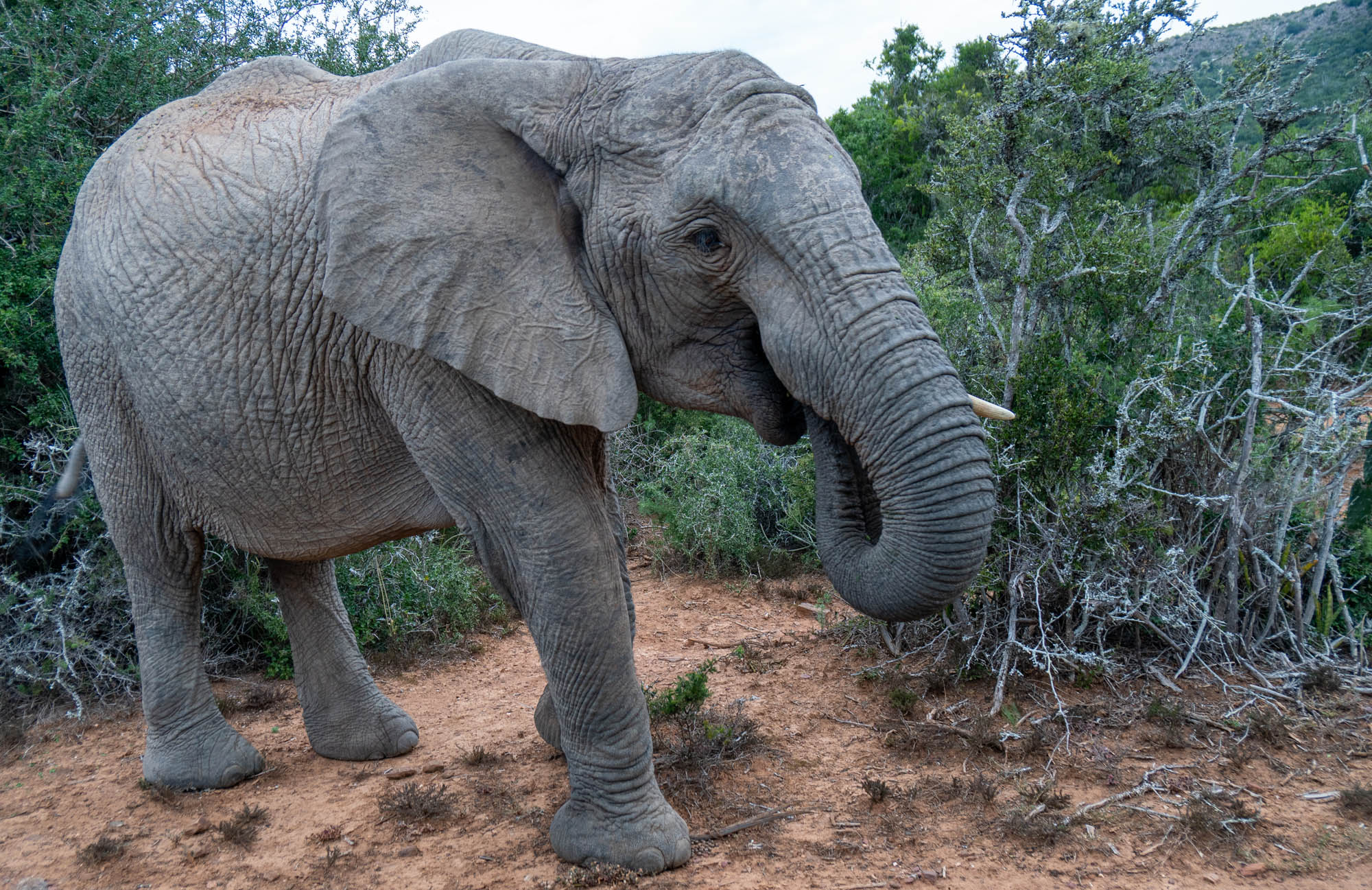
Overall I thought that the game-viewing at Kariega was very good; highlights were the abundance of giraffes, wide variety of antelopes, plenty of zebra, a good lion sighting and some great views of elephants.  

As elsewhere in the Eastern Cape, it would be advisable to spend no less than 3 or 4 nights in the area.  There is a lot of thick bush and to have a decent shot at seeing rarities like black rhinos, it is imperative to give yourself enough time and to do several game drives.  So stay 4 nights and include the beach excursion to the mouth of the Sundays River.


Image

SHAMWARI

My last two nights in the Eastern Cape were spent at Shamwari, a private game reserve which recently celebrated its 25th year as a pioneer of wildlife management and eco-tourism in the Greater Addo area.

Shamwari’s current range of properties include Bayethe Tented Camp, Sarili Private Lodge (ideal for family travel), Lobengula Lodge and its flagship classic lodge – Long Lee Manor, extensively rebuilt in 2019.  Two other properties – Riverdene and Eagle’s Crag – have also recently been rebuilt/renovated.  

Clearly Shamwari is making a very substantial investment in its future, re-asserting its position as the pre-eminent photo safari property in the Eastern Cape.

Here’s what surprised me about Shamwari: the abundance of wildlife (easily seen), the simply amazing natural beauty of the area and its diversity.


Image

I was fortunate to have Morne Hamlyn as my guide in Shamwari, operating out of the compact classic Lobengula Lodge.  More about the guiding later.  It was a welcome change of pace to be in a room just steps away from a pool, and not much further away from the dining room.  No long hikes to dinner, no armed escorts, just wait for the sounds of drums and off you go…

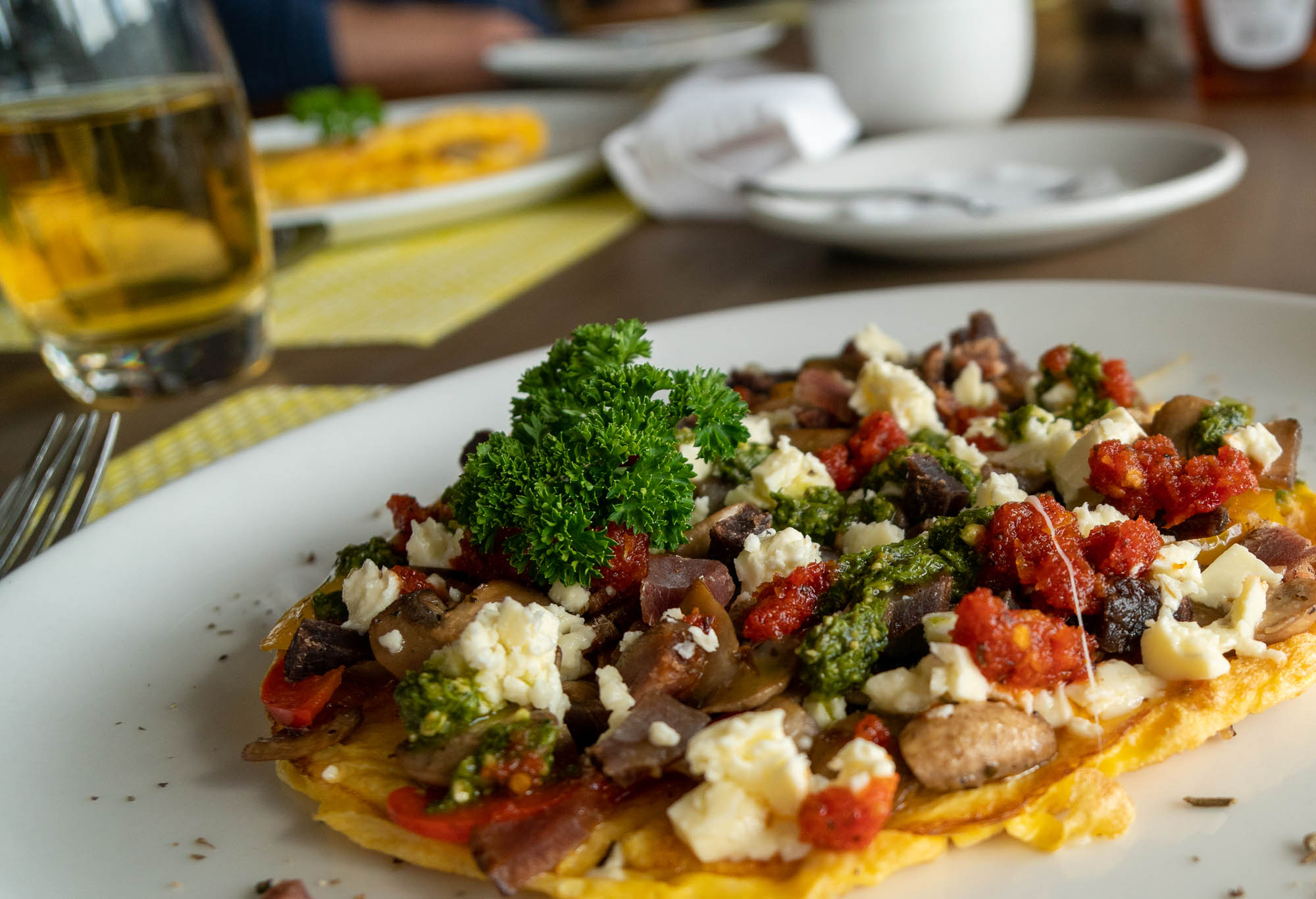
Breakfast at Lobengula was excellent; I tried a local take on Eggs Benedict one morning and it absolutely hit the spot; an omelette the second day was equally good.  Dinner results were mixed.  The meat for the charcoal grill (braai) on my first night there was presented in advance on a platter – you pick your portion and cut – and it was then prepared to order.  I selected a couple of lamb chops and asked for them to be done medium-rare.  I got them back well done and tough.  The side dishes were great, as was the dessert.  In fact the dessert (malva pudding) was excellent.


Image

The following night I decided to take a small gamble and ordered lamb again – this time a rack of lamb.  It paid off handsomely.  The chops were tender and succulent with that typical South African Dorper sheep taste:  a nice herbaceous undertone but quite subtle, and not at all mutton-like.  Dessert was again splendid.  

The ‘lamb chop experience’ at Lobengula underscored my experience of many years on safari.   Almost never have I found the meat prepared on a ‘bush dinner’ or outside grill/barbecue – a ‘braai’ as the South African refers to it – to be anywhere close as good as similar cuts prepared in a proper kitchen setting.  Just too many unknowns and variables with grilling outside, particularly when the chefs are cooking for a whole camp-full of people.  Visibility is bad in the dark, the charcoal temperature is difficult to regulate, it is hard to get the timing right, and so on.   Boerewors sausage and chicken (other than breast portions) are generally the best choices for bush dinners.  

Throughout my stay at Lobengula I could not have received better service or friendlier attention than I did.  Irreproachable in every respect.


Image

Back to guiding:  Morne had guided me some years previously in the Timbavati at Kings Camp, where he worked as the head guide at the time.  Right now, Morne is at the apex of his guiding career and any visitor to Shamwari should thank their lucky stars to be in his vehicle.

Morne has all the attributes of a good guide:  personable, highly knowledgeable, friendly and enthusiastic, and he wants you to have fun and experience everything the area has to offer.  He will also make every attempt to find a ‘special’ animal or bird for you.  In my case it was black rhino, the only large mammal I had not seen previously on this Southern Africa trip.  Given the bushy habitat preferred by these rare animals, I knew it was a tall order but I need not have been concerned.  We found a striking black rhino female with a young calf, probably not even 40 minutes into our afternoon drive at Shamwari.  Initially motionless behind a bush with just the tip of her long horn giving away her location, she was in no hurry to relocate despite our proximity.  She then walked slowly to the next thicket, calf in tow, turned sideways to give us a look and then she disappeared.  Just like any animal can, in the eastern Cape thickets.


Image

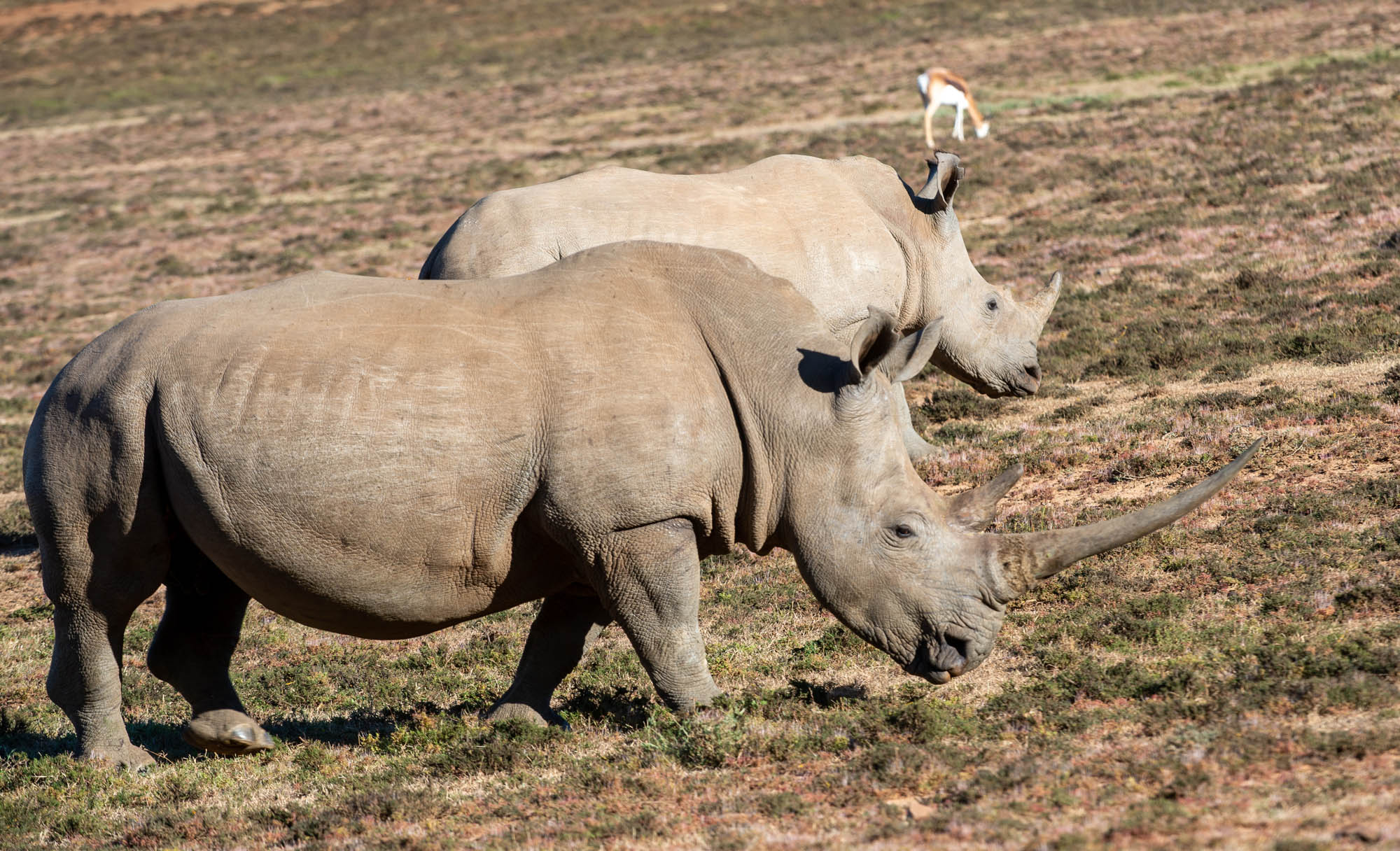
Over the course of two days at Shamwari I must have seen as many as 15 different species ranging from elephants (lots!) to Cape buffalo, lions, the aforementioned black and several groups of white rhinos, multiple giraffes, impala, kudu, Burchell’s Zebra, black wildebeest, springbok, waterbuck, gemsbok, warthog and hippo.  

Morne and I also checked out a few other properties at Shamwari including the beautiful Long Lee Manor (where we had lunch) Sarili (where we saw lions from the deck), and Bayethe Tented Camp which I think would be ideal for many north American visitors, with well-equipped and spacious tented rooms.  

In closing, a few words about fences.  Shamwari and in fact all of the Eastern Cape reserves operate in a mixed-use setting, where  fences  are an unavoidable reality and necessity.     Shamwari is huge and the presence of a fence was never an issue or hindrance on my particular visit.  At worst it is a reminder that wildlife thrive in areas which are rich in resources such as water and palatable vegetation.  Which means land that can usually be occupied by people as well.  So when you do see a fence in the eastern Cape, think survival and co-habitation – without a few strategically placed fences it would be near impossible to safely contain and conserve wildlife species in this area.  

Up next:  a return trip to Namibia including our first visit to Hoanib Skeleton Coast Camp.

More Info

Email bert@fisheaglesafaris.com

Email jason@fisheaglesafaris.com

@fisheaglesafarishouston

#FishEagleSafaris

YOU MIGHT ALSO BE INTERESTED IN

Destinations
Zambia

10th September 2021

Chindeni and the Bushcamp Company, Zambia

By late July we found ourselves at Chindeni, a small Bushcamp Company property
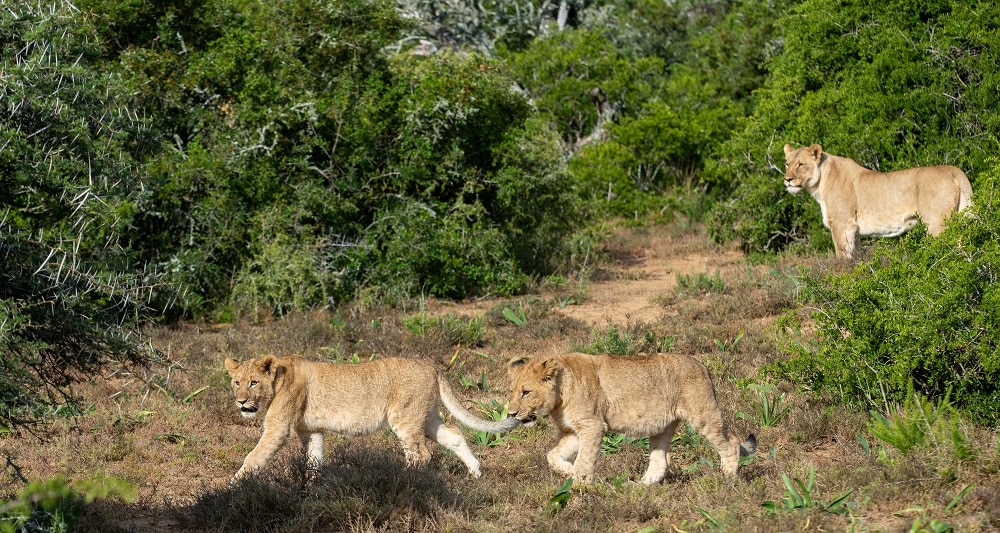
Read more
Botswana
Destinations
Okavango Delta

3rd October 2022

Camp Okavango, Botswana

Camp Okavango is in the heart of the permanent part of the Delta. In this idyllic setting there are no vehicles, and it is just a short walk

Read more
Area
Destinations
Nyerere National Park
Ruaha
Tanzania

14th October 2023

From My Safari Notebook: Wildlife Photography

Birds in flight and wildlife photographers have an uneasy relationship. Things go wrong as often as they go right. Getting focus-lock on a moving subject

Read more

SUBSCRIBE TO OUR NEWSLETTER

READERS FAVOURITES

Destinations
Zambia

10th September 2021

Chindeni and the Bushcamp Company, Zambia

By late July we found ourselves at Chindeni, a small Bushcamp Company property
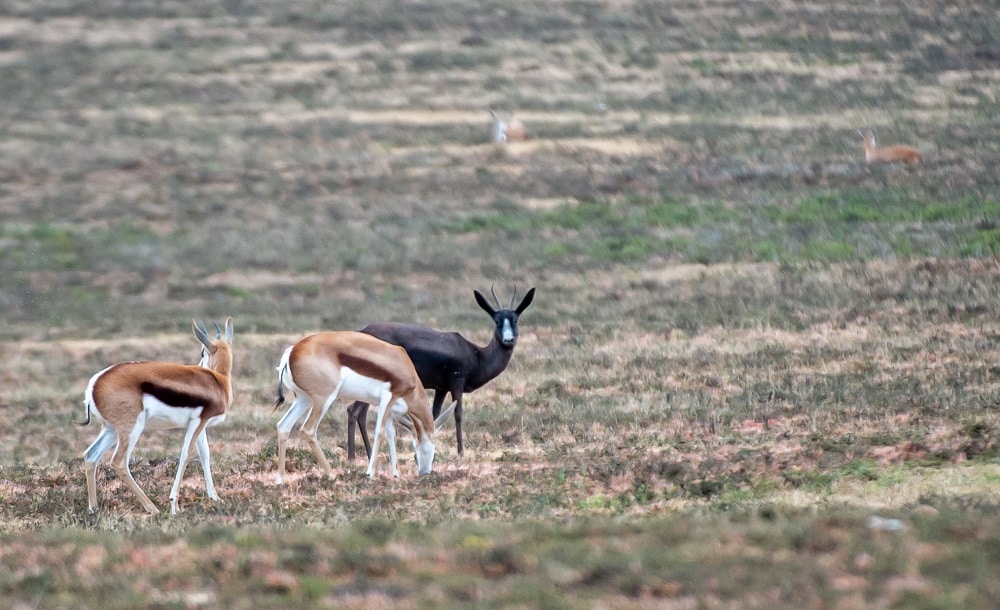
Read more
Botswana
Destinations

4th August 2022

On Safari At Belmond Eagle Island Lodge, Okavango Delta

What is the ‘secret sauce’ for an unforgettable few days on safari in Botswana? It starts with the animals, of course. The elephants, lions, giraffes, hippos

Read more
Destinations
India

27th May 2023

India

India’s tiger, mammals and birds.

Read more

Footer

Design

  • About
  • Destinations
  • Blogs
  • FAQS
  • Team
  • Contact
All Rights Reserved ©Fish Eagle Safaris 2022 | Terms & Conditions | Privacy Policy
Designed & Developed by B Online

SUBSCRIBE TO OUR NEWSLETTER

SIGN-UP TO OUR NEWSLETTER

Subscribe Form

Footer Widget Header

Related Blogs