A Safari Trifecta at Laba Laba Camp, Western Seronera
What is a safari trifecta, you might ask? Three desirable things, like any trifecta of course: an excellent guide, a great location off the beaten path and (cue the cymbals) lots of animals. Which is exactly what we found at the superb Laba Laba Migration camp, located in a quiet spot to the west of Seronera. Drivable distance to the Grumeti area, usually a wildlife hotspot.


What was it like driving from the southern part of Seronera to Laba Laba? Simply amazing. In this order we experienced several memorable sightings:
- Five big cats in three trees close to the road, one with two leopards, two with lions.
- Two young male lions seen from a bridge.
- The wildebeest and zebra migration in full force, filling the plains below Laba Laba camp.
- More lions on an afternoon drive: three young females and several cubs in the company of two older females.


A lion – and cheetah – day
On our first full day at Laba Laba we experienced a simply phenomenal wildlife viewing day with one awesome sighting after another:
First up – 17 hyenas including several youngsters at their den. And then, right on each other’s heels, seven bat-eared foxes and three female lions with several cubs of different ages. As if we hadn’t had our quota of lions, walking by slowly came three different males, one moving right past us with hundreds of wildebeest staring him down. Not to be forgotten: two male cheetahs resting up in a shady spot.
The afternoon game drive continued in the same vein with more bat-eared foxes, four more lions, three of them in their favorite tree and more great views of the migration.

Trouble in lion paradise
It is a known fact that in the world of lions, cubs lead a tenuous existence at best. If the pride – and particularly their mother- is thriving, so are they. If not, the cubs are usually the first ones to suffer from deprivation. Lion cubs face an uphill battle for survival, with a mortality rate of up to 80% before reaching the age of two. A devastating occurrence for young lion cubs is the death or displacement of the dominant male lion in a pride. When this happens, the cubs are often summarily killed by the new dominant male.
It’s not as if male lions are trying out for the role of Scarpia, the villainous police chief lusting after Tosca, in Verdi’s famous opera. While their behavior definitely reaches operatic intensity, there is no real malice intended. It’s simply instinctive behavior. When a lactating female lion loses her litter, she quickly goes back into oestrus, providing the new male with an opportunity to spread his genes.
While this sounds pretty grim in theory, few of us ever witness something like it. Even after decades of going on safari all over Africa the phenomenon of infanticide among lions has hitherto remained a purely abstract construct in my and Kathy’s minds. Until this day.
Rest assured, dear reader, that this is not going to end with dead baby lions. In which case – to be sure – this article would not have been written. So spoiler alert: the cubs got away. But not before the three of us (Kathy and myself and our fantastic guide Moses) had spent about an hour or so witnessing the most amazing scenes of conflict and aggression. A veritable window into the dark side of big cat behavior.


We were rather blindsided about what was to follow, as the setting and the lion pride’s prospects painted an idyllic picture. The pride pretty much had the world – or at least this corner of the Serengeti – at their feet. An abundance of prey in the form of hundreds – even thousands – of migrating wildebeest and zebras. Plenty of water, trees to climb into to get away from the pesky insects and seemingly little in the way of imminent threats.
Initially – once we had gotten into position alongside a tree-lined creek – everything was indeed lighthearted – all fun and games – and we spent a good 30 minutes watching the five young lion cubs playing. Mostly with each other and also with their mother. Running, jumping, biting, mock fighting and just generally having a whale of a time. If one can say that about lions.
One enterprising young male cub kept trying to climb up a thick tree trunk. Digging his claws into the bark, he stood on his hind legs, pulled himself up, up and came tumbling down. More than once. This future leader had what it takes though, including persistence. After three failed attempts he tried again and voila – success! Just like any young male of almost any species, he then proceeded to show off to all the other cubs and to whomever else was watching. Walking casually along several branches, imitating an adult male lording over the area, and clambering back down and up the tree more than once. In at least one of the photos I took while this was going on, a youngish adult male lion could be seen in the background. Unbeknownst to us – and the baby lions – this young male lion was going to end up being the villain of the piece.

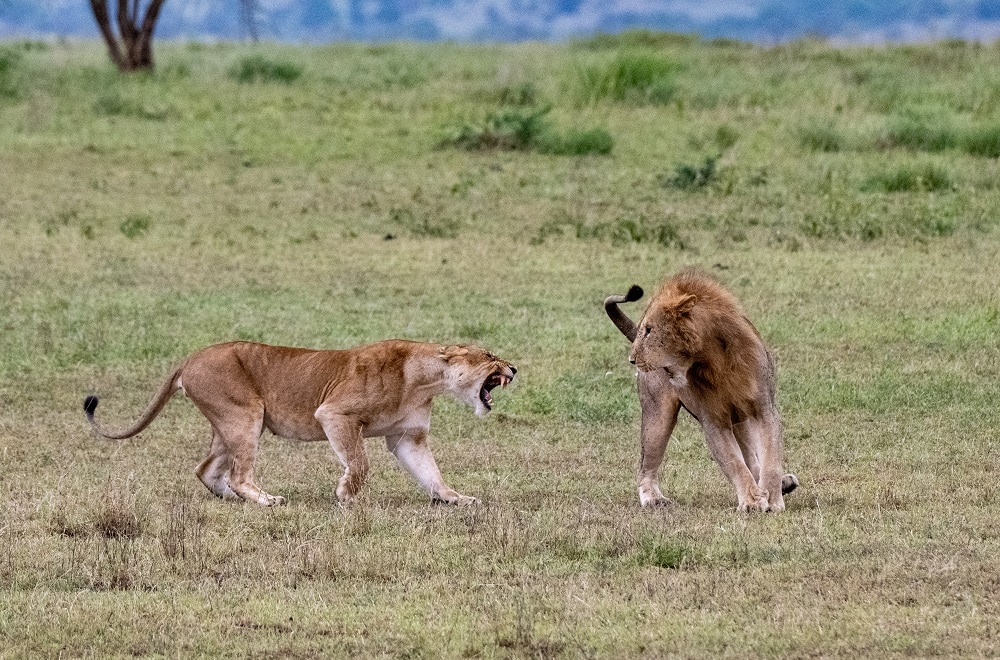


At first imperceptibly and then quite noticeably, the young male walked right up to the cubs. This precipitated instant conflict as the female lion rushed up to the scene, clearly anticipating an undesired outcome. She aggressively and repeatedly tried to drive him off. He would have none of it and stood his ground. Several times the enraged female snarled at the male, baring her fangs and clearly risking serious injury by trying to get him to leave.
It was a chilling display of a mother trying to protect her offspring at almost any cost. Accompanied by much snarling and vocalizing. Momentarily one of the cubs ran right up to the male and we feared for the worst. Just about then the lioness must have somehow transmitted a warning sound to the cubs as initially four of them and then the last one darted off to our left, pausing a safe distance away. For now at least the cubs were safe. By this stage the other two lionesses had joined the fracas and were assisting the mother, having inserted themselves between the intruder and the cubs.
That is pretty much how we left it. It may be that the crisis was later averted, with the young male interloper being successfully driven off or at least realizing that his presence was not welcome. It may very well be that he did not have murderous intent and that he simply wanted to be accepted into the pride. Which is a possibility as he was apparently related in some way to the three dominant males. The rest of the story will play itself out without us being present or even knowing the end. Hopefully the final denouement was less tragic than the ending of Tosca where in true operatic tradition, of course, everybody dies.

About the camp and our guide
We knew right away that we were going to get along just fine with Moses, our Laba Laba guide with whom we’d be sharing a private vehicle for the next three days. For one thing, he listened to us, on the fly adjusting what had been planned as a full day outing to a considerably less ambitious activity. Also – he was enthusiastic, knowledgeable and struck just the right balance between being informative and entertaining. We know that requesting Moses as the guide for our guests yet to spend time at Laba Laba will be a good decision.
As for Laba Laba camp itself, we looked hard and couldn’t find anything lacking. Superbly designed and equipped rooms with ample lighting, enough power points, lots of space to unpack your stuff, an effective low pressure shower and an outdoor (enclosed) tub which we put to good use. The large king size bed was about as comfortable as they come and at night the outside tent flaps could remain up – or down. Dial in your own level of adventure.


Even though Laba Laba is a migration camp which moves three times per year to stay within striking distance of the herds, it puts many a permanent camp to shame in terms of its common areas, facilities, and food and beverage offerings. The French-inspired cooking was delightful and the head chef talked to us before every meal. Vegan or plant-based and other dietary requirements are handled with aplomb. The quality and care extended into the wine list as well, with a fine selection of South African and French wines on offer.
The lack of exercise facilities at the vast majority of safari camps anywhere is an issue to many visitors. Not so at Laba Laba where you’ll find a decently equipped gym tent with a rowing machine, a step master, some barbells, a Swiss ball and proper exercise mats. They may want to add a skipping rope or two.
The camp’s lounge area and bar has a museum-quality collection of artifacts, fossils and semi-precious stones, complete with a reference guide.
Finally, and likely as important as anything, the location of the camp was ideal. Not super far as the crow flies from the heart of Seronera, but likely three times the distance by road. This discourages casual day trippers from making the plains below the camp their picnic lunch destination, resulting in far fewer vehicles being around than what one may expect the case to be.

Call us at 713-467-5222 any time and leave a message with our answering service, or email Bert at bert@fisheaglesafaris.com, for suggestions as to how and when one of the Laba Laba properties can be included with a Tanzania trip.

Camp images courtesy Laba Migration Camp
YOU MIGHT ALSO BE INTERESTED IN
10th September 2021
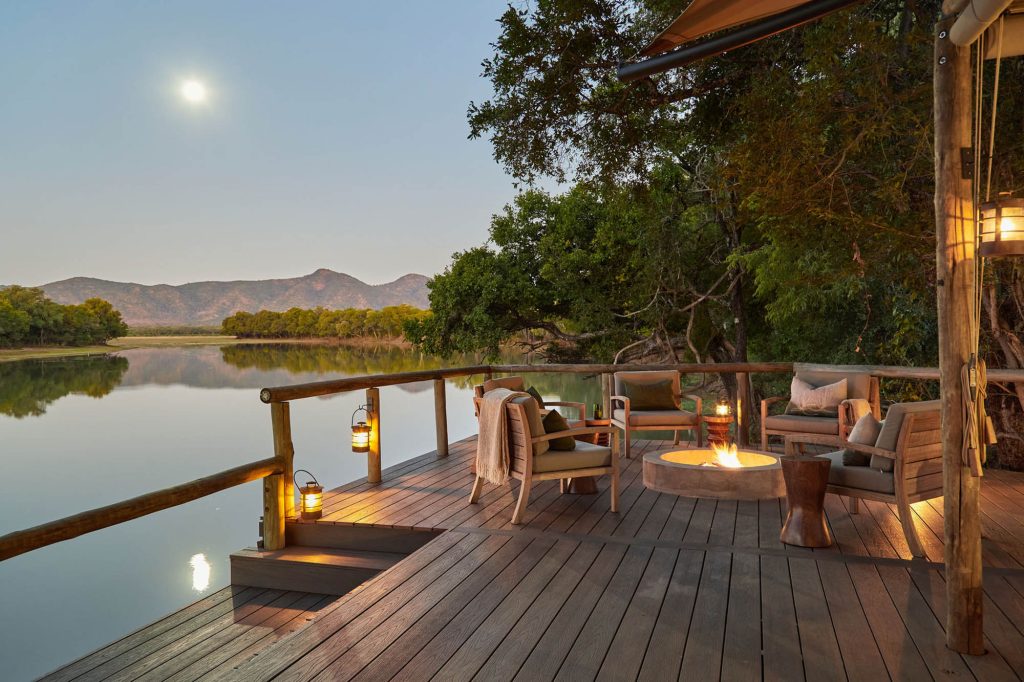
Chindeni and the Bushcamp Company, Zambia
By late July we found ourselves at Chindeni, a small Bushcamp Company property
3rd October 2022
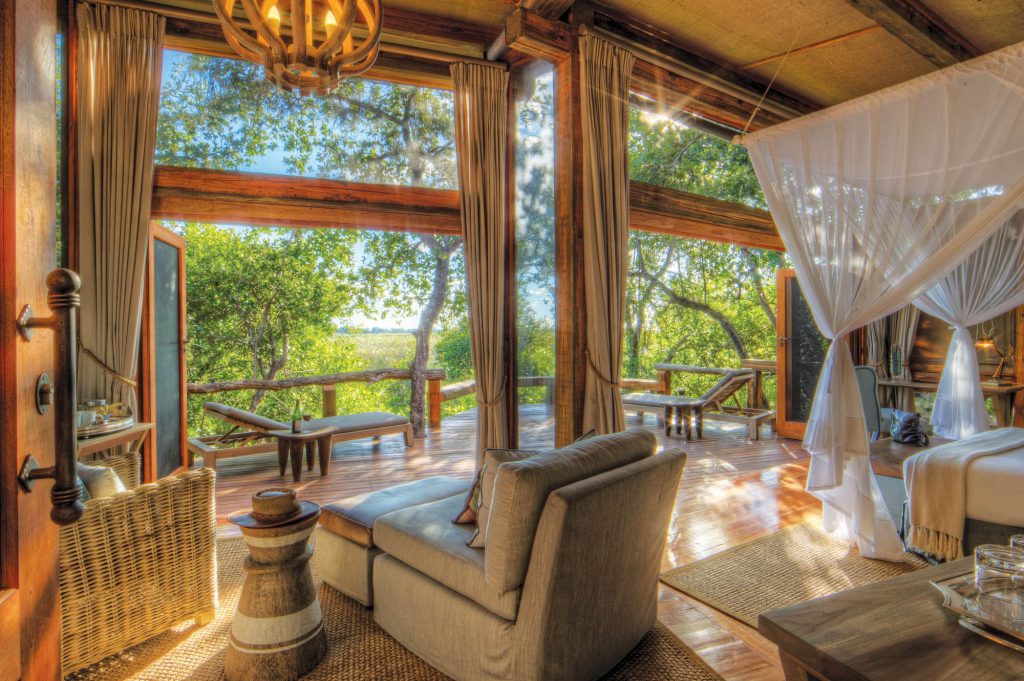
Camp Okavango, Botswana
Camp Okavango is in the heart of the permanent part of the Delta. In this idyllic setting there are no vehicles, and it is just a short walk
14th October 2023
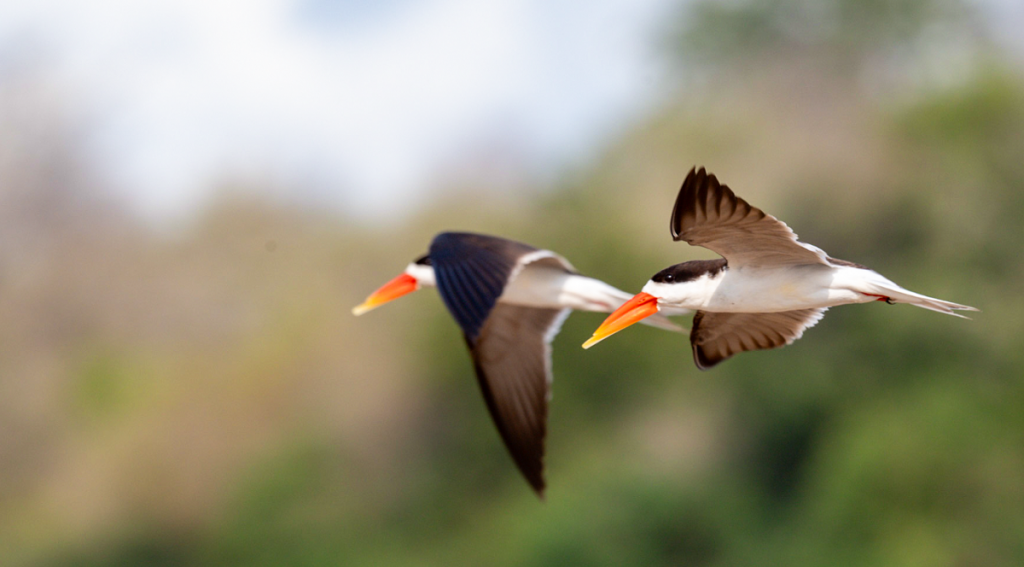
From My Safari Notebook: Wildlife Photography
Birds in flight and wildlife photographers have an uneasy relationship. Things go wrong as often as they go right. Getting focus-lock on a moving subject

SUBSCRIBE TO OUR NEWSLETTER

READERS FAVOURITES
4th August 2022
On Safari At Belmond Eagle Island Lodge, Okavango Delta
What is the ‘secret sauce’ for an unforgettable few days on safari in Botswana? It starts with the animals, of course. The elephants, lions, giraffes, hippos
10th September 2021
Chindeni and the Bushcamp Company, Zambia
By late July we found ourselves at Chindeni, a small Bushcamp Company property