32-day India Tiger Safari - Part 3
Indrajit Latey and Ashwin HP
The participants on our two recent back-to-back small group India tiger safaris were extraordinarily fortunate to be able to find and photograph several beautiful Bengal tigers over the course of about 10 nights total in three tiger reserves.
They also benefited greatly from the presence of the two professional local guides who led the two respective groups. The two guides – Indrajit Latey and Ashwin HP – both experienced, keen naturalists and accomplished photographers – have their own individual style but they have a lot in common as well. Most noticeably, they are true ‘people persons’ able to relate to guests and service providers alike, always a step or two ahead of any issues and ready with advice on anything from tiger viewing etiquette to Indian street food.
Indrajit and Ashwin helped with currency advice, checking in and out, finding lost cell phones, and reminding us not to carry power banks in our checked luggage. Mostly though they were fun to be with, great birders and every bit as enthusiastic as we were when there were any tigers about. Our trips would not have been half as enjoyable without them. India can potentially be tough to handle on one’s own, but with Indrajit and Ashwin in charge, everything happens smooth as silk.
Our late March/early April tiger safari in India’s Madhya Pradesh state took us to two other superb tiger reserves in addition to Bandhavgarh which we reviewed in an earlier blog post HERE. The first of these was Kanha National Park.

Kanha National Park
Following our major tiger success at Bandhavgarh, our luck seemingly abandoned us for the first two days in Kanha. Despite the best efforts of our highly experienced naturalist guide Tarun Bhati, we only had the barest glimpses of two tigers hidden in thick vegetation. We did have views of a couple of new mammals for the trip including barasingha deer and an otter. I also finally managed to get a decent photo of a red jungle fowl.
It’s a lesson that we learn and re-learn on every wildlife safari: animals move around in real time and are not guaranteed or destined to be in specific places at specific times. Any manner of external factors can adversely affect wildlife activity and distribution. In a tiger reserve these run the gamut from a sudden cold snap, rain, wind or other change of weather, an animal census bringing pedestrians into a park, smoke from controlled burning to the presence of the firebreak control personnel. So don’t be disappointed if you have a slow day on safari in India or anywhere – it happens every now and then and it is nobody’s fault, least of all your guide’s. Your guiding team is doing everything possible to get you within sight of tigers quickly and regularly. When the animals are hard to find it’s just nature.
By day three our luck turned and we had a great view of a female tiger crossing the road, after we had remained in essentially the same area for a good hour and a half. Finding tigers is equal measure skill and patience. The following morning we enjoyed a great sighting of a large pack of Indian wild dogs, numbering all of 22. Looking nothing like their African counterparts, the Indian wild dogs are quite similar in terms of size, family make-up and general behavior. It was a new mammal sighting for all of us.


During our second swing through Kanha we had several more excellent tiger sightings:
- By 7:30 one morning we had seen two different tigers, a large dominant male – Pattawallah – and a pregnant female MV3.
- A full day outing (special permit required) started with a bang. The same female tiger MV3 walked right by our vehicle, right at 6 am. Note to night owls: a tiger safari requires quite a bit of lark-like early morning activity.
- Observing the DJ9 female tiger with a guide who was familiar with her habits and preferences resulted in her being nicely lined up for photos twice in the span of 10 minutes. Had we been even three minutes away, we wouldn’t have seen anything.
- An afternoon game drive started on a promising note when we saw an older female tiger in a dam. Things got really interesting when the subadult daughter showed up and interaction ensued. Unfortunately the pair walked into thick cover so we had to abandon the pursuit.
- A series of alarm calls and seeing spotted deer running got us into just the right spot to see a female tiger emerge from the forest and walk right by the back of our vehicle.
- Later that morning we observed another female subadult on the edge of a dam taking a serious interest in some spotted deer. To the extent of mock stalking them but clearly with almost zero chance of success. By the end of our stay the tally was 14 sightings of 12 different tigers.

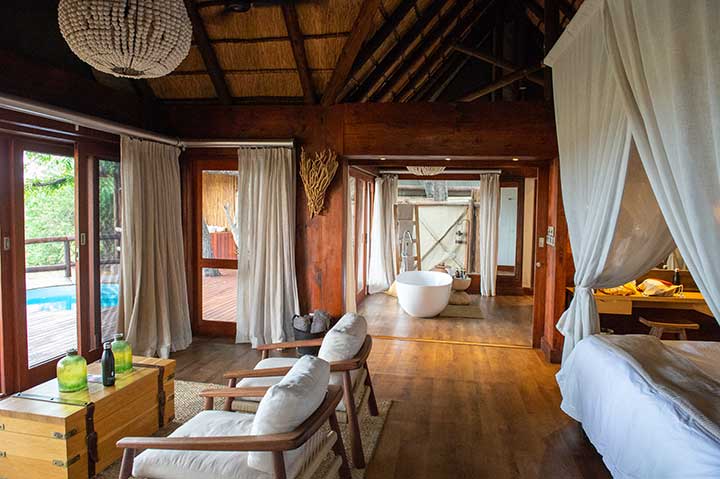
Kanha Jungle Lodge was every bit as delightful as on my first visit. The food and all round hospitality were impeccable with most meals served al fresco under the trees. The lodge layout is quite pleasing with a large covered central area and a separate drinks/cocktail lounge. As at the other lodges on the trip, the rooms were effectively air conditioned. The Kanha rooms also had plenty of space, showers with sufficient water pressure and more than ample packing space and lighting.
On arrival – after a rather long drive – it was refreshing to take a nice walk to the river with co-manager Dimple Bhati, followed by dinner in the forest. A civet sighting was a pleasant surprise.

Pench safari camp
From Kanha, another longish drive along yet another series of winding roads through a few small villages took us to Pench Tiger Reserve in the southern part of Madhya Pradesh State. It was just a few hours’ drive from Satpura National Park where I had started my safari a couple of weeks previously.
Pench is predominantly teak forest habitat which by the late March timeframe had lost practically all of its leaves. This made for great visibility in much of the park. The Pench River runs along the western boundary of the park and a large reservoir seasonally backs up into a large part of the reserve, attracting good numbers of wildlife in the dry season.
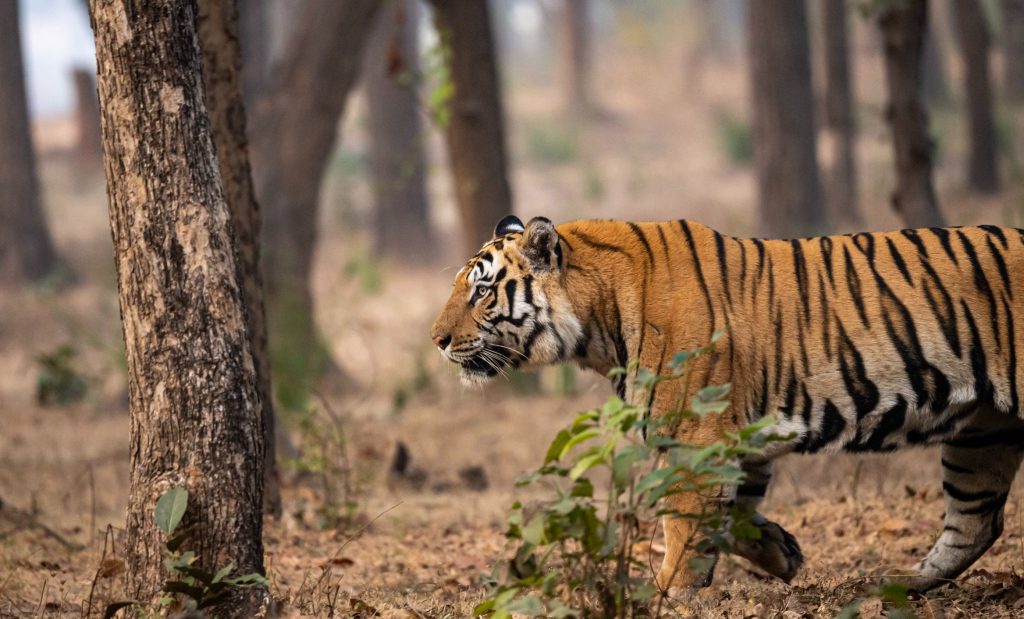
Over the course of a couple of days we had several tiger sightings including one young male walking through the woodland in really good light, a female on the edge of a small reservoir and a female tiger with three young cubs crossing a road. We also had a glimpse of a leopard, saw plenty of gaur, spotted deer, sambar deer, langur monkeys, rhesus macaque monkeys, jackals, forest hogs, and many interesting birds. Of those the best ones were the Malabar hornbills and several raptors including the spectacular honey buzzard, a real show stopper.
Camp manager Priti and head guide P. P. and their team maintain an impeccable standard of hospitality, food and all round experience.

Among our top Pench moments:
- On a morning game drive: rushing towards a tiger sighting and flying over a small rise in the road, we surprised a young leopard right in the road. It crouched down and moved quickly into grass cover just off the road. A fleeting yet memorable encounter.
- A distant sighting but a first for the trip: a female tiger with three 8-month old cubs. We watched from across a small creek as first the female and then two of the cubs emerged from a thicket and walked out in the open along the embankment and down into a ditch, disappearing from view.
- From there we drove to a small lake where a female tiger was lying down in the water, almost totally submerged. A few minutes later she sat up, walked along the bank, got back into the water and swam a short distance to a grassy peninsula where she got out of the water again.
From Pench it is a relatively easy drive to Nagpur from where we flew to Delhi. One last night at the very nice Andaz hotel at Delhi Airport worked very well. We had time to say our goodbyes, ordered room service pizza and gulab jamun and departed back to the USA via Istanbul the next morning.


Kaziranga National park – Assam
Visiting Kaziranga National Park in the far flung eastern Indian state of Assam was another reminder of the extraordinary diversity and beauty of India. The Assamese people look different, speak a different language and I’m sure there are many other things unique to the area and culture which would take more than a few days to discover. I almost immediately discovered the wonderful tea of Assam and now drink it at any opportunity I can get, just not all day long. Due to its relatively high caffeine content, Assam tea is considered a morning beverage.
One-horned rhinos and a golden tiger
Kaziranga is a beautiful and diverse park, with the far western zone being the most interesting of all, with mature riverine forest, patches of woodland, hills and some grassland. This part of the park, which we visited first, is known for regular sightings of gibbons. We heard them twice, but never saw them.
Seeing one-horned rhinos in Kaziranga NP is as easy as falling off a log. With more than 2,600 rhinos in the park, getting some great views and good photographs are a sure thing. Beyond the rhinos it is a good park for buffalo and elephants as well as barasingha and hog deer. Hog deer, which replace spotted deer in this part of India, are abundant with as many as 40,000 present in the park. Tiger sightings seem to be hit and miss, more of the latter than the former. I did get lucky with a rare golden tiger though. There are only a handful of these in India so it was a definite highlight. Even though the view was relatively long distance, I could see it very well in my binocs.


Kaziranga has a diverse landscape with significant open plains for grazers, there are patches of elephant grass and lots of water as the park encompasses the confluence of the Diphlu and the massive Brahmaputra river. With that much water around, it’s no surprise to have river otters around, and naturally a profusion of water birds including ducks, storks, egrets, herons and several waders.
My very first game drive, just after I had been given an introductory chat and shown to my room, actually took place along the main road with dozens of giant trucks and tankers sweeping by. It was disconcerting at best, closer to downright scary at worst, with our driver-guide abruptly slowing down on the main road, when something interesting was seen or heard. Unlike me, everyone else there was clearly quite used to this peculiar setting for wildlife viewing.
In addition to many one-horned rhinos, the drive into the western section delivered many excellent sightings, including Himalayan giant squirrel, hog deer, water buffalo, a 5-foot-long water monitor lizard and soft ground barasingha deer. As we were to witness elsewhere in the park over the next couple of days in both the central and eastern areas, there were abundant rhinos to be seen in the water and along the water’s edge. One of the one-horned rhinos even swam across a river.
Kaziranga is a birding hotspot and over the course of just a few outings, we compiled quite a list of local and regional specialities such as Pallas’s fish eagle, spot-billed pelican, Asian openbill, greater adjutant, blacknecked stork, green-billed malkoha, grey-headed fish eagle, and Oriental pied hornbill.
Kaziranga is very different and quite fascinating and it makes an excellent addition to a trip which includes mostly Madhya Pradesh tiger reserves.

Diphlu River Lodge
Diphlu River Lodge itself was top notch, starting with a thorough introduction by the affable lodge manager. The food was consistently excellent with both Western and more traditional, regional Indian options available for all meals. The high tea which is served at 5 pm after the conclusion of game drives, likewise had a variety of intriguing food and snack options. On one of the days we enjoyed lunch outside under the trees on the bank of the Diphlu River.
I was very fortunate to have Jugal assigned as my local guide; he was excellent, always enthusiastic and he also happened to know all the birds. As a result I added a bunch of life birds to my growing India list. If you’re headed to Kaziranga one of these days, be sure to request Jugal!

The road to Kaziranga
The way to almost anywhere in India runs through some neighborhoods where everything would look a lot better with a fresh coat of paint. You’re not going to find much of that on the asphalt road leading out of Guwahati, the biggest city in India’s far eastern state of Assam. Rather, the road is lined with seedy hotels and bars, Tata car dealerships, bike shops, and grandiose signs touting hole-in-the-wall restaurants, also known as dhabas. Everywhere, there are weirdly designed buildings painted in unusual colors, at least from the perspective of an American visitor. Many of the buildings seemed to have been under construction for years.
Driving along Route NH27 out of Guwahati when heading for Kaziranga National Park paints a rather bleak picture. There’s very little in the way of making things look ‘nice,’ as American eyes would see it. It’s utilitarian at best and clearly the inhabitants have priorities which do not include winning the yard of the month award. Dotted along the route are small general dealers with not a lot of inventory, to hardly any. Also the odd hardware store where paint is not a best seller. Just my guess. Occasionally, in marked contrast to their plain Jane neighbors, there would be an unusually large, extravagantly colored home or apartment block with an elaborate facade and balconies all round. Further east, close to Kaziranga itself, the views improve with vivid green tea plantations on the right hand side of the highway and floodplain on the left.
One thing which Assam clearly has in common with much of the rest of India, is the crazy driving. Around every corner you’ll see a procession of heavy trucks and fuel tankers, one after another trundling down the highway and livening things up with their peculiar two-note honking sound. Many of these large trucks are colorfully festooned with ribbons and tassels and most of the drivers are Punjabis, or so I was told. Trucks by themselves are not necessarily a hazard. What makes the situation untenable are small pickup trucks and vans overtaking the large trucks in a manner which is often reckless and occasionally borderline suicidal. Obscured vision, blind rise, sharp corner ahead? No problem. Fortunately our professional drivers consistently adopted a defensive driving mode.

Kaziranga timing issues
Diphlu River Lodge clearly has no control over it, but the fact that all of India has one time zone, coupled with the odd operating hours of the park itself, negatively affect the overall experience. For one thing, Assam and the other far eastern states should clearly have their own time zone. Drive from Mumbai to Assam, all the way west to east and your vehicle will have 1,750 more miles on the odometer at the end of the trip. On March 30 this year, the sun rose over Assam at 5:16 am; over Mumbai first light was at 6:35. A good two hours of daylight are essentially wasted in summer in Assam.
More importantly – and probably something that at least has a chance of being changed for the better – is the gate opening time at Kaziranga National Park. Right now the park opens for two elephant-back riding excursions at 5:00 am and 6:00 am respectively, and then only at 7:30 am for Jeep safaris. By 7:30 am the sun has already been up for well over two hours. The early morning ‘golden light’- so sought after by photographers – is practically gone by then. Bird and mammal activity is at a peak in the early morning hours right after sunrise and by 8:00 am it is already tailing off.
So Jeep drives should ideally start at the same time as the first elephant-back safari at 5:00 am and certainly no later than 6:00 am.

For information about our Fish Eagle Safaris March 2026 small group trip to India please contact Bert at bert@fisheaglesafaris.com, or leave a message with our answering service at 1-800-513-5222 or at 713-467-5222.

Lodge photos courtesy Kanha Jungle Lodge and Diphlu River Lodge
YOU MIGHT ALSO BE INTERESTED IN
10th September 2021
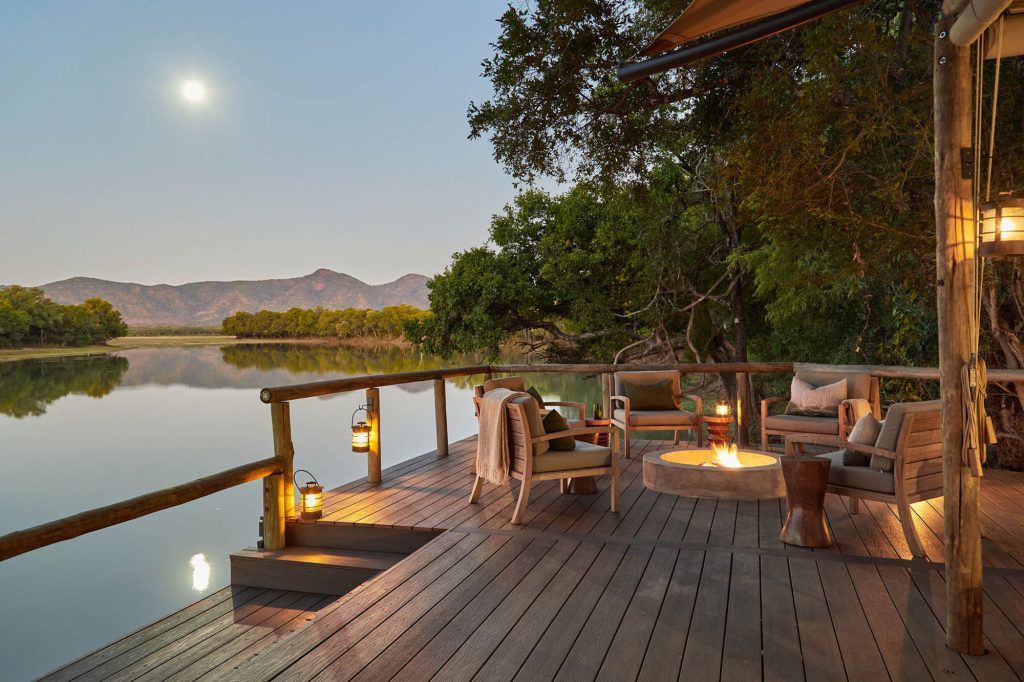
Chindeni and the Bushcamp Company, Zambia
By late July we found ourselves at Chindeni, a small Bushcamp Company property
3rd October 2022
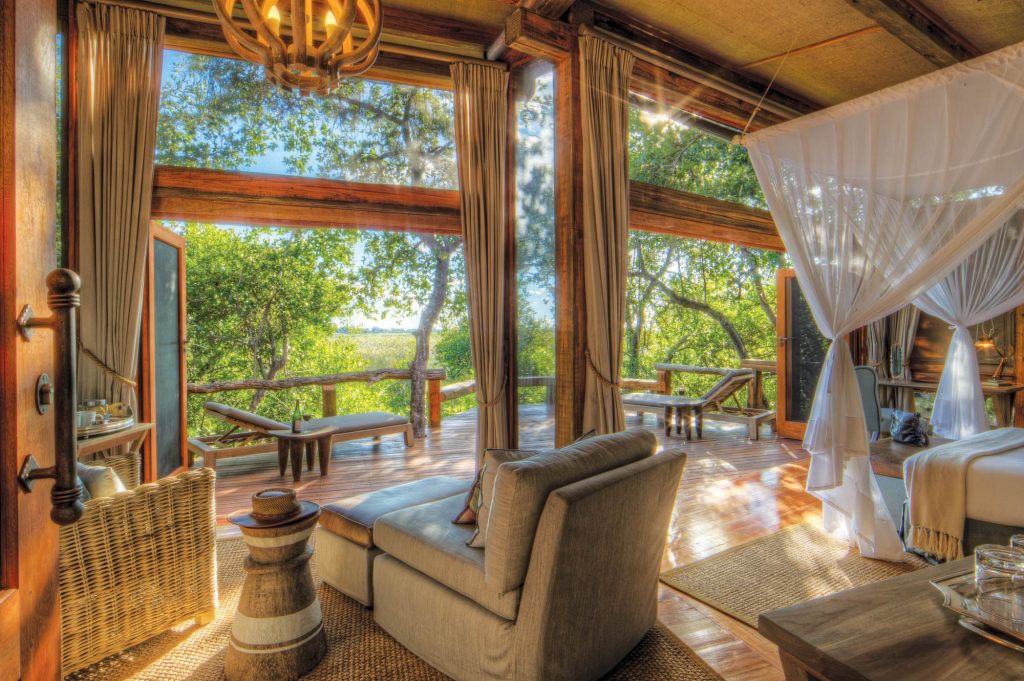
Camp Okavango, Botswana
Camp Okavango is in the heart of the permanent part of the Delta. In this idyllic setting there are no vehicles, and it is just a short walk
14th October 2023
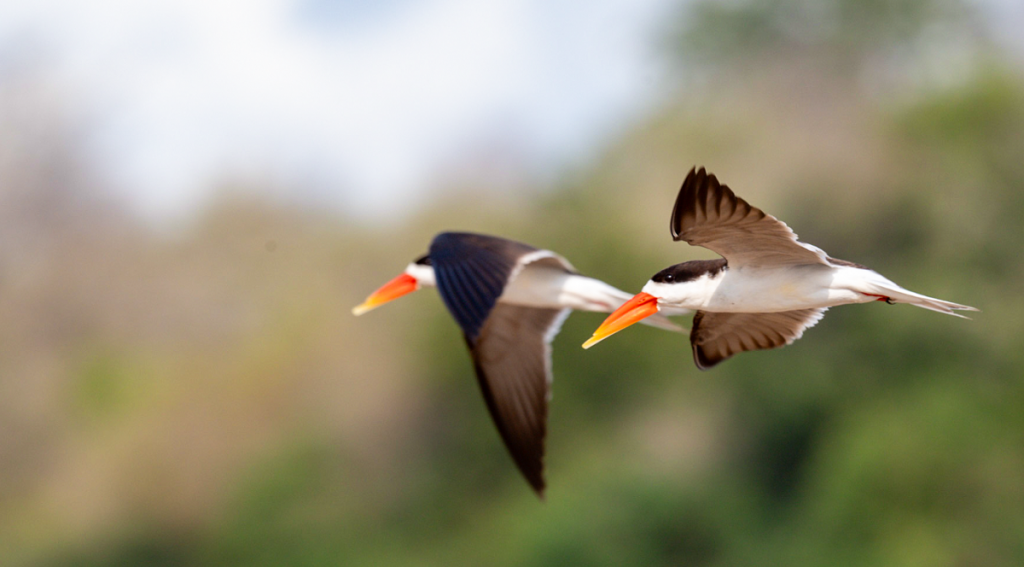
From My Safari Notebook: Wildlife Photography
Birds in flight and wildlife photographers have an uneasy relationship. Things go wrong as often as they go right. Getting focus-lock on a moving subject

SUBSCRIBE TO OUR NEWSLETTER
READERS FAVOURITES
4th August 2022
On Safari At Belmond Eagle Island Lodge, Okavango Delta
What is the ‘secret sauce’ for an unforgettable few days on safari in Botswana? It starts with the animals, of course. The elephants, lions, giraffes, hippos
10th September 2021
Chindeni and the Bushcamp Company, Zambia
By late July we found ourselves at Chindeni, a small Bushcamp Company property